
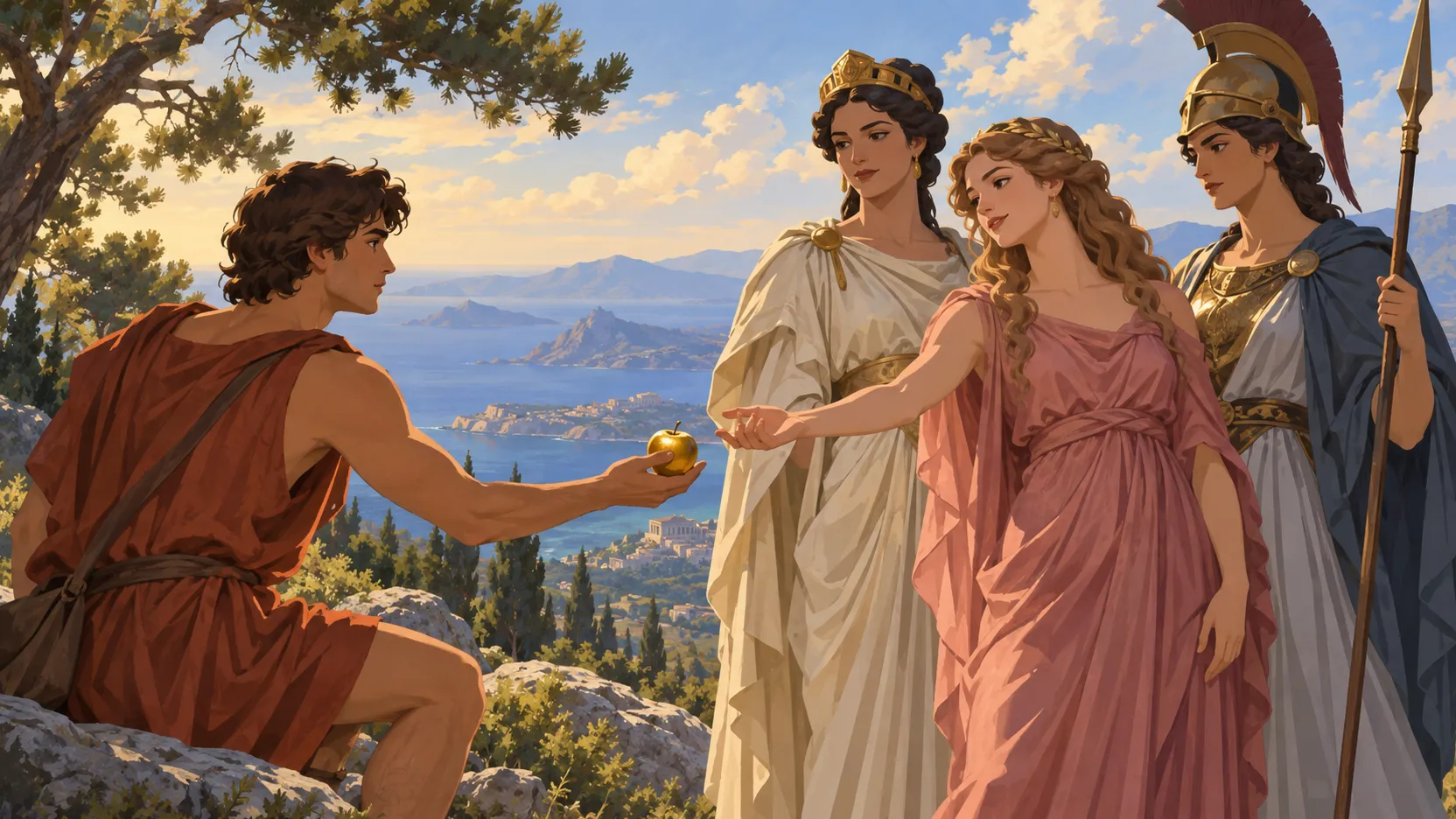
Paris heard the sheep scattering before he saw the strangers.
Three women stood among the pines on Mount Ida. The sheep would not go near them. Even the ram that lowered its horns at dogs had backed into the rest of the flock.
A young man came down the path ahead of the women, carrying a golden apple.
“Paris, son of Priam.”
Paris set down his shepherd’s staff. Few people on the mountain addressed him as a prince of Troy. Fewer knew his name before he gave it.
The stranger held out the apple. It had the weight of a stone and the warmth of something that had lain all day in sunlight. Words were cut into its skin, awarding it to the fairest.
“Give it to the one who deserves it,” said Hermes.
Then Paris understood who waited beneath the trees.
He looked from Hera to Athena, and from Athena to Aphrodite. Behind them the path climbed into ordinary woods. He wanted, very badly, to be walking along it.
“Surely Zeus can judge.”
“Zeus has sent me to you.”
At the wedding feast of Peleus and Thetis, Strife had cast the apple among the gods. These three had claimed it. The quarrel had followed Hermes down from heaven, and now it stood on a mountainside where Paris had expected nothing more difficult than finding a strayed ewe.
Hera came forward first.
There was no need for her to lift her voice. Paris found himself standing straighter as she spoke.
“Kings will bow when you enter their halls. Lands you have never seen will answer to your command.”
He thought of his father’s palace, of standing among brothers older and more admired than himself. He imagined them waiting for him to speak.
Athena rested the butt of her spear on the ground.
“What is a kingdom that another man can take from you? I offer victory. When armies meet, yours will stand when the others break.”
The apple shifted in his palm. For a moment he saw himself returning through Troy’s gates with the dust of battle on his shoulders. His brother Hector would come to meet him, and this time the cheering would be for Paris.
Aphrodite waited until his eyes came to hers.
“Helen,” she said.
Paris had heard the name. Men spoke of the queen of Sparta even in Troy: Helen, whose beauty had brought princes to seek her hand from across the sea.
“She has a husband.”
“Menelaus.”
Aphrodite did not look away. She let the name lie between them, then stepped closer.
“I can bring you to her.”
Paris looked down at the apple. He could feel the sharp little edges of the letters beneath his thumb. A kingdom was vast and distant; a victory needed an enemy and a battlefield. Helen had become, in that instant, someone who might turn at the sound of his step.
He held the apple out to Aphrodite.
Hera’s face grew still. Athena lifted her spear from the earth.
When the goddesses had gone, the sheep began to graze again. Paris stood alone with his empty hand extended.
The Guest from Troy
In Sparta, Helen watched the Trojan prince accept a cup from her husband.
Menelaus had given him a place at the table, food, shelter, and the safety owed to a guest. Paris thanked him graciously. But when Helen spoke, the prince’s attention moved to her so completely that she forgot the end of her sentence.
Aphrodite was at work in the house.
Helen felt it in the quickening with which she listened for the guest’s voice, and in the strange distance that opened between her and familiar rooms. Paris spoke of Troy, of the high walls and the view across the plain. He brought gifts. She found herself asking questions she had not meant to ask.
Then Menelaus was called to Crete for a family funeral. He left the Trojan guests in Helen’s care.
On the night Paris meant to sail, she found him near the doorway, his traveling cloak fastened.
“The ship is ready,” he said.
Helen looked past him. Beyond the courtyard lay the road to the water. Behind her were the rooms of her own house, and her daughter sleeping in it.
He reached for her hand.
“You can come.”
For a long moment she did not move. Then she put her hand in his.
Servants carried treasure down to the ship. Helen went aboard in the darkness, and the oars began to work. The land withdrew. She could no longer have returned by stepping back across a threshold.
The sea did not give them an easy passage. Hera drove a storm against the ships. Ropes strained; water broke over the sides. Paris clung to the rail while men fought to keep the bow from turning broadside to the waves. Helen crouched under a soaked covering, hearing timber complain around her.
They reached Sidon and lingered in distant ports before making their way to Troy. Paris had time to believe that pursuit had been left behind.
At home, the gates opened for the king’s son.
Cassandra’s warning rose against the welcome. She saw ruin approaching with the newcomers; her voice followed them toward the palace. Paris kept walking. Helen could feel the people watching her, and looked for somewhere to rest her eyes.
Far across the sea, Menelaus returned to Sparta.
He passed through the courtyard where he had welcomed his guest. The treasure was gone. Helen was gone. Their daughter remained.
He went to his brother Agamemnon, and together they called on the kings who had sworn to defend Helen’s marriage. Messengers took to the roads. At each hall, the same oath was spoken aloud again.
In Troy, Paris had brought home the woman promised to him. In Greece, the first ship was being drawn down to the sea.