
Thoth found the first pawprint where the cultivated land ended. Wind had softened its edges, but the hollow was deep enough to hold his hand.
Farther south, there would be no mistaking the trail.
Hathor had left Egypt in anger. She had gone beyond the river towns into Nubia, taking the shape of a wild cat, and no call from her father had brought her back. In the courts where people once sang to her, the instruments lay unused. Thoth had passed a harp with a broken string still hanging from its frame. No one had troubled to mend it.
Before he departed, Ra had summoned him.
“Bring my daughter home.”
Thoth had looked into the face of the sun god. Hathor was his Eye, the fierce power that guarded him. To go looking for her was to go looking for the very thing other creatures fled.
“Will she hear me?”
“Go to her.”
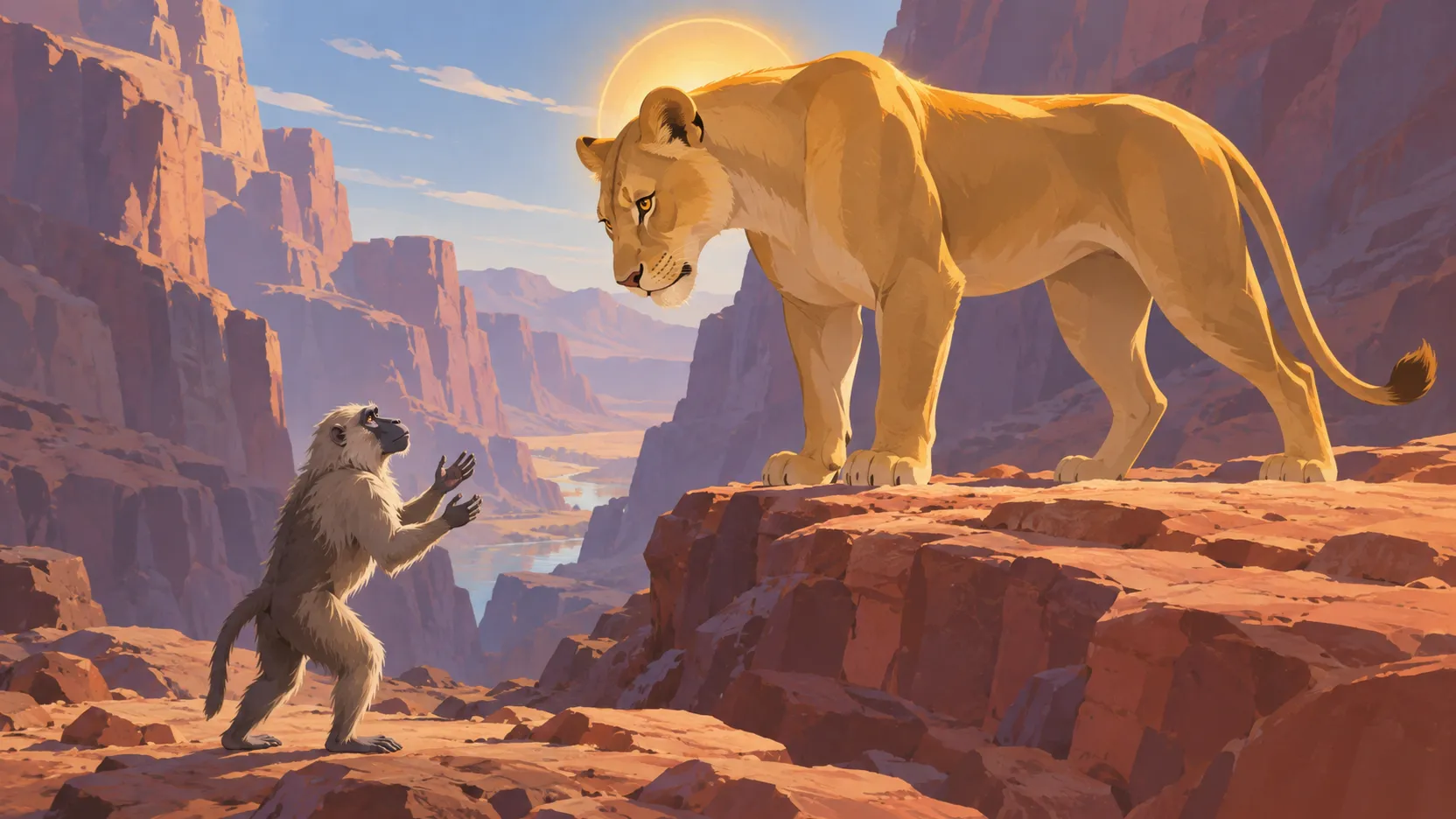
Now he stood over the pawprint in the shape of a small baboon. He lifted his hand out of it, shook away the dust, and went on.
He found her above a dry ravine.
The cat lay along a shelf of red stone, her forepaws crossed, her tail hanging over the edge. One ear turned towards his footsteps. Nothing else moved. Beyond her, ridge after ridge stood bright beneath the sun.
Thoth stopped below the ledge.
“Hathor.”
Her eyes opened.
He bowed. For a while the only sound was grit sliding down the ravine.
“You have come a long way,” she said.
“From Egypt.”
“I know where you have come from.”
Her tail struck the rock once. Thoth let the words he had prepared remain behind his teeth.
She watched him. At last she lowered her head upon her paws, but her eyes stayed open.
He sat where she could see both his hands.
“The river is still there,” he said. “And the fields. Men go out in the morning carrying their tools. The ovens are lit.”
“Then they have what they need.”
“They eat without singing.”
She turned her face away.
Thoth spoke of the cool rooms beside the river, of grain laid out to dry, of the smell that rose from warm bread when it was broken. He kept his voice low. The cat’s ears moved, though she seemed to be watching something far beyond the opposite ridge.
He spoke of her musicians.
At that, her claws came out.
“I had ceased to think of those things.”
Thoth fell silent.
“I could lie here,” she said, “and hear only the wind. Then you came.”
She stood. Small flakes of stone slipped from beneath her paws.
“You would put Egypt in my mouth until I can taste nothing else.”
“My lady—”
“You would lead me.”
The cat swelled before him.
Thoth scrambled backwards. A lioness stood upon the ledge, vast enough to hide the ridge behind her. Light burned along her back. When she opened her jaws, the air between them shimmered, and heat struck him across the face.
He could no longer see the path by which he had come.
Her tail swept the rock. Dust climbed into the sky. She roared, and the sound went down into the ravine and came back from every wall.
Thoth pressed his hands to the ground. The stone was hot.
He had meant to call her home. Now he could scarcely remember the beginning of a word.
The lioness lowered her head. Her eyes filled his sight.
He stood, though his knees shook, and raised his empty hands.
“I have seen you before,” he said.
Her breath washed over him.
“I have seen the singers waiting for you. They stand with their mouths open, each hoping you will look towards them when the song begins.”
He swallowed. Dust rasped in his throat.
“I have seen the green beads at your throat. The flowers they bring. I have heard the room change when you enter it.”
The glare held steady.
“They are waiting still.”
He dared not lower his hands. He could see only the burning eyes and, beneath them, the narrow shadow where he stood.
Then the shadow moved.
The lioness had lifted her head.
Air reached him that did not scorch. The dust thinned. High above the ledge, a strip of blue sky appeared.
Thoth took a breath, then another.
“Sit,” she said.
He sat.
For a long time she looked down at him. The fire faded from the stone. Her great paws rested together, but he did not mistake their stillness for weakness.
“You are afraid.”
“Yes.”
“And yet you have more to say.”
“If you will hear it.”
One ear inclined towards him.
So Thoth told her stories.
He spoke of creatures that watched from the heights and creatures that hid close to the earth. He gave them their quarrels and their voices. Sometimes she interrupted him. Sometimes he had to wait until she allowed him to continue. As the shadow of the ledge lengthened, she lowered herself to the stone.
He told her of a lion who had spared a mouse, thinking the tiny creature could never repay him. Later, bound in a hunter’s straps, the lion heard small teeth working in the darkness.
“The mouse came back?” she asked.
“It gnawed through the bindings.”
She glanced at his hands, so much smaller than her paws.
“And where did it go afterwards?”
“Into the lion’s mane. They went away together.”
For the first time, she laughed.
Thoth felt his fingers loosen against his knees. He had been gripping them without knowing it.
He did not hurry to fill the silence that followed. She looked past him now, along the way he had come.
“Your father calls for you,” he said. “The singers call for you. Come where they can hear your answer.”
She rose.
Thoth rose with her, then stood aside. There was room to pass him on either side: towards the open wilderness, or towards the path north.
She came down from the ledge.
“This way?”
He turned towards Egypt.
“This way.”
She followed him.
At first Thoth kept looking back. Every time, she was there. When the silence grew long, he began another story, and her voice came after him with a question. He answered as he walked.
The ridges fell behind them. The sound of water returned. They passed palms whose leaves rattled above their heads, and Thoth breathed in the river air.
Ahead, people gathered along the way. Someone ran to fetch the musicians.
When Hathor came among them, she wore her gentle human form. Sunlight caught the beads at her throat. Thoth stepped out of her path, and the people drew back far enough to let her pass. Their offerings waited in bowls and baskets; no one reached to touch her.
A woman lifted a sistrum. Its metal rattled once in the quiet.
Hathor turned towards the sound.
The woman shook it again. A drum answered. Then the singers found their breath, and the song Thoth had remembered beneath the burning ledge rose around him.
Wine was brought to Hathor. She took the cup, and when she lifted it, he saw Ra beyond the gathering, his face bright with joy.
She drank. Her eyes rested on Thoth over the rim.
He bowed, dust still clinging to his hands.
Hathor set down her cup and stepped into the music.