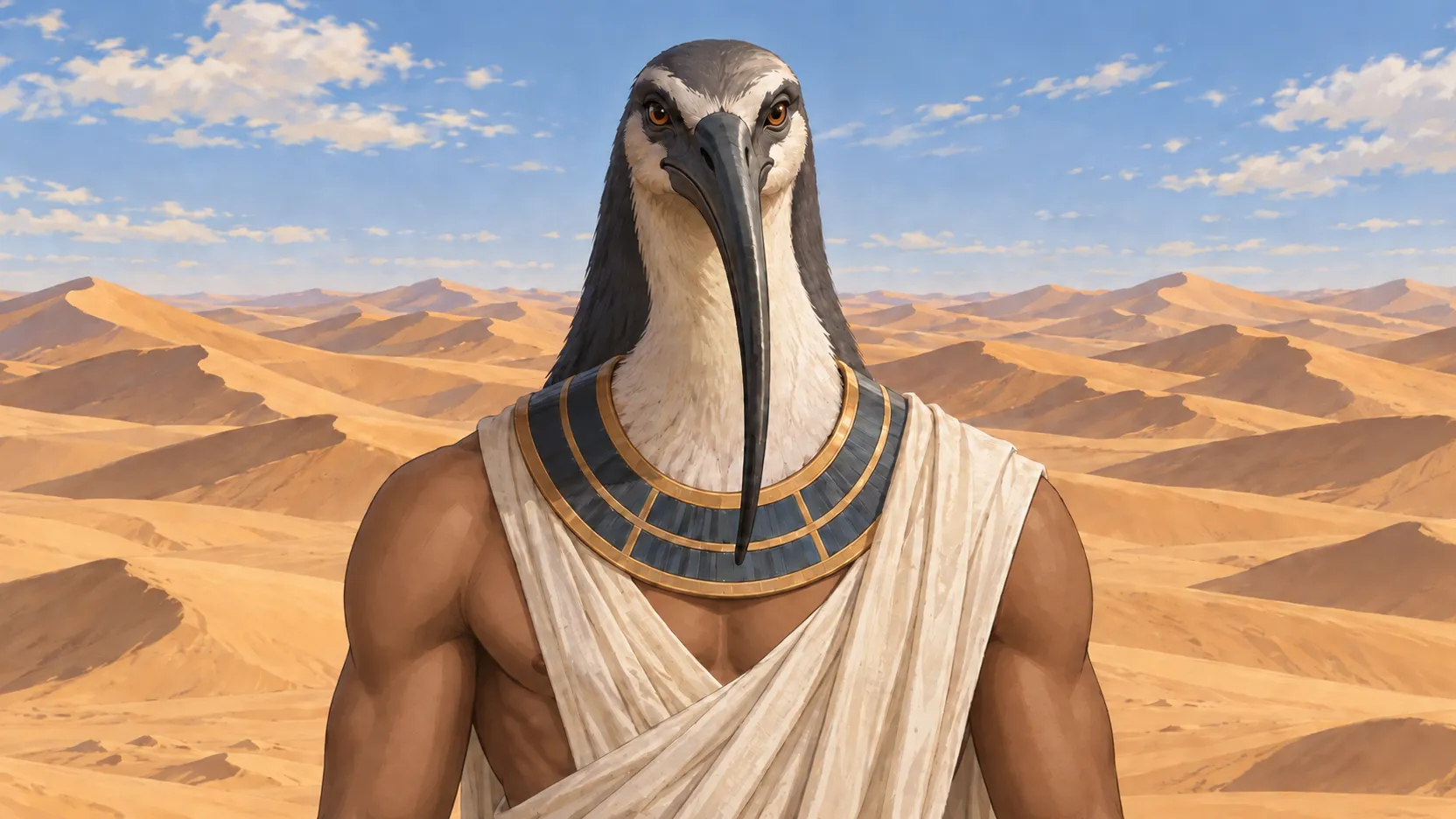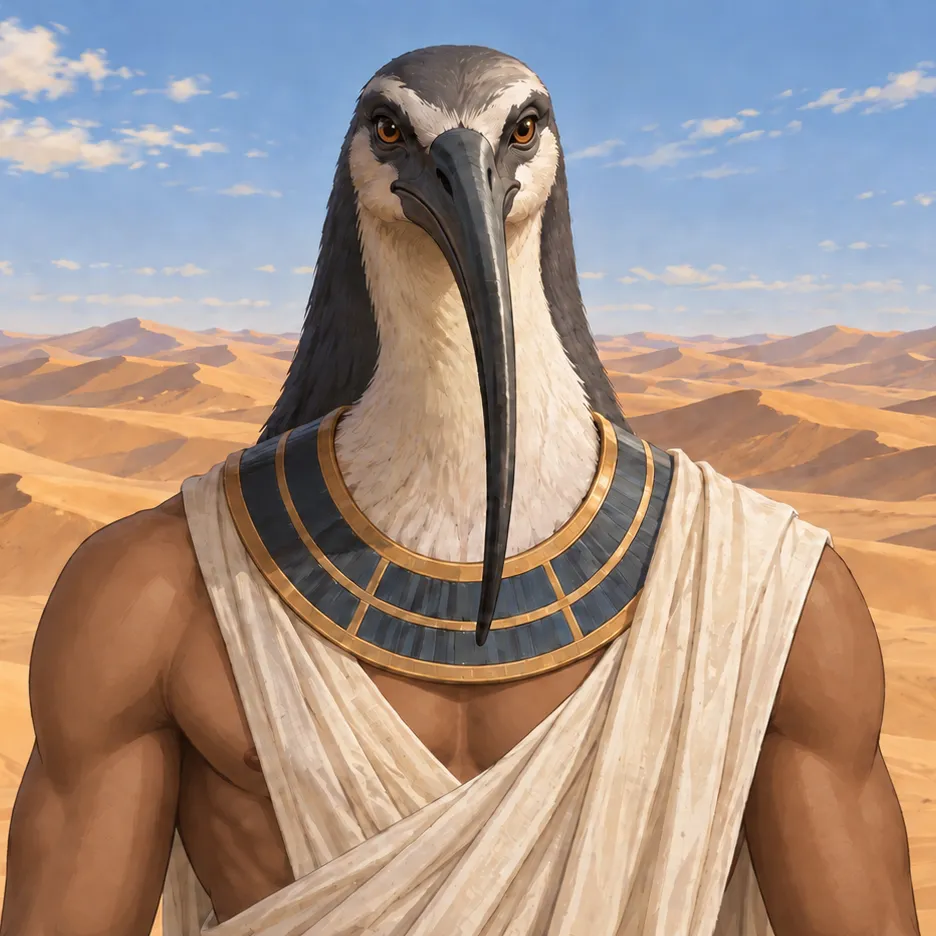
Thoth had reached the last day of the year when Nut caught his wrist.
“Count again.”
Her fingers pressed the bones of his writing hand together. Above them, the stars shuddered. One slid a little out of its place, and Thoth watched it, knowing that he ought to put it back, unable to look away from her grip.
He had counted twice already. Twelve months. Thirty days in each. He had unrolled the whole year across the floor until its far end vanished beneath the door. There was no date left to offer her.
Nut released him. Both hands went to her belly.
“Then read it.”
Thoth did not need the papyrus. He remembered the reed catching in a rough place, the tiny spray of ink beside the word year. Ra had spoken. Thoth had written. Nut would bear her children in no month of any year.
He read the words aloud anyway. Nut bent forward before he reached the end.
For a moment he held the wet reed above the prohibition. A stroke through one word would do it. His fingers knew exactly how much pressure would split the fibres so the old ink could never be recovered.
“Would that help?” Nut asked.
The reed stopped.
“No.”
“Then put it down.”
He laid it beside the roll. Outside, somewhere below the high chamber, a door closed and a woman called a child home. There would be supper, sleep, another morning. He had given every one of those things a place in his reckoning. Here was Nut, with five lives moving inside her, and he could give her nothing.
She saw him looking at the last column.
“What comes after it?”
“The new year.”
“And before that?”
He almost answered nothing.
Instead, he put a finger on the blank papyrus beyond the final line.
The Moon’s Price
The Moon was waiting beside a game board when Thoth found her. Her hands rested on its edges; light showed through the joints of her fingers. Between them lay two ranks of playing pieces, dark ones nearest the empty seat.
“You have brought your counting face,” she said. “I prefer the other one.”
“I need light.”
“Everyone does.”
“Enough to make five days.”
She glanced beyond him. In the distance the eastern horizon had begun to lose its stars.
“Sit.”
Thoth lowered himself onto the mat. He knew the board: two narrow tracks, crossings where an unguarded piece could be taken, an exit at the far end. Clear your pieces first and you won. They had spent long nights over it, neither willing to admit that the other had improved.
The Moon set five shallow cups beside her elbow.
“One measure for each game. What will you stake?”
“My palette.”
“And tomorrow you will make another.”
“My service.”
Her fingers lifted from the board.
“What service?”
“One night of reckoning for each measure I lose. I will keep your count while you rest.”
“That is work you enjoy.”
“Try losing to me. You will enjoy it less.”
She smiled, and pushed the first dark piece towards him.
He won the opening game by refusing a capture. The Moon had left a piece temptingly alone; he passed it, kept his pair together, and reached the exit while she was still bringing her last piece around the turn. She tipped her hand above a cup. Light gathered in it, thick and still.
Thoth reached for it.
A cry came from below.
On the river, a boat had swung across the current. Its sail had been lowered, but the poleman was still leaning into his pole, searching for the bank. The bright strip of water by which he had been steering had vanished. Thoth saw the man thrust into empty darkness. The pole struck nothing. The boat turned again.
He drew back his hand.
The Moon waited.
“Put it back,” he said.
“You won it.”
“The boat—”
“I see the boat.”
He took the cup and poured its contents over the edge of the board. Silver opened across the water. The poleman found the shallows with a splash that reached them faintly through the night.
Nut’s fingers had left four pale marks on Thoth’s wrist. He rubbed them with his thumb.
“You could have warned me.”
“You asked for light. Where did you think I kept the spare?”
He looked at the empty cup. He had imagined carrying a small bright victory back to Nut. He had not imagined the hands that would grope after it when it was gone.
The Moon began putting the pieces away.
“Wait.”
Her hand stayed inside the box.
Thoth drew his palette from his belt. On its back he marked a circle, divided it, divided it again. A little from this illumination, a little from the next. No whole stretch of river surrendered in a single night. He made the marks smaller. The reed moved faster.
“Spread the taking,” he said. “A small share from each return. Give me the claim now, and let the light be gathered over the course of the year.”
“And the next year?”
He looked up.
“You want the children born once,” she said. “But will you close their days behind them? Tear those dates out when the year comes round again?”
“No.”
“Then you are not asking for a loan.”
The cup between them was perfectly empty. Thoth could see the grain of the wood through it.
He turned his palette over and began another account.
The Unguarded Piece
By the time four measures stood beside the board, the lowest stars had faded. Thoth had lost twice. Two nights of service were already written against his name, and a third hung close: the Moon had trapped his foremost piece at a crossing.
She could afford to wait there. He could not.
From the chamber behind him came a low sound. It ended suddenly, as though Nut had bitten down on it.
Thoth touched his trapped piece.
“Move that one,” the Moon said, “and I take it.”
“I can see.”
“You have been looking at it for some time.”
He lifted his hand. The piece remained where it was.
His carefully guarded pairs had carried him through the earlier games. Now his last pair stood behind the blocked crossing. Every safe move led back towards the place he had just left. Every attempt to preserve his advantage spent time he no longer had.
The Moon leaned forward, examining his new account.
“You have left a line unfinished.”
It was the line beneath the yearly contribution of light. He had drawn a place for the work of maintaining the count, watching the diminished nights, attending to what his five days took from them. He had not written a name.
“You could put yours there,” she said.
“And if I lose this game?”
“The work remains.”
“That is not a stake. That is a gift.”
“It is the condition under which I can give you what you want.”
He stared at her. Her face was thinner than it had been when he arrived. Four cups stood full at her elbow. He had watched them as winnings, each one a step nearer to Nut. He had not watched her hands grow less bright.
A quick false total would hide the difference. No one knew his reckonings well enough to find it before the children were born. He could write abundance where there was a debt and leave someone else to discover the shortage.
He dipped the reed.
Across the little space he wrote his name.
The Moon read it. She turned the palette so the first light from the horizon fell on the fresh ink, then laid it beside her own hand.
“Your move.”
Thoth took the piece from the crossing and advanced it alone.
She captured it at once.
Wood clicked against wood. His piece went back to the beginning. Hers crossed onto his track to take it, and for an instant he felt the sick certainty that he had paid for the privilege of losing.
Then he moved the pair behind it through the crossing she had abandoned.
She stopped reaching for the next piece.
The route to the exit lay open. She could follow him or bring her remaining pieces together, but she could not do both. Thoth kept his hand flat on the mat while she considered. He would not hurry her. He had put that in the account too, when he wrote his name: the agreement must hold even if he lost.
The Moon brought her pieces together.
He sent his pair out. She advanced. He moved the captured piece from its starting place, now with an empty track ahead of it.
For several turns they played without speaking. The Moon had to bring her scattered pieces around the far bend; Thoth had only the one to move. Each time she reached for a different piece, he advanced the same dark shape. It passed the place where his pair had waited. Her foremost piece left the board. His reached the final crossing.
Behind him, Nut called his name.
He kept looking at the board.
The Moon moved.
Thoth put his last piece beyond the edge.
Neither spoke. A small draught passed over the mat, cold enough to raise the feathers at his neck.
The Moon took the fifth cup. She held it so long that he thought she was going to show him its emptiness. Then the light began to gather.
He reached for the full cup with both hands.
“Your palette,” she said.
“Keep it. I will need it when I come back.”
Beyond the Last Line
Nut was on her knees beside the unrolled year. She had dragged it towards her, crushing one edge beneath her hand.
“Where?” she asked.
Thoth set the cups down. He pulled the last length of papyrus flat. There was the final day, its neat marks unchanged. There was the blank beyond it.
The eastern light touched the threshold.
He poured the first measure onto the empty space.
It would not stay. The brightness ran towards the old column, towards a date that already had a name. Thoth spread his hand across the line. Cold light pushed between his fingers.
Nut made a small, furious sound.
He set his other hand beside the first, leaving a narrow space between them, and began to count. Not the old days. Not the months. The new measure, from its beginning, each part spoken distinctly enough to hold its place.
The light slowed.
He could feel it pressing at his palms. Behind him the new year’s dawn waited at the door; before him Nut gripped the torn edge of the roll. He counted until the brightness lay still in the space he had made.
“Now,” he said.
Nut caught his shoulder. Her weight bore him down, and for a while there was no room for counting, only her breath and his hand braced on the floor and the impossible strength with which she held him.
Then a child cried.
Thoth stayed very still.
Nut loosened her grip. In her arms Osiris drew another breath, outraged by the air. She bent her head over him. Thoth had prepared words for the opening of the day, but none seemed necessary just then.
Four cups waited beside the roll. He placed them within reach, one after another.
When Nut looked up again, he was smoothing a fresh strip of papyrus across his knee.
“More counting?”
He nodded towards the west. The Moon was fading, but he could still make her out.
“Someone is expecting me.”
Nut shifted the child into the crook of her arm and held the loose end of the papyrus for him. Thoth sharpened a new reed. While Osiris breathed between them, he ruled the first line.