
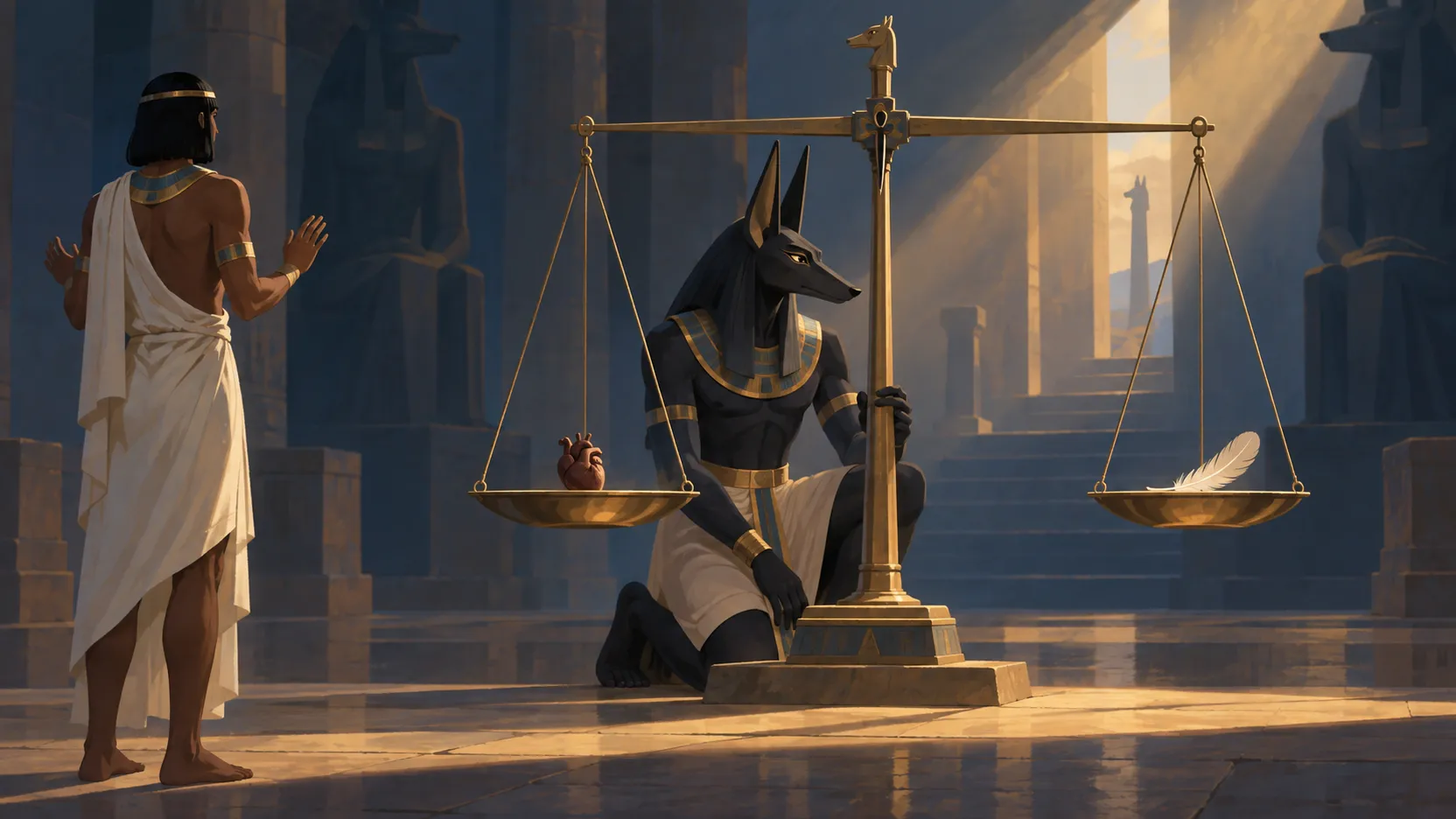
Ani saw his heart on the scales before he saw the creature waiting to eat it.
It lay in the shallow pan, small and dark, with a crease along one side. He put a hand to his breast. Beneath the white linen there was no wound, but the sight of that familiar, unknown thing made him draw his fingers tight against himself.
In the other pan stood a feather.
His wife was beside him. He knew the fold of her sleeve, the line of her cheek. He wanted to turn towards her, to ask whether she could see what he saw, but beyond the balance something opened its eyes.
A crocodile’s head rested above the forepaws of a lion. Behind the tawny shoulders rose the heavy body of a hippopotamus. The creature’s jaws were slightly parted. She had no need to bare her teeth further.
Ammit.
Ani lowered his hand.
Above them the gods sat in judgment, their sceptres upright. At the scales knelt Anubis, his black jackal ears sharply outlined against the pale wall. One hand attended the balance. Beside him stood Thoth with his writing implements, the long curve of his ibis beak bent towards the pans.
Ani had spent his life keeping accounts. He knew the pause before a measure settled, the watchfulness of men whose grain lay in a basket, the sound of a reed moving across a record. His hands knew how to make a clean mark and how to scrape away a mistaken one.
There was no reed in his hand now.
He looked again at the feather. Maat’s feather, slender and untroubled. The air in the hall scarcely stirred it.
Anubis raised his head.
Ani’s mouth had gone dry. He could remember the words he had brought for this place, yet for a moment he could not begin them. His heart lay within reach of the Devourer. If she took it, there would be no waking elsewhere, no further door through which to pass.
His wife lifted her hands in reverence. Ani lifted his own.
“Heart that came to me from my mother,” he said.
The words sounded small beneath the seated gods. He fixed his eyes on the dark shape in the pan and spoke to it as he might have spoken to someone close beside him.
“You have been with me since I began. Do not stand against me here. Do not leave me before the keeper of the balance.”
He paused. Nothing answered from the pan.
“Go with me to the place where I may live.”
Anubis turned his attention to the beam.
Ani watched the god’s fingers. They were deliberate, making no haste. The cords hung clear; neither pan touched the upright. Anubis examined the balance as though there were nothing else in the hall, neither the waiting gods nor the creature with her mouth open.
Then the beam moved.
Ani’s hands stopped in the air. The heart sank a little; the feather lifted. The movement returned, smaller now, and the edge of one pan caught the light, lost it, caught it again.
He could not tell where it would stop.
For a moment he wanted to reach out. It was his heart. He had carried it through every hour of his life without once seeing its shape. Now a span of empty air lay between them, and he dared not put his hand across it.
He held still.
Thoth’s reed remained above the writing surface.
The beam moved once more, so slightly that Ani followed its shadow to be certain. Anubis watched the tongue of the balance. Ammit shifted her weight onto her forepaws.
Ani heard the faint scrape against the floor. His gaze darted towards her and returned to the scales.
The pans were level.
He waited for them to move again.
They did not.
Anubis lifted his hand away. Heart and feather remained in balance.
Thoth began to write.
The little sound reached Ani with terrible clarity. He watched the reed travel, stop, travel again. The god was making a record. Until he spoke, Ani could not bring himself to lower his hands.
“Hear the judgment,” Thoth said.
His voice carried to the highest seat.
“Ani’s heart has been tried in the great balance and found true. No wrongdoing has been found in him. He has not squandered the offerings. His deeds have done no harm, and his words have brought no evil report against another.”
The reed was still.
Ani looked up at the assembly. Thoth had spoken, but the gods had not yet answered. Ammit remained beside the scales.
Then their reply came.
“The judgment stands. Ammit shall have no power over him. Let him enter before Osiris. Let offerings be given to him, and a dwelling among the blessed.”
Ani’s arms fell to his sides. Only then did he feel how stiffly he had been holding them.
A hand reached towards his.
Horus stood beside him, falcon-headed, wearing the double crown. Ani placed his fingers in the god’s open palm. He took one step, then another. They passed the balance. They passed Ammit. Ani could see the pale edge of a tooth, the crease where her jaw closed, but she did not rise to follow.
Ahead stood the shrine of Osiris.
The lord of the dead sat wrapped in close-fitting linen, the crook and flail held against him. Isis and Nephthys stood behind his throne. Before him were flowers, vessels, and loaves laid upon an offering table.
Horus brought Ani forward.
“I have brought Ani to you,” he said. “His heart has come from the balance righteous. Let him enter your presence and receive the food appointed to him.”
Ani knelt upon the reed mat.
The words he had to speak were no longer caught in his throat.
“I am here, lord of the west. I have not knowingly spoken falsely. Let me have a place among those who stand beside you.”
He bowed his head. Beneath his knees the mat was firm, each reed distinct through the linen. He had reached the place beyond the scales.
When he raised his eyes, the offering table was before him. A loaf lay close to its edge, its crust split where it had risen in the baking.
Ani opened his hand and reached for the bread.