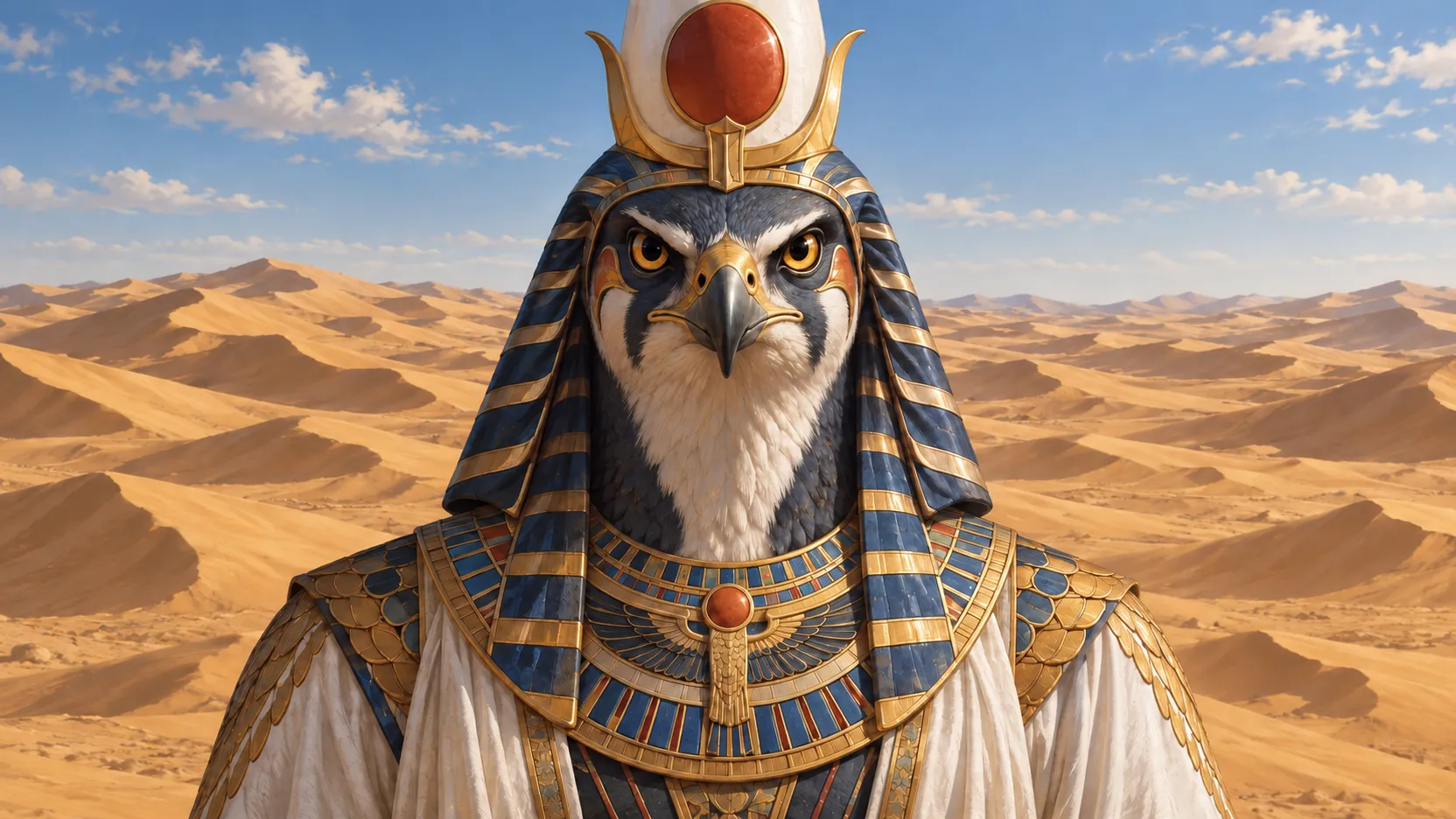
Seth opened his hand, and Horus saw the river twice.
One river lay below the landing, black between its muddy banks. The other shone inside the eye resting on Seth’s palm. In that small brightness, water slid past reed beds Horus could no longer see. A fish turned under the surface. A woman on a ferry tightened her grip on a sleeping child.
Horus reached for it.
Seth closed his fingers.
The second river vanished. Horus’s hand struck the mooring post instead, hard enough to split the wood.
“Still reaching too soon,” Seth said.
Horus pulled back his hand. Blood collected beneath a nail. He kept his remaining eye on his uncle and turned his head until the landing stood where he expected it. Since the injury, distances had been treacherous. Steps rose beneath his foot before he was ready for them; things offered to him remained a finger’s breadth beyond his grasp. He had learned to conceal this from the gods.
Seth watched him calculate the distance.
“Give it back.”
“In the morning, tell them the throne is mine.”
Beyond Seth, a ferry rope stretched into the darkness. Someone aboard coughed. The boat should have reached the landing already, but its ferryman stood with his pole lifted, waiting.
Horus planted the butt of his spear beside his foot.
“My father’s throne.”
“Your father’s,” Seth agreed. “And now we come to the difficulty.”
He rested his closed fist on the mooring beam. The beam lay across two posts, holding the heavy guide rope by which boats crossed the current. Seth could have rested a cup there. He made the gesture seem equally idle.
“The judges will ask you again. You will say what you have always said. Your mother will speak. Someone will call for another witness. We shall eat, and return the next day.” His thumb moved over the knuckle beneath which the eye was hidden. “You could see with both eyes before dawn.”
Horus could hear his own breathing. His face ached where Seth had torn it, though there was no fresh blood there now. He remembered the pressure of the fingers more clearly than the pain: the intimacy of his uncle’s hand, the confidence that he could take what he wanted.
He shifted his grip on the spear.
The ferryman lowered his pole. “Lord, may we come in?”
Seth did not turn.
“When my nephew has answered.”
The Crossing
Horus moved before Seth could close his other hand over the eye.
He drove the spear shaft upward beneath his uncle’s wrist. Seth’s elbow struck the beam; the fist opened. Light spilled across the timber.
For an instant Horus saw through it. He saw himself from below, the sharp, furious head, the dark hollow in his face. He saw the spear coming down.
Seth twisted aside.
The copper point sank into the rope.
Fibers parted with a sound like a deep breath drawn through teeth. The line jumped. Out on the river, the ferry swung broadside to the current.
A pot shattered. Someone shouted for the ferryman.
Horus tore the spear free, caught the severed rope with his other hand and felt the boat’s weight wrench his shoulder forward. Mud slid beneath his heels. He struck the post with his hip and wound the line around it before the current could pull him in.
Across the widening strip of water, a little boy stood against the boat’s rail. He had woken in the sudden turn. One hand clutched a cloth bag; the other reached toward his mother, who had fallen among the passengers.
“Lie down,” Horus called.
The boy looked at him.
The ferry struck the end of the landing.
The rail broke beneath the child’s knees.
Horus let go of the spear and caught him by the wrist.
The child’s weight came down against his injured side. For a moment there was no bank, no boat, only the pull in his arm and the wet slipping of small fingers. Horus dropped to one knee and drew him up. The cloth bag burst against the boards. Grain scattered around them.
The boy tried to gather it with his free hand.
“Leave it.”
“My mother—”
“I have you.”
“My mother is there.”
Horus looked back.
The ferry had swung away. Its stern remained caught against the landing, but the current was driving the bow downstream. Passengers clung to the central bench. The ferryman braced his pole against the riverbed, his body bent over it.
Seth stood at the outer end of the landing. He held the eye between finger and thumb.
“Now,” he said, “you have something else to hold.”
Horus reached for his spear. The boy tightened both arms around his neck.
He could put the child down. The bank was only a few paces behind him. By the time he turned, Seth would be gone, or the ferry would be. He searched the boat for a place where the boy’s mother might still be standing and found only a shawl dragging in the water.
Then someone took hold of his elbow.
He struck backward.
Isis caught his wrist.
“On this side,” she said. “I am on this side.”
He had not heard her approach. That was worse than the shame of the missed blow. She had seen him miss; she had seen the severed line. He expected her to ask why he had come alone, or why he had believed Seth would return anything without making him pay for it.
Instead she tried to lift the boy from him.
The child would not release his neck.
“Look at me,” Isis told the boy. “We shall go up the bank. You can watch from there.”
Horus bent his head until the child’s cheek pressed against the feathers beside his beak.
“Go with her.”
“You will get my mother?”
He could not find the woman.
“I will go to the boat.”
The boy’s arms loosened.
As Isis carried him away, Horus pulled the spear from the mud. A few pale grains clung to the copper. He wiped them off with his thumb and went down onto the landing.
The Weight of the River
The mooring beam groaned.
The rope he had wound around the post was holding, but every movement of the ferry forced the timber sideways. One support had split almost to the water. Horus pushed the spear shaft beneath the beam, using it as a brace.
The wood settled against it. His hands shook with the strain.
“Come forward,” he called to the passengers. “One at a time.”
The ferryman looked at the distance between boat and landing.
“Bring the bow in.”
“I cannot.”
Horus could see why. The pole had lodged beneath the boat. If the man released it, the bow would fall away; if he held on, he could do nothing else.
Seth stepped closer along the beam. He opened his hand again.
The eye’s light ran over Horus’s fingers. Suddenly he saw the rope below the surface, the split in the support, the empty water between the landing and the boat. He could judge the distances. He knew precisely where to put his foot.
He leaned toward it despite himself.
“One word tomorrow,” Seth said.
The beam shifted. Horus pressed the spear upward.
“You would have me buy it.”
“I am offering you a kingdom’s worth.”
The ferryman cried out. His pole bent, and the bow began to move.
Horus could not hold the beam and catch the boat. He could scarcely see the ferryman without turning his whole body. He wanted his eye with a hunger that made every other thing on the river seem briefly small.
Seth held it closer.
Horus drove his shoulder beneath the beam and lifted.
“Pull,” he told his uncle.
Seth laughed.
“The rope. Pull it.”
“Have you heard nothing?”
Horus raised the beam another hand’s breadth. Water broke around the leaning post. The spear bent against his palm.
Then the support gave way.
The beam rolled. Seth’s foot slipped into the gap between the timbers, and his laugh stopped. He caught at the rope as the falling wood pinned his leg.
The eye dropped onto the landing.
It rolled toward Horus, bright as a living thing, and lodged in a crack beside his foot.
There was room to reach it. He could let the beam descend. His uncle’s trapped leg would take the weight; the rope would hold for a little while. With the eye restored, Horus could cross the gap himself. He could fly from this place and arrive before the gods whole again.
Seth pulled at his leg. For the first time that night he was looking down.
Horus moved his foot toward the light.
A hand rose over the side of the ferry. The boy’s mother gripped the broken rail. Her shawl was gone, and her hair lay across her mouth. She tried to lift herself, failed, and tried again.
Horus stopped reaching.
He pushed the beam upward with both hands.
Pain ran from his shoulder into the hollow of his face. The timber rose too slowly. Seth wrenched his knee and snarled.
“Turn your foot,” Horus said.
“Lift it.”
“Turn it first.”
Seth twisted. Horus lifted until the spear cracked and the weight came entirely onto him.
His uncle’s foot came free.
For a moment Seth stood beside him without touching the timber. Horus could not turn to watch him. He had nothing left with which to compel him, no weapon, no free hand. The eye burned near his heel.
“Under the beam,” Horus said.
Seth’s fingers closed on the wood.
The weight eased.
“Higher.”
Together they raised it. Horus shifted the freed end across the gap and lowered it onto the ferry’s prow. The boat lurched against the makeshift bridge. Seth held the rope short, muscles standing out along his arms.
“Now,” Horus called.
The ferryman abandoned his pole and climbed out first. Horus caught his hand, set him on the landing and sent him toward the bank. An old man followed on his knees. A girl pushed a basket ahead of her; when it tipped into the river she went after it, and Horus caught her by the back of her dress.
“Keep going.”
The mother was last. Her foot had caught beneath a bench. She pulled at it with both hands while water climbed over the floorboards.
Horus stepped onto the beam.
Behind him, Seth made a small movement toward the light on the landing.
“Hold the rope.”
Seth looked up. Horus waited until the line tightened again, then crossed.
He knelt in the boat and worked his fingers beneath the bench. The woman’s ankle was twisted under it. She cried out when he lifted.
“Again,” she said before he could stop.
He broke the bench away.
She could not stand. He took her on his back and felt her hands close around his shoulders, in almost the same place the child’s had been. The beam was wet beneath his feet. He kept his remaining eye on the landing and moved one step, then another, while the rope trembled in Seth’s hands.
Isis met them at the bank.
Only when the woman had reached her son did Horus return for his eye.
Seth was still beside the rope. He watched Horus kneel and lift the small brightness from the crack.
“You have not won the throne,” he said.
Horus closed his hand around the eye, gently this time.
“Bring your claim in the morning.”
He turned his wounded side toward Seth and walked up the bank.
What Returned
Thoth made him sit beside the stranded ferry until his hands were steady enough to open.
Horus kept looking toward the water. The sky was paling. Men had come down from the houses with ropes and new timber; the ferryman was showing them where to fasten the boat. Every time something shifted beyond Horus’s sight, he turned.
“Here,” Thoth said.
Horus looked at him.
Thoth lifted the eye from his palm.
At the first touch, Horus jerked backward. Thoth withdrew his hand and waited. From farther up the bank came the scrape of a basket: the boy and his mother were gathering what grain they could from between the boards.
Horus set both feet on the ground.
“Again.”
This time he stayed still.
Light entered in a narrow line. The landing doubled, blurred, and slowly became one. He saw the split post and the broken spear. Beyond them, the woman’s torn shawl had caught in a clump of reeds. The current lifted it, lowered it, lifted it again.
Thoth took his hand away.
Horus did not rise immediately.
When the ferry was ready, he went down to it. The woman sat with her bandaged ankle stretched before her; her son held the patched grain bag against his chest. At the bank, Isis watched him approach the plank.
The ferryman reached out a hand.
Horus could see the distance perfectly now.
He took it and stepped aboard.