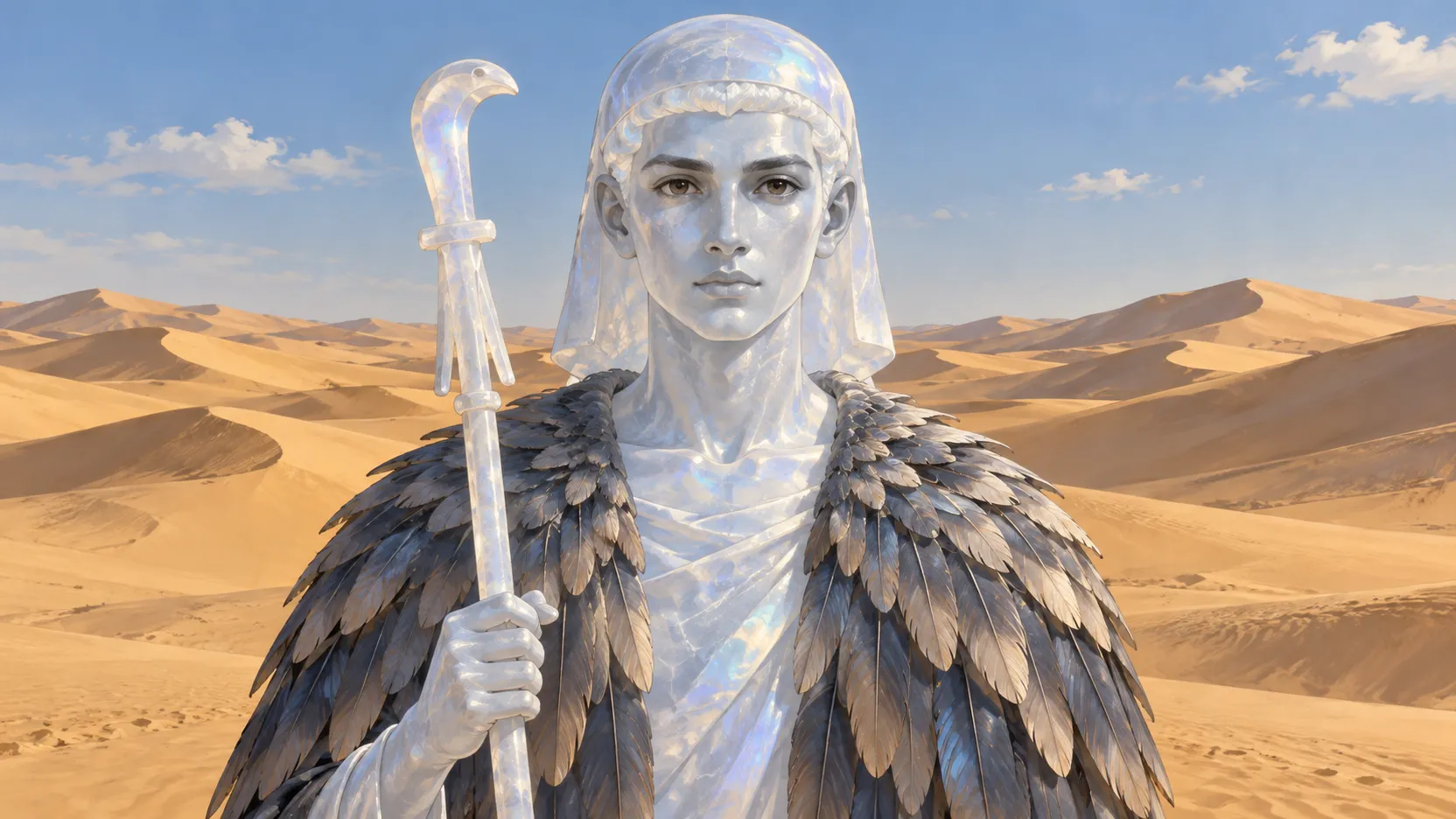
The girl on the bed knocked three times against the wall. Then her other hand seized her wrist and held it still.
Khonsu heard the knocks from inside his shrine.
The men carrying him had stopped at the chamber door. Beyond their shoulders, the ruler of Bakhtan stood with a drawn sword. He had dressed to receive a god, but one sleeve was wet where he had been bathing his daughter’s forehead.
“Bring him in,” he said. “And shut the doors behind him.”
The bearers stepped over the threshold. Their poles creaked. After a year and five months on river and road, the travelling image of Khonsu entered the room for which it had left Thebes.
Bentresh turned her head.
“That took a long time,” she said.
It was not the girl who spoke. The voice used her breath without troubling to fit her mouth; the last word continued after her lips had closed.
Her father raised his sword.
“Leave us,” he told the voice.
The girl’s fingers tightened around her own wrist. Her eyes watered. The ruler lowered his weapon a little, unable to find a place to strike.
Inside the shrine, Khonsu felt the protection laid upon him before his journey. In Thebes, his other presence, Khonsu-Neferhotep, had inclined toward the departing image. Four times the power had passed between them. One Khonsu had remained in his house. Another had crossed the world.
Now he reached beyond the carved surface of his face.
The chamber came to him through the space between the girl’s two hands: one pressing down, one struggling to rise.
“Bentresh,” he said.
The spirit smiled with her mouth.
“I am listening.”
Khonsu waited.
Beneath the restraining fingers, one knuckle moved. It struck the plaster once.
“There you are,” he said.
A Place at the Table
The spirit drew back inside her.
Khonsu followed. He did not see a second creature curled among her bones. He felt a will laid over hers, forcing every small desire aside. She wanted to swallow; it made her laugh. She wanted her father to stop watching; it turned her face toward him. She wanted to sleep, and it had kept her awake to listen to its own voice.
For the first time since entering the room, Khonsu felt anger.
The spirit felt it too. Bentresh’s back lifted from the bed.
Her father dropped the sword and caught her shoulders.
“Hold her!” he shouted.
The servants ran forward.
Khonsu pressed his power into the narrow place where the girl’s will still resisted. He held that place open. Her next breath belonged to her; the breath after it did too. The spirit clung to the sound in her throat, but there was no longer room for it in her chest.
Bentresh coughed.
Something struck the wall above her bed. The lamp flame flattened. The ruler ducked over his daughter as a voice spoke beside his ear.
“I know you, Khonsu.”
The pressure had gone out of the girl’s limbs. Her hands fell apart on the linen.
“Then you know why I have come,” the god said.
“I will go back.”
“Go.”
The lamp recovered. Its flame rose straight, though everyone in the room could still feel the presence against the wall.
“Give me a feast before I leave.”
The ruler lifted his head.
For a moment he seemed unable to understand what had been asked. Then he reached down for the sword.
“It ate her sleep,” he said. “It made her bite her own tongue. It spoke to me while she was crying. And I am to feed it?”
Bentresh moved under his hands. He looked down, expecting another seizure.
“Water,” she whispered.
He forgot the sword. He snatched a cup from a servant, spilled half of it, and held the rest to her mouth. She drank slowly. When he tried to tip the cup farther, she pushed it away.
Khonsu let him feel that small refusal before speaking.
“Make the offering.”
The ruler looked toward the shrine. His hand still cupped the back of his daughter’s head.
“What will keep it from coming back?”
“My command.”
“And if it disobeys?”
The unseen presence scraped along the plaster. Khonsu turned his attention toward it. The scraping stopped.
The ruler heard the silence.
He ordered the tables brought.
They spread the feast in the courtyard, beneath a sky the spirit had not seen through its own eyes for a long time. Bread steamed where it had been broken. Beer stood in deep cups. The ruler placed the first portion before the empty seat, his jaw working as though he were chewing grit.
Bentresh sat beside him with a blanket around her shoulders.
“Must she be here?” he asked.
“She asked to come,” said the servant who had helped her down.
The ruler drew breath to answer, then pushed a dish within his daughter’s reach instead.
At the empty place, the bread split. A cup tilted without a hand. Nobody spoke while the spirit ate.
When it had finished, Khonsu felt its attention turn toward the girl. Her father felt it too. His arm went across her body.
But the spirit addressed the god.
“I have received what I asked.”
“Then leave what you have taken.”
The cool weight that had filled the courtyard lifted. A dog outside the gate began barking, followed by another farther down the road. Then even that disturbance passed beyond hearing.
Bentresh reached for a piece of bread.
Her father watched her swallow. He watched her reach for another. When she laughed at something her attendant said, he gripped the edge of the table until his nails whitened.
That night he went alone to the shrine.
He laid both hands against its doors.
The Guest Who Stayed
At first there were good reasons to delay the journey home.
The roads needed inspecting. The horses needed replacing. A gift worthy of the god could not be finished in a day.
Khonsu’s priest accepted the first delay. He protested the second. By the third, guards stood beside the shrine with orders to admit everyone who brought an offering and no one who brought carrying poles.
The ruler visited daily.
He brought gold, fragrant wood, cloth so finely woven that light passed through it. He stood before the image and described each gift, waiting after every description for a sign.
Khonsu gave none.
Outside, the moon diminished and returned. Bentresh began walking in the gardens. The ruler posted men at the garden gate. When she rode beyond the walls, he sent an escort large enough to clear the road before her.
Three years and nine months passed over the shrine.
On the last evening, Bentresh came to it without an offering.
Her father found her with the priest, examining the old carrying poles. The wood had been wrapped and stored. She had unwrapped one end and was rubbing dust from the place where a bearer’s shoulder would rest.
“What are you doing?”
“Getting these ready.”
“They will need new fittings.”
“The priest says they are sound.”
“He has wanted to leave since the first season.”
“Yes,” she said. “He has.”
The ruler looked at the priest. The man lowered his eyes, but did not step away from the poles.
“Go to your chamber,” the ruler told his daughter.
Bentresh set down the cloth.
“If he had left the spirit in me, would you still be giving him presents?”
Her father recoiled as if she had spat on the shrine.
“Everything here is because he saved you.”
“Then let him finish.”
He reached for her arm. She stood still and let him take it.
That was worse than resistance. Through the image’s carved eyes, Khonsu watched the ruler feel how lightly he needed to hold her now. He could have drawn her after him with two fingers.
Instead he released her.
“The god stays,” he said, and left them.
Bentresh remained beside the poles until the lamps were lit. Then she touched the shrine once and went away.
Khonsu followed her father’s footsteps into the dark.
The Open Hands
In his dream, the ruler heard wings striking wood.
He rose from his bed and found himself inside the shrine. Its doors stood above him, enormous. Between them, in a blade of moonlight, a golden falcon beat its wings.
He knew the bird before it turned its head.
“Wait.”
The falcon climbed toward the opening.
The ruler caught it.
It was warm between his hands. He could feel the rapid movement of its breast. Its feathers pressed against his palms, and beneath them was a strength that could have broken his fingers.
It did not break them.
Beyond the doors lay the road to Egypt. He could see it all at once: the mountain passes, the dust rising behind wheels, the river widening toward Thebes. He had never travelled that whole road, yet now every bend seemed to draw something out of his hands.
“If you go,” he said, “what happens when she is sick again?”
The falcon’s talons touched his wrist.
He tightened his grip before they could find purchase. One wing folded awkwardly against the other. The bird stopped moving.
The stillness terrified him.
He loosened his hands enough to let it breathe.
“What am I supposed to do?”
Through the opening came a sound from his daughter’s chamber: three knocks against a wall.
He turned toward it, but the shrine enclosed him. There was no door he could reach while holding the bird.
The knocks came again.
He remembered the bed, the two hands locked together, the sword with nowhere to strike. He had begged the god to give her back. For years afterward he had risen each morning and counted all the things that might take her away.
The falcon shifted in his grasp.
He felt its wing begin to open, testing the small space he had allowed it.
“No promise?” he asked.
Khonsu looked at him through the bird’s bright eye.
The ruler opened one hand.
The wing spread across his face. For an instant he could see nothing but gold. His other hand closed by itself around the bird’s feet.
He made it open too.
The falcon struck the air and rose. Wind filled the ruler’s mouth. He fell backward, reaching after it, and woke with both arms raised above his bed.
Morning had begun at the window.
He called for the priest.
“Prepare the journey.”
The man stared at him.
“Today,” the ruler said.
By noon the shrine stood in the courtyard. Men tested the poles under its weight. Horses stamped beyond the gate, beside the gifts that would travel to Thebes.
The ruler approached the image one last time. He had a prayer ready, a request for protection in exchange for everything he was sending. His lips formed its first word.
Then he stepped aside.
Bentresh stood at the gate. When the bearers came toward her, she took hold of the heavy door and pushed it wide. Her father started forward to help, but she had already braced her foot and moved it.
The shrine passed through.
“Go safely,” she called.
Khonsu heard her long after the courtyard disappeared.
In Thebes, when the journey ended, his priest carried the gifts into the house of Khonsu-Neferhotep. Gold and fragrant wood lay before the god who had sent him. The travelling image returned to its own place with empty hands.
That evening, far away in Bakhtan, Bentresh opened her chamber window. Her father paused outside her door, heard her moving about inside, and went on down the passage.