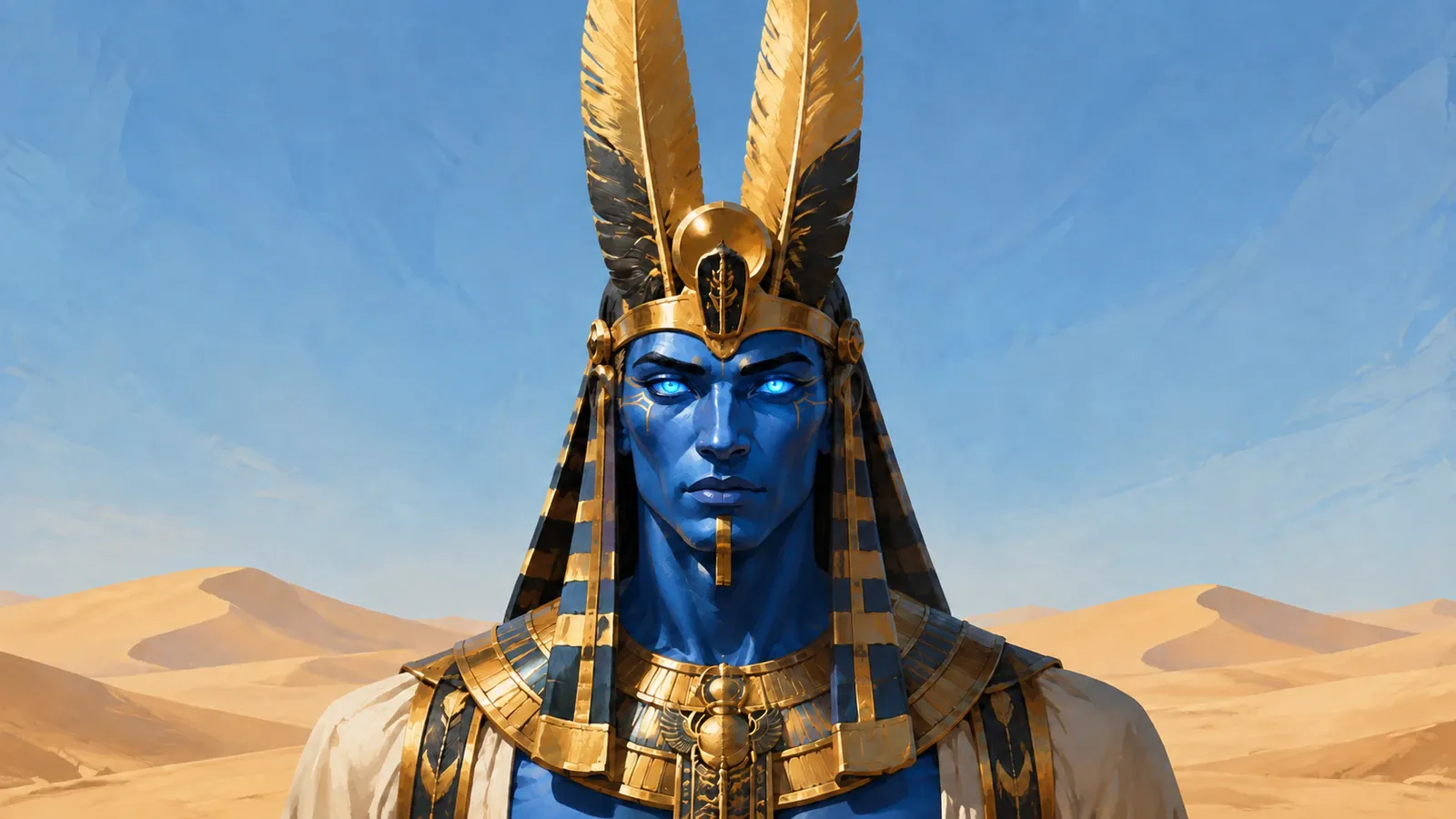
A Mother’s Question
“And will she be happy?”
Amun had been naming the lands her daughter would rule. At the question, he stopped.
Ahmose sat on the edge of the couch, drawing a fold of linen through her fingers. The chamber still held the sweetness of his arrival. He had come to her wearing the likeness of her husband, Thutmose; now she knew who had entered the royal house. She had heard his name, and the name of the daughter she would bear, and the promise that the child would sit upon the throne of Horus.
She waited for something he had not said.
“She will have the protection of the gods,” he answered.
“You have told me what she will have.” Ahmose let the linen fall. “I asked how she will live.”
Beyond the doorway, a servant moved quietly past with a lamp. For a moment its light caught the edge of the door, then slipped away. Amun could have called her back, filled the passage with witnesses, made the whole palace kneel to hear the future spoken. Before the assembled gods, his purpose had needed only his voice. Here, the queen was looking at the empty place beside her on the couch.
“Hatshepsut,” he said.
Ahmose repeated the name under her breath. She laid her palm on the linen as though testing a place where a small body might rest.
“And when she is only that?” she asked. “Before anyone puts gold on her. Before she knows your name. Will you know her?”
“She is my daughter.”
“Then come when there is a daughter to hold.”
He had meant to leave her with a promise. Instead, he left with an invitation that would not release him.
The Open Hand
Khnum pressed his thumbs into the turning clay. Amun stood close enough to see water gathering in the channels of the craftsman’s fingers.
Two small forms rose upon the wheel: the child and her ka, the life that would accompany her. The wheel hummed beneath them. Khnum worked without haste, drawing out a shoulder, supporting the slight neck with the edge of his hand.
“Give her strength,” Amun said.
Khnum reached for water.
“The strength to bear the Two Lands,” Amun continued. “To stand before men who will wait for her to falter. To endure the weight they bring her.”
Water ran from Khnum’s fingers. He smoothed the child’s shoulder and turned the wheel again.
“Show me where you want the weight to fall.”
Amun extended one finger toward the little arm. Khnum stopped the wheel before he touched it.
For an instant the room was very quiet.
The arm was scarcely thicker than a reed. Amun had seen stone dragged across the desert and raised into gateways through which whole processions could pass. He had received gold heavy enough to bend the carrying poles. The body before him would begin its life unable to lift its own head.
“Make it stronger,” he said.
Khnum folded the tiny fingers inward, closing the hand. He showed Amun the compact fist.
“Like this?”
“It must be able to hold.”
The craftsman opened the fingers again. Between thumb and palm he left a space so narrow that Amun could have covered it with a nail.
“Then it must open.”
The wheel turned. Amun followed the small hand as it moved away and came back to him. Open, it seemed unfinished. Anything might be taken from it.
Khnum bent over the child’s face. He parted the lips with the tip of his finger.
“And there?” Amun asked.
“For breath.”
Heqet came to stand beside the wheel. She watched Khnum free the mouth from the last touch of clay, then leaned close to the two figures.
Amun lifted his hand. Both gods looked toward him.
There was still time to command another shape. He could demand a body that answered every fear the queen had placed before him: no weakness in the limbs, no need in the mouth, no opening through which grief might enter. Khnum waited, wet hands held clear of his work.
Amun looked at the child’s open palm.
Ahmose had made a place beside her. A child would lie there, wake hungry, reach for something she could not yet name. Whatever strength he gave her would have to begin in that reaching.
He lowered his hand.
“Let her breathe.”
Khnum set the wheel moving beneath his foot. Heqet brought life to the waiting forms, and Amun stayed beside them until the work was done.
The Weight of a Child
When Ahmose’s time came, Khnum and Heqet took her between them and led her toward the birth chamber. At the threshold she stopped. Her fingers tightened around their hands; she bent her head and waited for the pain to pass. Then she went on.
Amun followed as far as the doorway.
Inside, someone asked for water. A bowl knocked against another bowl. He heard Ahmose draw breath, hold it, let it go in a sound that made the attendants move closer.
He had already promised the child a throne. There was nothing in that promise that would carry this moment for her mother.
He remained at the threshold while Heqet worked. When Ahmose called out again, he did not summon her away from the hands supporting her. He waited where she would find him when the door opened.
At last a thin, furious cry broke through the chamber.
Amun stepped forward.
Hathor emerged carrying a bundle of linen against her breast. One corner had come loose. Beneath it a foot thrust out, small toes spreading, then vanished again.
“Your daughter,” she said.
He could see almost nothing of the face. He reached to draw the linen back, and the child turned toward the movement. Her eyes opened briefly. Then she squeezed them shut and cried harder.
The sound struck through the welcome gathering on his lips.
He drew back his hand. Light lay across the child’s face, falling from his crown and the gold at his throat. She burrowed toward Hathor, rooting blindly into the shelter of her arm.
“Bring her to me,” he said.
Hathor moved nearer, but kept the baby against her.
“Here she is.”
He held out his arms. They were the arms in which kings sought victory, the hands lifted over offerings and bowed heads. The child could not see them for the brightness.
Hathor shifted her weight. The baby quieted a little as her face passed into shadow.
Amun watched the small mouth tremble open. On Khnum’s wheel he had seen the place made for breath. Now breath came through it in broken, indignant bursts, demanding something of him.
He took off his crown.
The tall feathers passed between him and Hathor as he lowered it. He set it on the stone beside the doorway, then laid down the staff from his other hand. Without them, he could move closer.
Still the child clung to the curve of Hathor’s body.
“Under her head,” the goddess said.
He put his hand where she showed him.
“And here.”
His other arm received the folded linen. Hathor eased her hands away a little, and the weight came to him: warm, uneven, moving of its own accord. The baby’s head rolled against his palm. He bent at once to support it.
Her crying stopped for a breath. He waited. It started again, softer this time.
Amun lowered himself to one knee. The linen slipped, and he caught it with his wrist rather than loosen the hand beneath her head. Hathor let go.
Now he held her.
Her fist worked free of the wrapping. It brushed his chest, missed, opened. He offered a finger, and the fingers Khnum had shaped closed around it.
He could hardly feel their strength. When he moved, she held on.
“Hatshepsut,” he said.
Her eyes opened. They wandered past his face and returned without recognition. He remained there, bent over her, while she examined the nearness of him.
Hathor reached for the loose linen. Amun turned his wrist to help her, and a small, startled laugh escaped him. His daughter had tightened her grip.
Before the Crown
Ahmose was awake when he brought the child back. Her hair lay damp against her temple. She lifted her head from the cushion, searching his arms.
He sat beside her.
“Did you know her?” she asked.
“She took hold of me.”
Ahmose looked down at the little fist around his finger. Her mouth softened, though her eyes were still tired.
“She will want that hand back.”
He eased his finger free. Hatshepsut stirred at once, seeking what had gone, and Ahmose slipped her own finger into its place.
Amun lowered the child into her mother’s arms. He kept his palm beneath the small head while Ahmose settled the linen and drew her daughter close. Only when the queen had her securely did he withdraw it.
Outside the chamber, the double-plumed crown stood where he had left it. Inside, he reached for the fallen corner of the coverlet and laid it over his daughter’s feet.