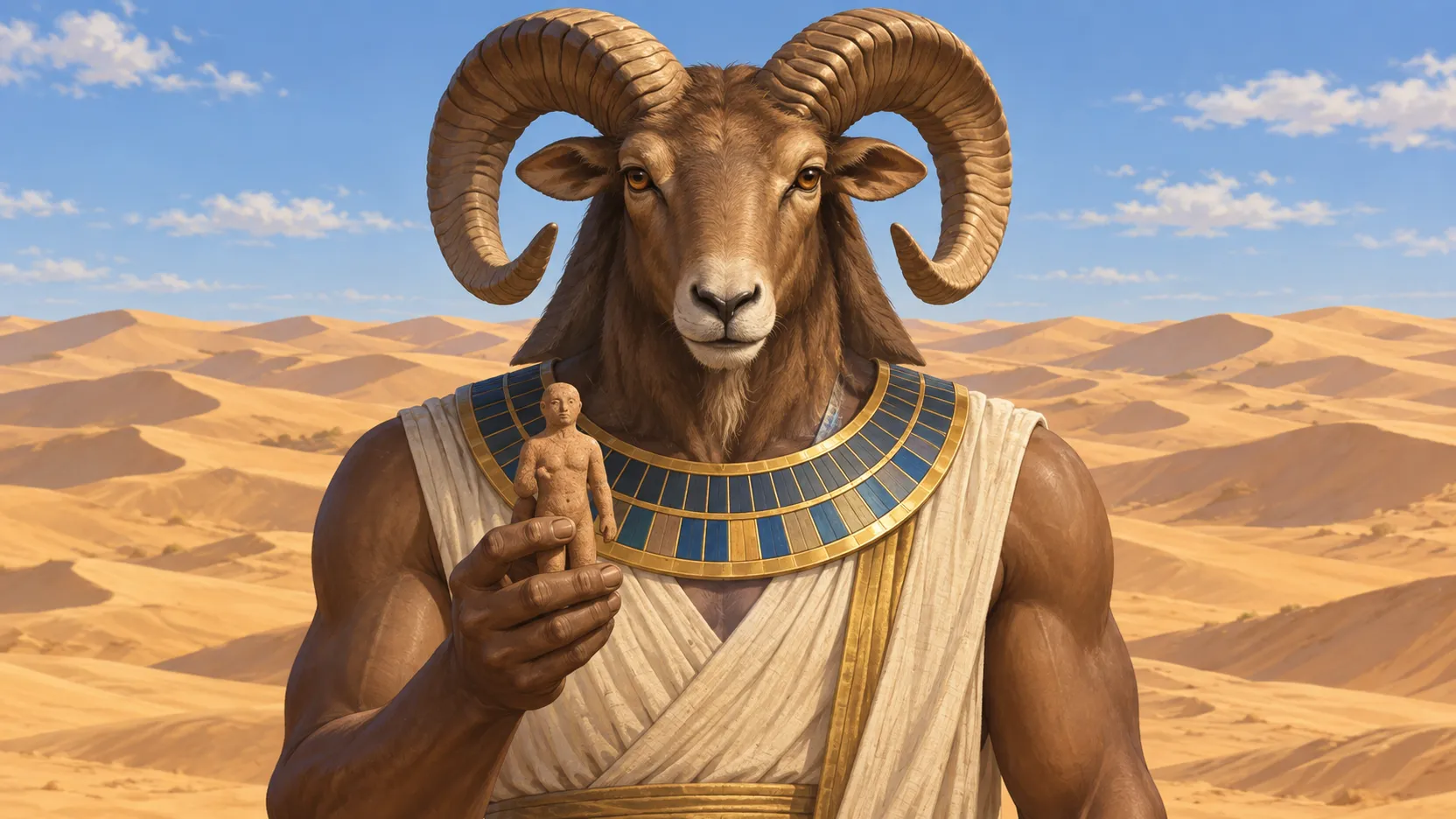
The second child’s mouth slid sideways beneath Khnum’s thumb.
He stopped the wheel. Across from the spoiled face, its companion sat upright in the wet clay: knees drawn up, fists against its chest, every finger finished. One was the body. The other was its ka. Both had to leave his hands together.
He wetted a finger and began the mouth again.
Water struck the underside of the floor.
The wheel jumped. A thin crack opened through the little face.
At the doorway, Heqet caught the lintel. Muddy water ran between her ankles and spread across the stone.
“How long?” she asked.
“Longer if you shake the room.”
“That was your river.”
Khnum pressed the crack closed. Beyond his workshop, the channels beneath Elephantine grumbled against their rock walls. He had listened to them all morning while he worked. Now a heavier sound moved among them, a knocking deep enough to feel through his stool.
Heqet crossed to the wheel. She held out her hands.
“Her pains are close. Give them to me.”
“The second is unfinished.”
“Then finish it.”
He looked up. Heqet’s arms were wet to the elbows, though she had only just stepped through the shallow water at his door. She had come straight from the woman.
“Is she alone?”
“Her sister is with her. She keeps asking whether the water has reached the house.”
Khnum listened again.
The northern outlet should have been drawing that heavy current away. He could hear its narrow, familiar hiss, but none of the deeper rush. Something had lodged in its throat.
He slid a wet cloth over the two figures.
“Keep this damp,” he said.
Heqet took the bowl. “Khnum.”
He was already at the door.
“Come back with time to use both hands.”
The Water Behind the Stone
The channel beyond the workshop had disappeared beneath brown foam.
Khnum braced his hooves on the steps and reached into it. The current snapped his arm downstream. Under the water, stone ground on stone. A slab had fallen from the passage roof and wedged across the outlet, leaving only a finger’s width for the Nile to escape.
He found its upper edge and pulled.
The slab moved. Water drove through the opening, struck the opposite wall and flung a sheet of mud against his chest. Farther along the passage, another stone cracked.
He let the slab settle back.
Pulling it free would bring the damaged roof down. The narrow opening would become a sealed throat, and the rising water would find its own way through the rock beneath the houses.
He climbed the steps. A reed basket drifted past the workshop door. He caught it before it could strike the wheel.
Inside lay little coils of clay, prepared for the joints of fingers.
He stood holding the basket while the water ran from it.
There was another way north. He had cut it himself, long ago, to drain the room when he washed the floor. It passed beneath the wheel and emerged beyond the village, among bare rocks. It was scarcely wide enough for a hand.
He set the basket on a shelf and took up his broad shaping blade.
“What are you doing?” Heqet asked.
“Giving it a larger mouth.”
He drove the blade into a seam in the floor. Stone lifted. A black slit opened beneath it, and the water at his feet hurried inside.
Heqet looked from the slit to the wheel.
“Through here?”
“The far end opens beyond the houses.”
“And this end?”
Khnum drove the blade again. The stone broke with a sound like a jar dropped in an empty room.
“This end is here.”
He pried up three more lengths of flooring. Water rushed along the exposed drain, carrying chips of stone. The wheel stood over its narrowest point. Beneath the wheel’s heavy round bed, he could now see the old channel bending north.
If he opened the rest before the wheel was moved, the current would take it. If he moved the wheel first, there would be nothing broad enough to guide the first rush into the cut. The water would spread through the room and force its way out toward the houses.
He set down the blade.
The drain was ready. The children were not.
The Second Form
Heqet lifted the cloth.
The finished body had tilted, but it held its shape. Beside it, the ka’s face had begun to sag into the shoulder.
Khnum sat. He set the wheel turning with a push and cupped the little head between two fingers. The clay was too wet. He had left it under the cloth too long.
“Dry clay,” he said.
Heqet reached for the basket he had rescued.
“Not that. The shelf above.”
She brought a lump wrapped in linen. He shaved it into the bowl, mixed the powder with his thumb and worked the thicker clay into the head. Beneath his hands, the face lifted. He made room for the eyes and drew the jaw gently forward.
Water climbed the legs of his stool.
Heqet turned toward the doorway.
“Stay,” he said.
“I can hear her.”
“So can I.”
He could. Through the turning clay, a woman’s effort reached his fingers: the tightening, the held breath, the brief release. He steadied his hands and opened the small mouth.
The wheel lurched.
The finished body slid toward the rim.
Khnum caught it against his palm. His other hand went out to stop the wheel, and his wrist struck the ka.
For a moment it lay whole on the wet stone.
Then the running water folded its face flat.
He lunged after it. His fingers closed on mud.
Heqet seized his wrist before he could reach farther into the opened drain.
“Put the first one in my hands.”
He did not move. The body rested against his palm, protected by the curve of his fingers. Between his other fingers, the lost form dripped away.
“Khnum. You cannot work like that.”
He looked at the little body. He had made the soft place beneath its chin, the fold behind each knee. One heel carried the faint whorl of his thumb.
Heqet waited with her hands open.
He laid it in them.
Then he scraped the remaining clay from the rim of the wheel.
There was enough.
He pressed it down hard. Water had begun to lift the wheel from beneath; it turned unevenly, resisting him at each broken edge of the floor. He planted one knee against its base and drew the clay upward.
No smoothing first. The trunk. The bend of the legs. The shoulders, small but separate. He split the arms from the body with the tip of his blade, laid the blade aside and used his fingers for the hands.
Heqet crouched beside him, sheltering the finished child against her breast.
The pressure beneath his knee grew.
He leaned harder. A stone came loose behind him and struck the wall. The northern outlet was closing.
The ka still had no face.
Khnum braced his free foot against the wall. He pinched the chin from the clay, pressed two hollows above it and lifted the brow. The mouth opened beneath his nail.
This time it held.
What His Hands Could Keep
“Take it.”
Heqet shifted the first figure into the crook of her arm.
Khnum slid his fingers beneath the ka. The wheel rose against his knee. He bowed over it, horns nearly touching the wet stone, and lifted the figure clear.
For a breath he held it above her waiting palm.
Then the floor split behind him.
The current struck his back. Heqet staggered, caught the ka and closed her hands around both forms.
“Go up,” he said. “The shelf. Then the doorway.”
She climbed. Water struck the wall where she had been standing.
Khnum could no longer hold the wheel down. He let its upstream edge rise and caught the rim with both hands. The old stone was slippery with clay. He pulled it toward him, turning its round face across the room, and wedged the lower edge into the cut he had opened.
The flood hit it.
Pain ran through his shoulders. His foot skidded. He drove it into the broken floor and pushed the wheel farther over, until the current slid along its face and into the northern channel.
The room shook. A shelf collapsed behind him. His shaping bowls struck the water, vanished and came apart against the stone.
Above the noise, Heqet called his name.
She stood in the doorway with the two figures held close. A final step would take her out of the workshop.
“Go,” he said again.
She went.
Khnum held the wheel while the water widened the channel beneath it. The current took the stool, the basket, the cloth that had covered the figures. It stripped the clay from the wheel in long pale ribbons. When the stone had settled firmly into the broken floor, he eased one hand away.
It held.
He let go with the other.
By the time he climbed out, the water was running north between the bare rocks. The houses stood above it. On one roof, a woman was hauling a sleeping mat away from the edge. Someone called to her from below, and she laughed once, sharply, before kneeling to pull again.
Khnum sat on the upper step of his workshop.
His hands had begun to shake.
He waited until they stopped. Then he waited longer.
Heqet found him there. She was carrying neither figure.
He looked at her empty hands.
“She wants to know whether her house is safe,” she said.
“Yes.”
“I told her you would see to it.”
From somewhere above them came a thin, furious cry. It broke off, gathered strength and began again.
Khnum shut his eyes.
Heqet sat beside him until the child quieted.
When she rose to go, he caught the edge of her sleeve.
“The heel,” he said. “Did I smooth the heel?”
“She has counted his toes three times. She has found nothing to complain of.”
After she left, Khnum descended the steps. His wheel lay fixed across the channel, its surface washed clean. Beyond it the shelves were gone, but a lump of clay remained on the highest ledge, still wrapped in linen.
He brought it into the daylight and set it on the stone between his feet.
With the heel of his hand, he began to press it into a circle.