
Twelve men hauled their boat onto the beach. Then they went straight to the boathouse and dragged Thorfinn’s great vessel out of it.
Grettir watched from above the shore. He had seen thirty men struggle to move that boat. These twelve shifted it together, grunting, and put their own in its place.
They meant to stay.
Thorfinn was away celebrating Yule on the mainland. At home on the island were his wife, their daughter, eight servants, and Grettir, the young Icelander he had rescued from a shipwreck. The daughter had been ill. There were no thirty men waiting in the hall.
Grettir went down to meet the visitors.
Their leader called himself Thorir Paunch. Beside him stood his brother Ogmund. Grettir knew the names: raiders whom Thorfinn had helped drive outside the law.
“Is your master at home?” Thorir asked.
“You have chosen your day well,” Grettir said. “He will not be back before Yule is over.”
Thorir looked at his brother.
“There is ale enough for all of you,” Grettir went on. “Come up to the house.”
He led Thorir into the hall by the hand.
Thorfinn’s wife was preparing the room for the feast. At the sight of the men behind Grettir, she stopped.
“What have you brought into our house?”
“Guests,” he said. “We have had little company.”
She named them for what they were. Her husband had saved Grettir from the sea, fed him through the winter, given him a place at the fire. Was this how he meant to repay him?
Grettir kept his face turned towards the visitors.
“They need dry clothes before they need reproaches.”
Thorir laughed. He told her that her husband’s absence would cost her nothing: he and his men would take the husbands’ places tonight. Her daughter would have company too.
The women withdrew, frightened and weeping.
Grettir held out his hands for the men’s wet gear.
“Give me your weapons as well. The servants will never come near while you look ready to fight.”
Most of the weapons passed into his keeping. He carried them away, then brought the strongest ale he could find.
The visitors drank. Grettir kept their cups full and their attention on him, trading stories while the women remained out of sight. Each time a man put down an empty cup, he made certain it did not remain empty long.
Thorir began to speak of rewards. A man like Grettir might find a place among them.
“I might like that,” Grettir said. “If we are still such friends when you leave.”
They wanted to swear fellowship at once. He put them off until they were sober enough to remember it.
Night gathered outside. At last Thorir pushed back from the table. He had not forgotten what he had promised the women.
Grettir rose with him.
“First, let me show you where Thorfinn keeps his fine clothes.”
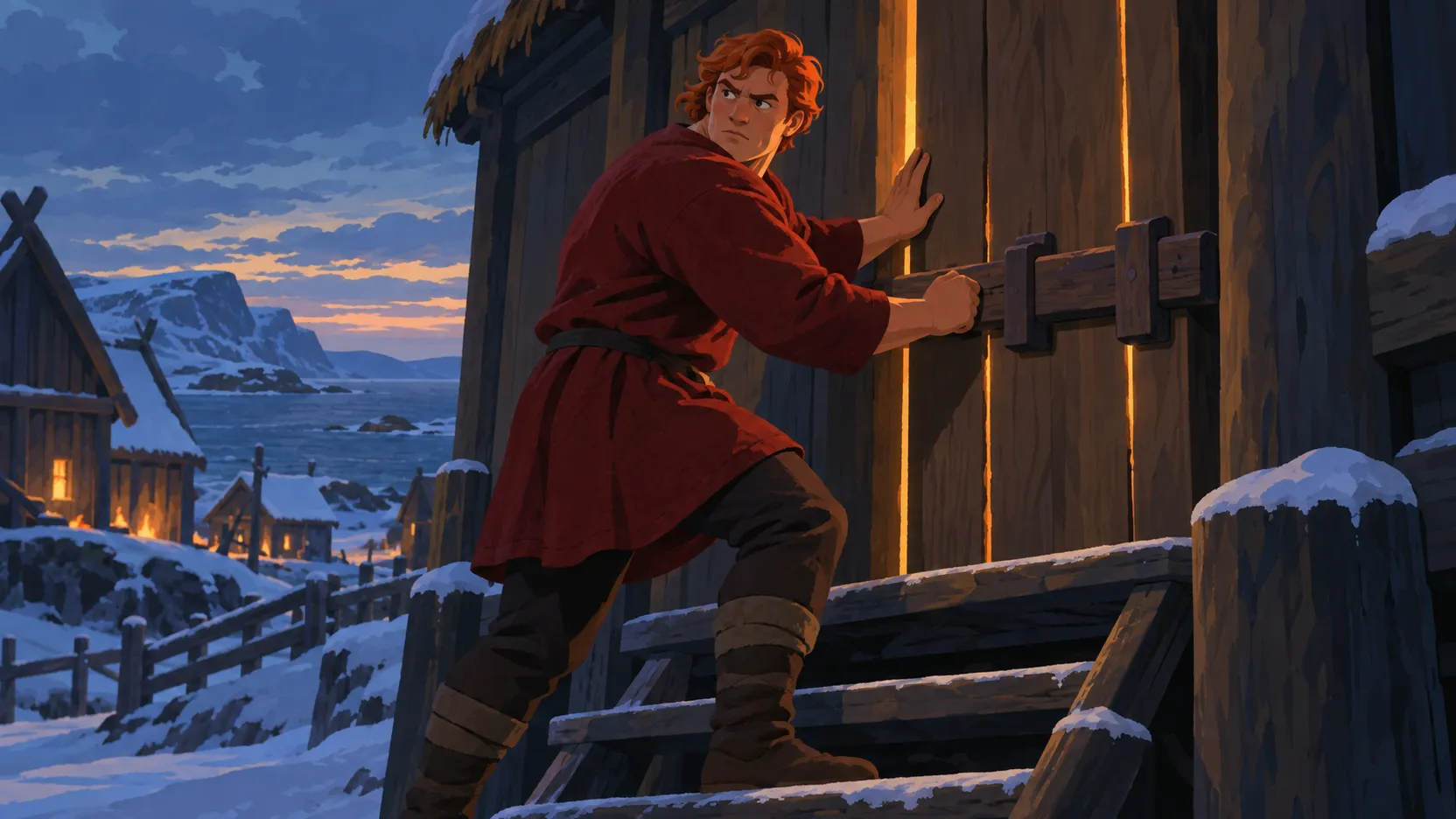
He took a light and led them out to a strongly built storehouse. Steps rose to its door. Inside, the men crowded around the things he showed them, pushing and jostling him in their good humour.
Grettir let himself tumble down the steps as though they had knocked him off balance.
He landed outside, swung the door shut, and fastened it.
For a moment the light still showed through the cracks. The men inside were laughing.
He ran to the house.
“Where are the weapons?”
No one answered. He called again, and Thorfinn’s wife came far enough forward for him to see her.
“What do you want with them now?”
“There is little time.”
She looked past him towards the storehouse. The laughter had changed. A heavy blow struck the closed door.
Above her husband’s bed, she told him: the spear, the helmet, and the fine short sword.
Grettir knew the sword. He had brought it out of a burial mound earlier that winter, but Thorfinn had kept it. He must do more to earn such a gift, his host had said.
Now Grettir buckled it on, took the helmet and spear, and ran out again.
The storehouse door was holding. The partition beside it was not.
Timber split. Thorir forced his way through the adjoining passage, with Ogmund pressing close behind. Grettir reached the foot of the steps before they could come down together.
He drove the long spear upward. The brothers fell against one another, and the men behind them fought to get clear.
Then the narrow passage emptied in a rush.
Grettir met them with spear and sword. They snatched up loose timber to defend themselves. Four servants came out to help him, but when the raiders turned on them they retreated towards the house.
Grettir held his ground.
Six men fell before the others fled to the shore. He followed them into the boathouse, where an oar struck him hard enough to send him staggering. He recovered before its wielder could strike again. Two more men died there. The remaining four broke away in pairs into the dark.
He pursued the nearer pair to a barn. By the time the fighting ended, his limbs were stiff and he could scarcely lift his arm.
Snow drove across the island. Somewhere out there two raiders remained, but Grettir could follow no farther that night.
He turned towards the house.
A light shone in its highest window.
Thorfinn’s wife had put it there. He kept his eyes upon it as he walked, losing it behind the blowing snow and finding it again. When he reached the door, she opened it herself.
This time she welcomed him.
Grettir slept in his armour. In the morning, the islanders went out to search. They found the last two raiders beneath a rock, dead from their wounds and the cold.
When Thorfinn returned, the strange boat in his boathouse made him fear the worst. His wife hurried down to the shore and embraced him. Then she told him what his winter guest had done.
He went up to the hall to thank Grettir.
Through the remaining winter, no one treated the Icelander as an idle stranger. In spring, when Grettir prepared to leave, Thorfinn went with him to the ship.
He brought the short sword.
This time he put it into Grettir’s hands and left it there.