
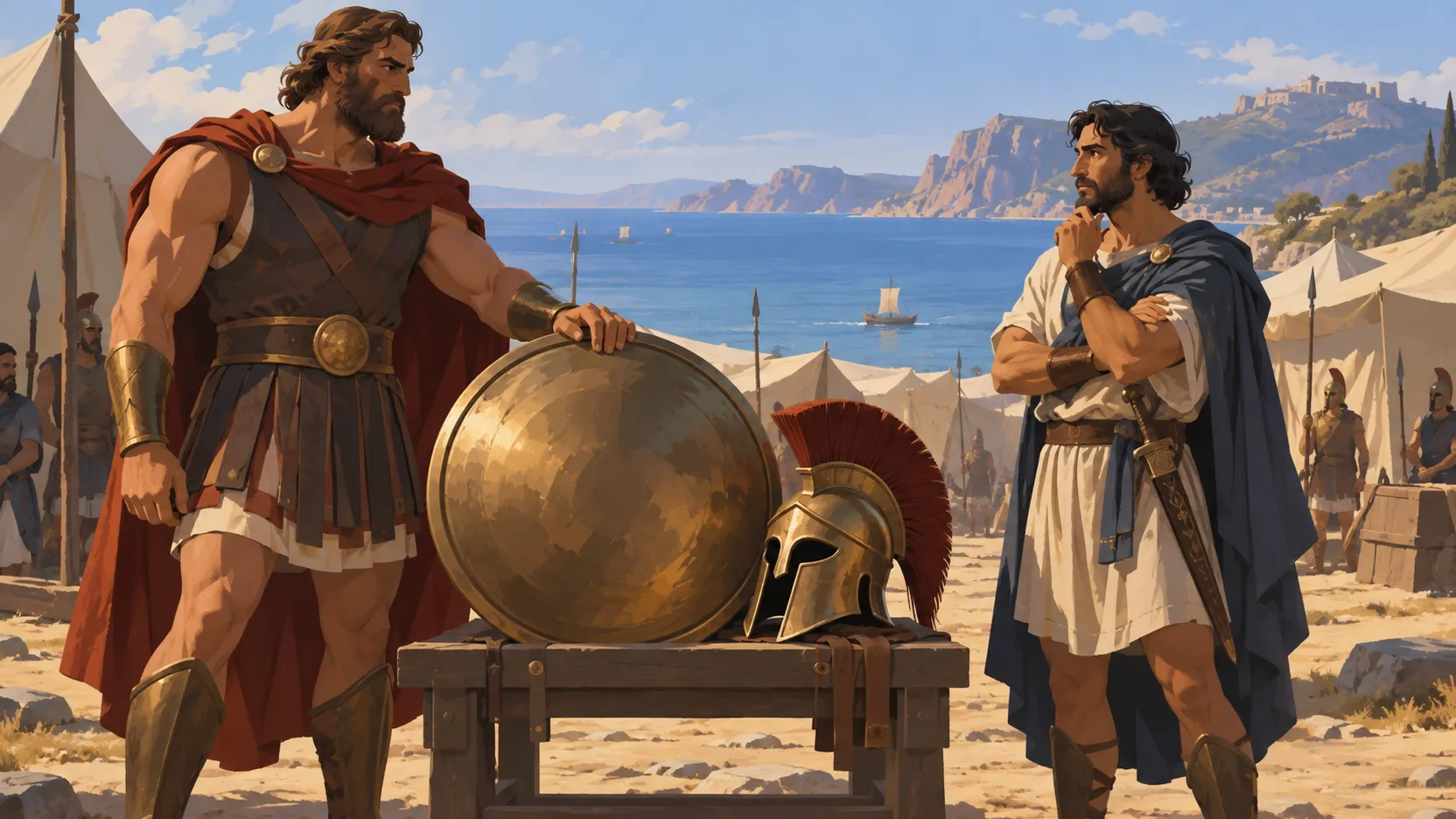
Ajax laid his hand on the shield.
“I carried him back.”
Across the assembly, Odysseus watched the great warrior’s fingers spread over the metal. Achilles was dead, killed at Troy’s gates by Paris and Apollo. His funeral mound stood near the sea. The armor made for him by Hephaestus had been set before the Greeks as a prize for the bravest.
Ajax had carried the body through a storm of weapons. Odysseus had fought beside him, keeping the Trojans away as they retreated.
Neither had forgotten the other’s part. Neither meant to surrender the armor.
Ajax spoke of the battles in which he had held the line, of ships defended and men brought safely out of danger. He did not speak easily, but his size and the scars of his shield made the things he named seem present in the circle.
Odysseus stood when Ajax finished.
“A body cannot be carried far if the men pursuing it are left free to strike.”
He spoke of the work that kept an army alive beyond a single clash: plans, embassies, dangerous journeys undertaken in darkness. He had stood beside Ajax at the rescue. He had also served when strength alone could not do what the army needed.
The judges listened.
When their decision was announced, the armor went to Odysseus.
Ajax did not move at first. Then he took his hand from the shield and walked away.
The Empty Place in the Camp
That night Ajax meant to attack the Greek leaders.
Athena met him with madness. The men he believed he was striking were herds and their keepers; she turned his fury away from the commanders and into a terrible delusion.
When he came to himself, the enemies he had imagined were gone. The destruction remained.
Ajax could not endure what he saw and what he believed the camp would say of him. He took his own life.
There was no contest to win him back and no enemy from whom to recover him. The Greeks buried him in the earth, apart from the funeral fires that had honored the others.
Odysseus still had the armor.
Beyond the camp, Troy’s walls had not changed.
The Man on Lemnos
In the tenth year, Calchas told the commanders that they needed the bow and arrows of Heracles to take Troy.
The bow belonged to Philoctetes.
On the voyage to the war, a snake had bitten him. His wound would not heal, and the army had found his suffering unbearable to live beside. On Agamemnon’s orders, Odysseus had left him on Lemnos.
Now Odysseus returned with Diomedes.
Philoctetes heard them before he saw them. He came from his shelter with the bow ready. One foot dragged as he moved.
Odysseus stopped several paces away.
The archer recognized him.
“No.”
“We have come to take you back.”
“You came to leave me.”
Diomedes glanced toward the empty shore. There were no companions here to speak for Philoctetes, no camp, no place at another man’s fire. He had survived by shooting birds with the bow they had come to claim.
Odysseus put down the food they had brought and stepped back.
“Eat. We can speak afterward.”
Philoctetes watched them for a long time. At last he eased himself down, keeping the bow beside his good leg. Diomedes set water within reach. While Odysseus held the archer’s attention with news of the army, Diomedes moved the bow beyond the hand resting near it.
Philoctetes saw the movement too late. He lunged, and the pain in his foot stopped him. Diomedes stepped away with the weapon.
“Give it back.”
Odysseus did not pretend that the trick had been kindness.
“Troy cannot fall without it.”
“You want that,” Philoctetes said. “You never wanted me.”
“We need you to use it. Podalirius can treat your wound.”
“Your army knew I was wounded when it sailed away.”
Odysseus had no answer that would undo the empty years. He stayed where he was while Philoctetes looked at the food, the stolen bow, and the men who had returned only when they needed him.
Beyond them, the ship rocked close to shore.
“Will you put me on another island when the fighting is done?”
“We are taking you to the healer.”
The archer reached toward the bow again. This time Odysseus brought it close enough for him to grasp.
Philoctetes held it against his chest. He did not thank either man.
“Then help me stand.”
Diomedes offered his arm. Philoctetes took it, and they went slowly down to the ship.
At Troy, Podalirius treated the wound. Philoctetes stood again among fighting men, and the bow of Heracles bent in his hands.
His arrow struck Paris. The prince who had brought Helen to Troy died, and the Trojans carried him in for burial.
The war did not end with him.
The Son and the Image
Helen became the wife of Deiphobus. His brother Helenus, who had also sought the marriage, left the city in anger and went to Mount Ida.
Odysseus caught him there.
Helenus knew the prophecies that guarded Troy. Brought into the Greek camp, he was forced to reveal them: the Greeks must obtain the bones of Pelops; Achilles’s son Neoptolemus must fight beside them; and the Palladium, the sacred image of Athena within Troy, must be taken from the city.
Messengers went for the bones. Odysseus and Phoenix sailed to Scyros for the son.
When Neoptolemus reached the camp, Odysseus brought out the armor.
The young man looked at it without touching it. He had come to a shore filled with people who had known his father better in war than he had.
“It is yours,” Odysseus said.
He helped lift the shield. Neoptolemus passed his arm through its straps and stood under its weight.
In battle, the son proved formidable. Eurypylus, who had brought fresh warriors to Troy’s defense, fell before him. The bones of Pelops arrived. Still the Palladium remained inside the walls.
Odysseus exchanged his warrior’s clothes for rags. He altered his appearance until the man beside Diomedes looked like someone the guards might scarcely notice.
They went to Troy at night. Diomedes waited while Odysseus entered in disguise.
Helen recognized him.
He saw recognition in her face and stopped breathing for a moment. A single call would bring armed men. She looked at his torn clothing, then at his eyes.
He waited.
She did not call.
With her help he reached the sacred image. The escape cost the lives of guards, and by the time he found Diomedes again the city behind him was dangerous with movement. Together they carried the Palladium to the ships.
Odysseus set it down in the Greek camp.
The image was smaller than the walls it had protected. Nearby, Neoptolemus stood in his father’s armor, waiting for the next command. Across the plain, lamps still burned in Troy.