
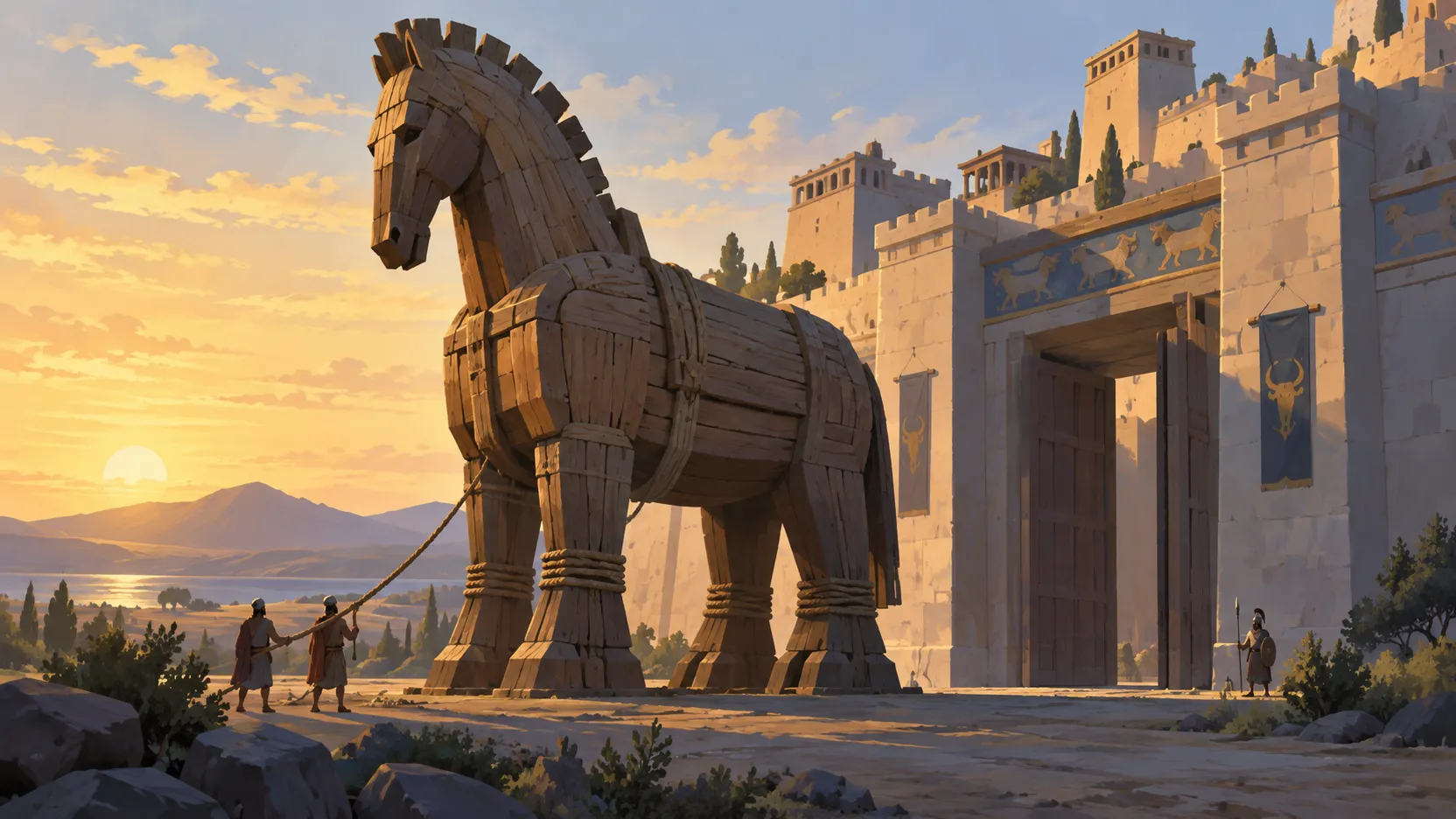
Odysseus put his hand against the inside of the horse.
The timber smelled newly cut. Beyond it, Epeus was working on the opening through which the men would enter. Each blow of his tool sounded larger in the hollow body.
“Can it be opened from here?” Odysseus asked.
Epeus showed him.
For ten years the Greeks had fought outside Troy. Achilles was dead; Hector was dead; Paris, who had brought Helen from Sparta and set the armies in motion, was dead too. The sacred image that had guarded the city had been stolen. Yet the walls still stood, and the Greeks still slept beside their ships.
Odysseus had proposed the horse. Epeus had built it from timber cut on Mount Ida: enormous, hollow, able to contain armed men.
Outside, men were coming to climb into it.
Some looked back at the sea before they entered. Once the opening was closed, they would have no way to fight unless the deception worked. The Trojans might burn the horse with them inside.
Odysseus watched each man find a place. Shields were turned so they would not knock against the wood. Spear points were kept clear of faces. Knees pressed against knees.
Then Epeus closed them in.
Light narrowed to a seam.
That night the rest of the army burned its shelters and sailed away. Sinon remained to signal the fleet’s return. The ships went only as far as Tenedos, out of sight from Troy.
On the horse, the Greeks had left a dedication to Athena for their voyage home.
What the City Wanted
At dawn, the first voices reached the men inside.
The Greek camp was empty. The ships were gone.
People approached cautiously, then in a crowd. Odysseus heard feet moving around the horse, hands striking its sides. He held one palm flat in the darkness: still.
Ropes tightened. The great body lurched.
A man beside him caught his breath as they tilted. Someone’s shield scraped the timber. Odysseus pressed his hand against it and held it steady until the noise outside covered the sound.
They were moving toward Troy.
The jolting seemed to last forever. Then it stopped, and the crowd gathered close again. Voices rose in argument.
“There are men inside!”
Cassandra.
Odysseus knew the name of Priam’s daughter, whose warnings the city would not heed. He listened as another voice supported her. Laocoon also urged the Trojans not to trust what the Greeks had left.
Someone called for fire.
In the dark, a hand found Odysseus’s wrist. He did not know whose it was. He could feel the pulse racing through the fingers.
Other voices protested. The horse was an offering to a goddess. The war was over; why bring divine anger upon the city now?
The argument moved around them, now close, now farther away. The men inside could do nothing to change it without betraying themselves.
At last the decision turned toward keeping the horse.
Soon afterward, cries came from the direction of the shore. Two serpents had crossed the sea and killed Laocoon’s sons. The fearful news passed through the city. But the horse remained, and no one opened it.
By evening the sounds outside had changed. Music reached the enclosed men. They heard cups, laughter, people calling to one another through streets freed, for one night, from the expectation of battle.
The hand let go of Odysseus’s wrist.
The Voice in the Dark
A woman stopped beside the horse.
She began to call the names of the men hidden within it.
Odysseus knew the speaker was Helen. But the voice she used was not always hers.
It became the voice of a wife waiting at home. Then another. A familiar tenderness came through the wood, carrying the sound of a room across the sea, a doorway, someone turning at a long-awaited step.
The men shifted.
One almost answered.
Odysseus caught Anticlus and held a hand over his mouth. The man struggled once, then felt the grip tighten and became still.
Helen called again.
No one replied.
At last her footsteps moved away. Odysseus kept his hand where it was until he could no longer hear them.
The feasting thinned. A last voice drifted across the square. Somewhere a door shut.
They waited longer.
Far outside the city, Sinon lit the beacon on Achilles’s grave. Across the dark water, the Greek ships began to return from Tenedos.
Odysseus reached for the opening.
Cool air entered the horse.
The Open Gate
Echion was the first to leap down. The fall killed him.
The others drew back from the opening. Odysseus lowered a rope, and they descended one by one, hands tight, feet searching for the ground.
The square was quiet.
They gathered beneath the horse, listened, and moved toward the gates. The men who had endured years of fighting outside now walked along the inner face of the wall.
The gate was opened.
The returning army came through.
Troy woke to Greeks in its streets.
Doors broke under blows. Men reached for weapons in rooms already filling with enemies. The shouting spread faster than anyone could discover where the attack had begun.
Priam took refuge at the altar of Zeus in his courtyard. Neoptolemus, Achilles’s son, found him there and killed him. The place of supplication did not protect the old king.
Menelaus killed Deiphobus and found Helen. He led her out toward the ships, past houses where fire was beginning to catch.
Aeneas lifted his father Anchises onto his shoulders and fled. The Greeks who saw the burden let him pass. Behind him, people were still running toward temples, seeking safety wherever a sacred doorway stood open.
Cassandra clung to Athena’s image. The Locrian Ajax tore her away and assaulted her in the sanctuary. Even the gods’ houses were violated in the taking of the city.
By morning, Troy was burning.
Beyond the Walls
Andromache was brought down to the shore.
Her husband Hector had died defending Troy. Now the Greeks took her son Astyanax from the city and cast him from the walls. Polyxena, Priam’s daughter, was killed as an offering at Achilles’s grave.
The surviving women were divided among the victors. Andromache was assigned to Neoptolemus, the son of the man who had killed her husband. Hecuba and Cassandra were taken to other ships.
There were people she could see but could no longer reach. Soldiers stood between the groups. A familiar voice called from farther down the beach, and she turned too late to find who had spoken.
At the gangway, she stopped.
Above the plain, smoke covered the roofs. Through it she could still make out part of the wall. She had watched Hector go through its gates; she had waited there for news, and once for his return.
A command came from the ship.
Andromache put her foot on the gangway. The wood moved beneath her weight. Behind her, another roof fell into the fire, and the sound reached the water after she had stepped aboard.