
The priestess spoke a name he had not brought with him.
“Heracles.”
He raised his head. In the dimness at Delphi, his hands lay open on his knees. They were the hands that had carried his children. When Hera had driven him out of his senses, they had killed them, and two of his brother’s children with them.
He had left Thebes. Thespius had purified him, but there was nowhere he could imagine setting down his sleeping mat. He had come to ask Apollo where he should live.
“In Tiryns,” the priestess said. “You will serve Eurystheus for twelve years. You will perform the ten labors he appoints.”
Eurystheus. Heracles looked down at his hands again.
The priestess spoke of immortality beyond the labors. He could scarcely hear that distant promise. Tiryns was a place he could reach. Service was something he could begin.
He stood, and went down the mountain.
The Lion of Nemea
The first arrow struck the lion’s flank and fell into the grass.
The beast turned its head.
Heracles had followed its tracks through deserted grazing land, past a sheepfold whose door hung from one hinge. Now the lion stood close enough for him to see the broken shaft beneath its belly. There was no wound.
He lowered his bow and took up his club.
The lion retreated before him into a cave. Heracles stopped at the entrance. A draft touched his face; somewhere beyond the darkness there was another way out. He climbed the slope, found the second mouth, and filled it with stones until the pale slit of daylight vanished.
Then he returned to the first entrance and went inside.
For a few steps he could see the ground. Then he could see nothing except the lion’s eyes.
It sprang.
His shoulder struck the wall. Hot breath swept his cheek. He let the club fall and caught the animal around the neck, pressing his face into the mane, keeping the jaws turned away. Its hind feet scraped for purchase. The cave filled with the sound of their struggle.
He tightened his arm.
The lion bore him down, and he held. Dust entered his mouth. His breath came in small, painful measures. He held until the claws ceased dragging against the stone.
When he came out, he had to sit awhile before he could lift it.
At Cleonae, the poor laborer Molorchus was preparing a sacrifice. Thirty days earlier, when Molorchus had welcomed him into his house, Heracles had asked him to wait: if he returned, they would sacrifice to Zeus the Savior; if he did not, Molorchus could make an offering for the dead.
The laborer saw the shape across his shoulders and stepped back from the altar.
“Not for me,” Heracles said.
Together they made the offering to Zeus.
But at Mycenae, Eurystheus recoiled from the dead lion. He ordered Heracles to bring no more trophies inside the city. From then on, the king’s herald Copreus would carry his commands outside the gates.
Heracles stood below the walls while the doors closed against him.
The next command was already being prepared.
The Hydra of Lerna
Iolaus held the horses well back from the marsh. His uncle had gone ahead with fire on his arrows, and now smoke drifted from the Hydra’s hiding place beside the springs.
Something vast moved beneath it.
Nine heads rose, one above the others. Heracles planted his feet. He struck the nearest head with his club, and where it fell, two more pushed into the light.
He struck again.
More mouths opened.
The Hydra coiled around his leg. He pulled, but the mud yielded under his other foot. Every blow made the air more crowded. He could no longer see the central head clearly through the snapping necks.
A great crab fastened on his foot.
He crushed it, twisted aside from a descending jaw, and shouted, “Iolaus!”
His nephew left the chariot. At the edge of the wood, fire caught in the dry branches; Iolaus came running with a burning brand.
“Here!” Heracles cried, striking another head away.
Iolaus thrust the fire against the place where it had grown. The neck writhed. Nothing rose from it.
They worked shoulder to shoulder. Heracles made an opening; Iolaus reached through it with the flame. Sparks fell into the marsh. Once a head snapped so close to Iolaus that Heracles had to drag him backward by his clothing.
At last only the middle head remained.
Heracles severed it, but its eyes stayed open. He buried it beside the road and rolled a heavy stone over the place. Under the rock, the deathless thing was hidden.
Before they left, he dipped his arrowheads in the Hydra’s poison. Iolaus watched him place each shaft carefully in the quiver.
At Mycenae, Copreus listened to the account and went inside. When he returned, he would not look at Iolaus.
“The king will not count this labor.”
“The Hydra is finished,” Heracles said.
“You had help.”
Heracles turned toward his nephew. There was a scorch mark across Iolaus’s sleeve, and the skin beneath it was red.
He could have died alone in that marsh.
“Then give me the next command.”
The Golden Hind
The hind stood between the trees, her golden antlers catching the morning light.
Heracles did not reach for his bow.
She belonged to Artemis. Eurystheus wanted her alive, and Heracles meant to take her without a wound. He moved one foot forward.
She vanished.
Through spring he followed her. Through summer he learned the places where she drank and found them empty when he arrived. Leaves browned, fell, and softened under rain. Sometimes he glimpsed the gold far up a hillside; sometimes he had nothing but a print in the mud.
A year passed before the chase brought them to the river Ladon.
The hind came down the bank, exhausted. Beyond the water the trees grew thick again. Heracles stood still and watched her gather herself to cross. His hand went to a clean arrow.
He shot, then ran.
She stumbled. He caught her before she could reach the current and knelt with her trembling weight against him. She was wounded, but alive.
He lifted her onto his shoulders and took the road through Arcadia.
Artemis met him there with Apollo beside her.
“Set her down.”
Heracles obeyed. The hind shifted weakly beneath his hands.
The goddess looked from the arrow wound to him. He had faced the lion at closer quarters without feeling so exposed.
“Eurystheus ordered me to bring her,” he said. “Alive. I have followed her for a year.”
“And now you carry my animal away.”
He told her of Delphi and the service laid upon him. He kept his hands on the hind to steady her; he did not reach for any weapon.
At last Artemis moved aside.
Heracles lifted the hind again, more carefully this time. He carried her onward with her breath warm against his neck, and brought her living to Mycenae.
The Boar in the Snow
On the road to Erymanthus, the centaur Pholus offered Heracles a place beside his fire.
There was meat, warmth, and shelter. Heracles asked for wine.
“The jar belongs to all the centaurs,” Pholus said.
Heracles urged him not to fear and opened it. The scent escaped into the evening.
Hooves sounded beyond the cave.
The centaurs came carrying rocks and uprooted firs. Heracles seized brands from the hearth to drive the first attackers back. When the others fled, he pursued them with his bow.
They crowded around Chiron for shelter.
Heracles loosed a shaft. It passed through an attacker and struck Chiron in the knee.
The bow fell against Heracles’s side.
He ran to him, drew out the arrow, and took the medicine Chiron put into his hands. He applied it and waited. Chiron’s fingers tightened on his arm.
The Hydra’s poison would not yield.
Heracles tried again. The wise centaur, who knew so many remedies, had no remedy for this. He could not heal, and his immortality would not let him die.
When Heracles returned to Pholus’s cave, his host was dead too. Pholus had examined one of the poisoned arrows; it had slipped and struck his foot.
The wine jar stood open.
Heracles buried him before he climbed toward the boar.
High on Erymanthus, he found the torn thicket where the beast lay. It burst out at his shout, tusks low, scattering earth. He sprang aside and drove it upward, away from the open slopes, toward the deep snow.
The boar plunged into the drift. It fought forward, sank, and fought again. Heracles followed until its rushes shortened and its heavy shoulders began to fail.
Then he cast the rope.
He bound the living animal and lifted it. Snow melted against his arms on the long descent. When he brought it to the gates of Mycenae, it was still struggling.
Copreus kept his distance.
Heracles waited for him to finish counting that one.
The Rivers of Elis
Augeas surveyed his cattle yard and smiled.
“One day?”
“One day,” Heracles said. “For a tenth of your cattle.”
The king agreed. He had herds beyond easy counting, and the filth lay thick across the yard. Heracles called the king’s son Phyleus to witness the bargain. He did not mention Eurystheus.
Then he went to look at the rivers.
The Alpheus and the Peneus flowed near each other. He followed their banks, studying the fall of the ground, then returned to the yard and began tearing an opening through its foundations.
Augeas watched him making damage instead of clearing dung.
Heracles broke another opening on the far side. After that he cut channels toward the rivers. The sun rose higher. Earth clung to his legs; stones rolled under his hands. He could feel the hours passing in the heat on his back.
At last he stood before the narrow bank that still held the water out.
He broke it.
The first stream curled around his ankles. Then the bank gave way, and he scrambled clear as the rivers entered the channels. Water struck the yard, spread, gathered force, and swept through the far opening in a dark, roaring flood.
By evening the ground was washed clean.
Augeas had learned whose command had brought Heracles there.
“I owe you nothing.”
“You made a bargain.”
“I made no such bargain.”
Before the men appointed to judge the dispute, Heracles called Phyleus. The young man stood in front of his father.
“I heard you promise,” he said.
Augeas rose before judgment could be given. He banished them both.
Heracles returned without cattle. At Mycenae, Copreus brought him another refusal: the cleaning would not count among the ten labors because he had undertaken it for payment.
He stood with dried river mud still on his sandals.
The king of Elis had refused to pay him. The king of Mycenae refused to count the work because he had asked to be paid.
Beyond the gate, neither king could see him close his hand and slowly open it again.
The Birds of Stymphalus
The wood beside the lake seemed to whisper even when there was no wind.
Heracles looked up. The branches were crowded with birds. Deeper in the leaves there were more, and behind those more again. An arrow could reach one, perhaps two; the rest would retreat into the cover of the trees.
He walked the shore, finding no place from which he could drive them out.
Athena came to him carrying bronze clappers made by Hephaestus.
She placed them in his hands.
He climbed the height above the lake. From there he could see the whole dark canopy. He raised the bronze and brought the pieces together.
The crash rolled over the water.
Leaves shook. A few birds lifted, then hundreds burst upward around them. He struck the clappers again, and the hidden flock broke into the open sky.
Heracles set down the bronze and took his bow.
Now he could see what he had been sent to face. His arrows rose among the wheeling wings. Birds fell toward the lake; others fled beyond it. The great moving shadow thinned until daylight lay on the water again.
He remained on the height, listening.
For the first time since his arrival, he could hear the reeds.
The Bull of Crete
Minos would give him no help.
“If you can master it,” the king said, “take it.”
The bull had come from the sea, sent by Poseidon. Minos had promised to sacrifice it, then kept the beautiful creature and offered another in its place. The god had made it savage.
Heracles found it in a field broken by its hooves.
It watched him approach. Its head lowered. For a moment nothing moved but the dust drifting past its legs.
Then it charged.
Heracles turned beside the horns and caught them. The force dragged him across the ground. His heels cut two furrows; he stumbled, recovered, and leaned his weight against the massive neck.
The bull shook him hard enough to blur the field before his eyes.
He could reach his knife. Instead he shifted his grip.
The animal drove forward again. This time Heracles went with it, then forced its head around, taking its balance. It fell to its knees, surged upward, and found him still holding on.
He stayed there until its strength ceased coming in great rushes and became a shudder beneath his hands.
He brought it across the sea and showed it to Eurystheus. Afterward it was released, to wander toward other lands.
Heracles watched the great head turn away. His palms had been rubbed raw against the horns. He flexed them while Copreus unfolded the next command.
The Mares of Diomedes
The mares struck the manger with their teeth.
Abderus stopped beside Heracles. These were no frightened animals waiting to be led out. Diomedes, king of the Bistones, kept horses that ate human flesh.
Heracles and his companions overpowered the guards. They brought the mares down toward the sea, holding the ropes wide so the animals could not crowd them.
Then armed men appeared behind them.
Diomedes had come for his horses.
“Keep them here,” Heracles told Abderus.
He put the ropes into the hands of the companion he loved and turned to meet the attack.
The fighting carried him away from the water. He could hear the mares screaming behind him, then the clash of weapons drowned them out. Diomedes pressed forward among his men. Heracles struck him down, and the Bistones broke and fled.
He came back calling Abderus’s name.
One rope trailed loose across the sand.
The mares had dragged Abderus down and killed him. Heracles knelt beside him. The men who had followed him stood silent, holding the animals away.
He had given Abderus the ropes himself.
Before he left that coast, he buried him. Beside the grave he founded a city and gave it the name Abdera.
Then he took up the ropes again.
At Mycenae, the mares were handed over. Eurystheus let them go; in time they wandered to Mount Olympus and were destroyed by wild beasts.
Heracles had no companion to bring back from the shore.
The Belt of Hippolyta
Hippolyta came to the ship without a weapon in her hand.
She wore the belt of Ares, the sign of her authority over the Amazons. Eurystheus’s daughter Admete wanted it, and her father had sent Heracles to fetch it.
The queen asked why he had come.
He told her.
She listened, looking at the ship and the men who had crossed the sea with him. Then she promised him the belt.
For a moment Heracles did not answer. He had come ready for another struggle. The object he had been ordered to obtain was within reach, freely offered.
On shore, Hera moved among the Amazons in the likeness of one of their own.
“The strangers are taking your queen,” she said.
Hands closed around spears. Riders mounted. The warning passed from mouth to mouth, and the beach shook with horses coming down to the ship.
Heracles turned at the sound.
Armed women were riding toward him. Behind him stood their queen. The gangway was narrow; his companions were reaching for their weapons.
He looked at Hippolyta and saw a trap.
She turned toward the riders.
He struck before she could stop what was coming.
Hippolyta fell dead. Heracles took the belt, fought through the attack with his companions, and got the ship away from the shore.
Only when the oars had carried them beyond pursuit did he loosen his grip on the trophy.
She had promised to give it to him.
The belt lay across his knees as the ship moved over the water. No one aboard reached for it.
The Cattle Beyond the Ocean
The road west carried Heracles to the boundaries of Europe and Libya. There he raised two pillars facing one another, marks of how far he had come.
Beyond lay Ocean, and beyond Ocean the red cattle of Geryon.
The sun beat on his head. The rock underfoot threw the heat back at him. At last he stopped, drew his bow, and aimed upward at Helios.
The Sun saw him standing there with the string drawn against a god, and admired his audacity. He lent him a golden cup in which to cross the waters.
Heracles lowered the bow.
The vessel bore him over Ocean to Erythia. There, on the slopes of Mount Abas, the two-headed hound Orthus found him.
Both mouths opened as the dog charged.
Heracles met it with his club. When the herdsman Eurytion came to its aid, Heracles killed him too. He gathered the red cattle and drove them toward the river Anthemus.
Hooves splashed into the shallows.
Then Geryon stood across his path.
Three bodies rose joined together, threefold strength advancing on the narrow crossing. The cattle crowded backward against Heracles. He pushed between them, found a little clear ground, and drew his bow.
Geryon came on.
Heracles loosed. He reached for another arrow as the giant staggered; the battle ended beside the river, and Geryon did not rise.
Getting the cattle into the golden cup took patience no enemy had required of him. They balked, turned, and followed one another in the wrong direction. At last the last red flank passed aboard.
He crossed to the mainland and returned the cup to Helios.
The journey home stretched through distant lands. He guarded the herd against thieves and pursued a bull that escaped across the sea to Sicily. Even when those trials were past, Hera sent a gadfly among the cattle.
The herd scattered into the foothills of Thrace.
Heracles ran after them. Again he had to climb, search, and turn back. Some he gathered; others escaped to live wild in the hills. Angered by the river Strymon, which hindered his work, he filled its channel with stones until vessels could no longer pass.
At last the cattle stood outside Mycenae.
Eurystheus took them.
Ten labors had been performed. Heracles waited below the walls.
Copreus came through the gate.
“The golden apples of the Hesperides.”
Heracles did not move.
“The Hydra does not count,” the herald said. “Nor the cattle yard of Augeas.”
For a while there was only the sound of cattle being led away within the walls.
“Where are the apples?” Heracles asked.
Behind the walls, the king prepared to sacrifice the cattle to Hera.
The Weight of the Sky
Finding the garden meant finding someone who knew the road.
Nymphs led Heracles to Nereus, the old sea god. He caught him sleeping and held him as the shape in his arms changed. No shape could make him let go. At last Nereus told him where the apples were.
The road took him through more countries and dangers, until he reached the Caucasus and saw an eagle descend toward a figure bound to the rock.
Heracles set an arrow to the string.
The eagle fell.
On the mountain, Prometheus lifted his head. Heracles broke his bonds. Chiron, whose poisoned wound no medicine could heal, consented to surrender his immortal life in his place, and Heracles brought that exchange before Zeus.
The suffering centaur could at last die.
Before Heracles continued his journey, Prometheus gave him counsel.
“Let Atlas fetch the apples. Take the heavens from him while he goes. And be careful when he returns.”
Heracles listened until he understood both the errand and the means of escaping its danger.
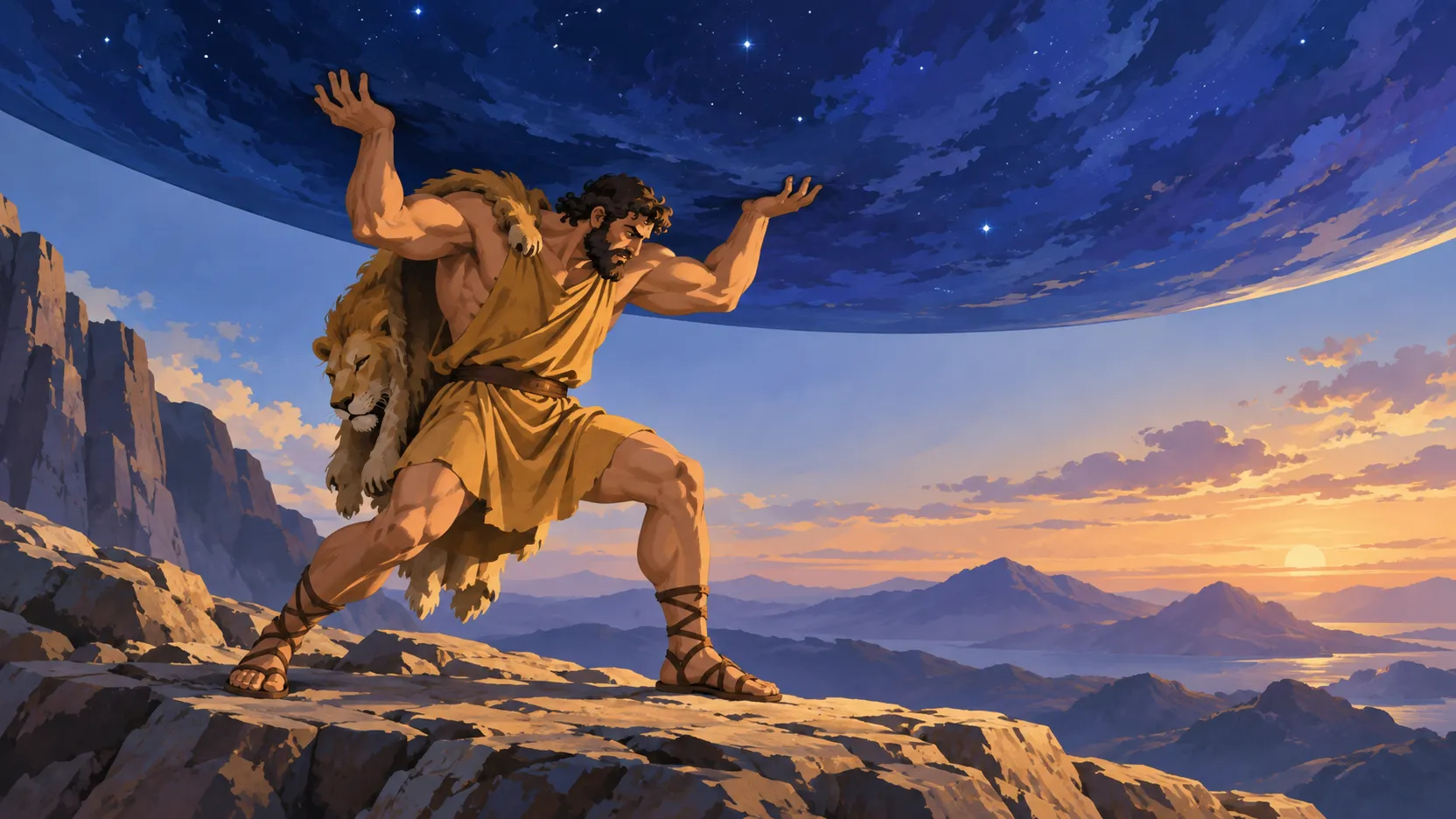
In the land of the Hyperboreans he found Atlas beneath the sky.
The Titan could turn his eyes toward him, but little else. Above his bowed shoulders the heavens stretched beyond sight.
Heracles told him what he wanted.
Atlas looked at the space beside his feet.
“Come here.”
Heracles stepped beneath the burden.
At first it seemed merely heavy. He had lifted stones, dead lions, living beasts. He braced himself as he had braced himself against the bull.
Then Atlas withdrew.
The whole weight settled.
Heracles’s knees bent. The breath stopped in his chest. He forced one foot farther out and caught the balance just before it was lost. His shoulders burned. Above him, beyond the weight, the sky remained terribly still.
Atlas straightened.
He stretched his hands, slowly, as though discovering what hands could do when they were empty. Then he walked away.
Heracles could not turn his head to watch him go.
There was no battle to hurry through. He had to stand. When his knee trembled, he steadied it; when breath became possible, he took a little. He could not wipe the sweat from his eyes.
Atlas returned carrying three golden apples.
“I will take these to Eurystheus myself,” he said.
Heracles heard the pleasure in his voice. The Titan made no movement toward the place beneath the sky.
“Very well,” Heracles managed.
Atlas shifted the apples into one hand.
“But take it for a moment first. Let me put a pad beneath it.”
He could scarcely get the words out. That helped: there was nothing feigned about his pain.
Atlas laid the apples on the ground and stooped beside him. The weight began to move. Heracles waited until it had settled securely on the Titan’s shoulders.
Then he stepped free.
His arms hung useless for a moment. Air entered his lungs so sharply that he coughed. At his feet the three apples shone against the bare earth.
He bent and picked them up.
Atlas watched him leave.
At Mycenae, Eurystheus received the fruit and gave it back. Athena took the apples from Heracles to restore them to their sacred place. They could not remain among men.
Heracles’s hands were empty when Copreus brought the last command.
This time the king wanted the hound that guarded the dead.
The Hound of Hades
At Eleusis, Heracles sought purification for the killing of the centaurs and was admitted to the mysteries. Then he went to Taenarum, where the way into the earth stood open.
He descended while the light behind him narrowed.
The dead fled from the living weight of his footsteps. When the shape of Medusa confronted him, he drew his sword.
Hermes checked him.
“A shade.”
Heracles looked again. There was nothing his blade could kill.
Near the gates he found Theseus and Pirithous held fast. They reached toward him. He clasped Theseus’s hand and pulled him free, but when he tried to lift Pirithous, the earth shook beneath them.
He stopped.
The ground trembled again, deeper this time. Heracles let go.
Farther within, before the ruler of that country, he asked for Cerberus.
Hades gave him permission on one condition: he must master the hound without using the weapons he carried.
Heracles laid them aside.
At the gates of Acheron, Cerberus waited. Three heads turned toward the approaching man. Serpents stirred along his back, and his tail moved with a life of its own.
Heracles still wore his armor and the lion skin. He drew the hide close and stepped nearer.
The first growl seemed to come from the ground. The others joined it.
He had come through the whole world to reach this gate. Behind him were weapons he could not use; before him was a creature he had to bring back alive.
Cerberus sprang.
Heracles caught him high around the necks. The impact drove him backward. One jaw snapped against the lion hide, another thrust toward his face. He turned his head away and pulled the struggling weight close, denying the hound room to strike again.
Claws dragged across the stone.
The serpent tail whipped around and bit him.
His grip loosened for an instant. Cerberus heaved, and Heracles felt the strength gathering for another leap.
He locked his hands.
Pain climbed his side. He could not strike at the tail without releasing the necks. He pressed his cheek against the rough hide over his shoulder and held on.
The hound dragged him sideways. He found his footing, lost it, and found it again. All three heads struggled against him. His arms shook as they had beneath the heavens, but this burden fought to tear itself free.
He held.
At last the wrenching became less violent. The jaws closed. Cerberus stood rigid within his arms, breathing in three harsh rhythms.
Heracles waited until he could loosen his grip without losing the hound.
Then he began the ascent.
Through Troezen he brought Cerberus into the upper world. Daylight fell on the three heads. The creature shrank from it, and Heracles steadied his hold before taking the road to Mycenae.
At the gates, Copreus stopped so abruptly that dust rose around his feet.
“Tell him,” Heracles said.
The herald disappeared inside.
Eurystheus saw the hound. The last command had been fulfilled.
Heracles did not keep Cerberus in the sunlight. He took him down again, along the road into the earth, until the gates of Hades stood before them.
There he released his hold.
The hound moved away. Three heads turned once toward him, then settled to their watch.
Heracles climbed back alone. No trophy dragged at his shoulder. His weapons were his to carry, his hands his to open. Far above, a pale patch widened between the rocks.
He stepped into the light.