
The smoke from the funeral fires drifted through the assembly.
Achilles stood where every man could see him. Beyond the ring of soldiers, the ships lay drawn up on the shore. Behind them waited Troy, still unconquered after nine years of fighting.
The Greeks had crossed the sea to recover Helen from Paris. They had landed under spears, lost their first man on the beach, and fought their way inland. Since then they had raided the surrounding towns, taken captives, buried friends, and watched the seasons pass beneath the same high walls.
Now men were dying without going near those walls.
“Speak,” Achilles told Calchas. “I will protect you.”
The seer glanced at Agamemnon, commander of the army.
“Apollo demands the return of Chryseis.”
Her father, a priest of the god, had come with ransom. Agamemnon had driven him away. The priest had prayed, and Apollo’s plague had entered the camp.
Agamemnon rose.
“Then she goes back. But I will not be the only king left without his share.”
Achilles looked at the smoke. “There is no common store to divide. Give her back now. When Troy falls, the army can repay you.”
“When Troy falls?” Agamemnon stepped toward him. “You keep what you were given while I surrender mine?”
The men nearest them shifted uneasily.
“I will take Briseis,” Agamemnon said. “From your shelter.”
Achilles’s hand closed on his sword. Briseis had been taken when her city fell, and awarded to him by the army. Now Agamemnon meant to take her again, before everyone, to show which man must yield.
The blade had begun to leave its sheath when a hand caught Achilles by the hair.
Athena stood behind him. No one else in the assembly could see her.
“Put it away.”
He stared into her terrible bright eyes. His fingers trembled on the hilt. Then he thrust the sword home.
“You will need me,” he told Agamemnon. “And I will remember this.”
He walked out through the circle of men.
Chryseis returned to her father, and the plague ended. Two heralds came for Briseis. Achilles let them take her; she followed them unwillingly along the shore. He would not fight again for Agamemnon.
At the water’s edge he called to his mother, Thetis. He asked her to obtain from Zeus what the Greek commander denied him: proof that the army could not prevail without Achilles.
Thetis carried his plea to Zeus.
The Borrowed Armor
Patroclus came back from the wounded with their voices still in his ears.
He had seen men who could scarcely lift a cup trying to rise at the sound of battle. The Trojans had forced the Greeks behind their defenses. Hector, son of Troy’s king, was driving them toward the ships.
Achilles watched his friend approach.
“What is it?”
Patroclus tried to answer, but anger and pity caught together in his throat.
“They are dying there.”
Achilles said nothing.
“Diomedes is wounded. Odysseus too. The men who can still stand are holding the ships.”
A shout rose beyond the shelters. Patroclus turned toward it, then back.
“If you will not go, let me.”
Achilles looked at him sharply.
“Give me your armor. Let the Myrmidons follow me. When the Trojans see your helmet, they may draw back. We only need room to breathe.”
For a little while the two men listened to the fighting.
Then smoke rose from a ship.
Achilles stood.
“Drive them from the fleet,” he said. “When the ships are safe, come back.”
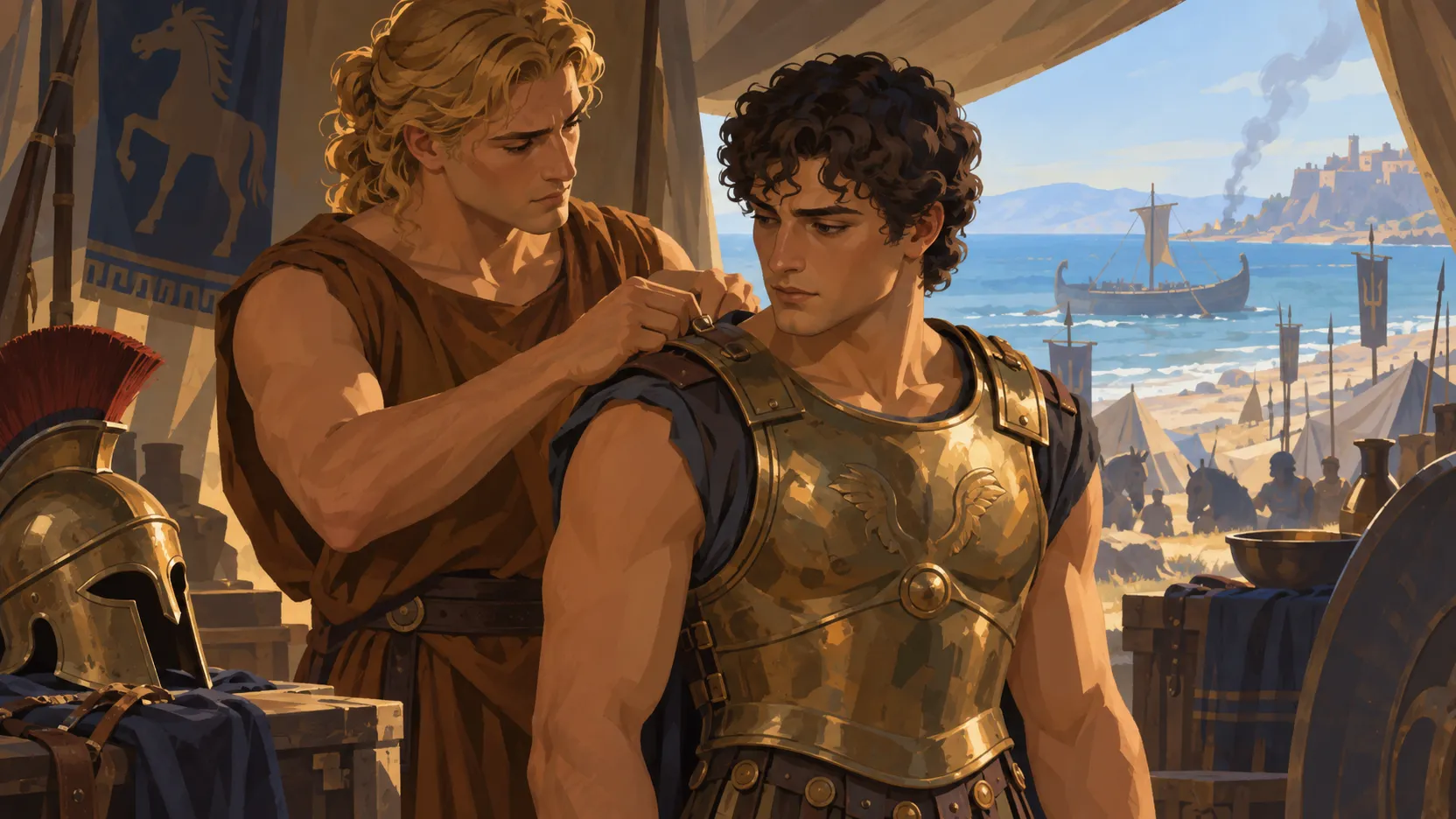
Patroclus reached for the armor.
“Listen to me.” Achilles caught his arm. “Do not chase them to Troy. Even if they run. Come back.”
Patroclus nodded.
The straps were familiar; he had seen Achilles fasten them countless times. Now Achilles helped settle the armor on his shoulders. He took a spear he could wield, leaving Achilles’s great ash spear behind, and climbed beside Automedon in the chariot.
The Myrmidons were ready. Their stillness broke into a shout when they saw him.
Achilles watched them go. Then he poured a libation and prayed that his friend would save the ships and return unharmed.
Beyond the Ships
The Trojans saw the helmet first.
A cry traveled through their ranks. Achilles had returned.
Patroclus struck into the battle while they were still turning. Men who had been defending the ships came forward behind him. The fire was beaten out. The Trojans fell back across the ground they had fought so hard to gain.
He could have turned then.
But ahead of him the enemy was running, and each stretch of open ground seemed to offer the end of the danger. He urged Automedon onward.
Sarpedon, the Lycian king and son of Zeus, stood against him. Their spears crossed. Sarpedon fell, and the fighting closed around his body. Patroclus pressed on when the struggle was won. The distant walls had grown large enough for him to see men moving upon them.
At Troy, Apollo barred his way.
Patroclus felt a force against his shield that no human arm could have given. Again he tried to advance; again he was driven back. The god’s warning rang above him: the city was not his to take.
He drew away from the wall, but the battle had him now. Hector was coming. Men crowded between them, then scattered.
Patroclus charged once more.
A blow struck his shoulders from behind. He had seen no one approach. His helmet rang against the ground. His spear broke; the shield slipped from him. Apollo had stripped the borrowed strength away.
Patroclus stood dazed in the dust.
Euphorbus wounded him and withdrew. Patroclus tried to reach his own men. He could hear them calling, but the space between their shields would not come nearer.
Hector met him before he reached it.
The spear struck. Patroclus fell.
Hector stood above him, speaking of the city he had saved. Patroclus heard only part of it. He forced out a warning: Achilles would come for Hector, and soon.
Then his voice stopped.
The Empty Place
Antilochus found Achilles beside the ships.
Achilles knew from the young man’s face before he could bear to know it from his words.
“Patroclus is dead. Hector has the armor.”
Achilles sank to the ground. He gathered dust in both hands and poured it over his head. Antilochus knelt beside him and held his hands while the cry went out across the shore.
Thetis heard it under the sea.
When she came, Achilles could scarcely speak. His wish had been granted: the Greeks had learned how badly they needed him. Patroclus had paid for it.
“I was here,” he said. “He was there, and I stayed here.”
Thetis touched his head.
“Hector will die,” Achilles said.
“Your own death will follow his.”
He raised his face to her. She was waiting for him to turn from it, to choose the ships and the voyage home.
“I could not save him.”
Thetis bowed her head. She could bring her son new armor from Hephaestus. She could not bring back the friend who had worn the old.
Achilles looked toward the place where Patroclus had stood while he fastened the straps. Then he rose to meet the men carrying him home.