
Arachne was choosing a thread the color of deep water when someone behind her said that Athena must have taught her hands.
The thread stopped between her fingers.
Women had come from neighboring towns to watch her work. Nymphs had left the vineyards of Mount Tmolus and the gold-bearing river to stand in her little workshop at Hypaepa. They crowded close enough to shade the loom. Arachne had scarcely room to move her elbow, yet until that moment she had been glad of every one of them.
“My hands are here,” she said. “You can watch them.”
A few of the women smiled. The nymph who had spoken did not.
Arachne drew the blue strand through the waiting threads and pressed it into place. Her father dyed wool for a living; purple stained his fingers no matter how often he washed them. There had been no fine name to bring people to his daughter’s door. They came for the cloth.
“Let Athena bring her loom,” Arachne said. “If she can weave better than I can, she may choose my punishment.”
The visitors fell quiet. In that silence, a stick tapped against the threshold.
An old woman stood in the doorway, bent beneath a faded shawl. Arachne had not seen her cross the yard. The woman leaned on her stick and looked past the watchers to the loom.
“You have skill enough to win praise from anyone living,” she said. “Be content with that.”
Arachne reached for another thread.
“Age has taught me something,” the stranger continued. “A mortal may be the finest among mortals. Leave the goddess her honor. Ask pardon for what you have said.”
“Have you come to buy cloth?”
“I have come to give you good advice.”
“Then give it to someone who asked for it.” Arachne turned on her stool. “Why must I ask pardon before she has even tried? If your goddess objects, let her come herself.”
The old woman straightened.
The shawl fell from shoulders that were no longer bowed. The hand around the stick became a strong, unlined hand; the gray hair darkened, and the worn face beneath it grew terrible in its composure. Arachne heard cloth rustle behind her as the women sank to their knees. The nymphs lowered their heads.
Athena stood inside the door.
Heat rushed into Arachne’s cheeks. She looked down at the thread caught around her finger, at the little red mark it had made. For a moment she could think of nothing to say. She could kneel with the others. There was still space on the floor.
Instead she unwound the thread.
“There is room for another loom,” she said.
Athena looked at her for a long moment. Then she set aside the last remnant of her disguise.
They stretched their warps and made ready.
Arachne fastened her loose clothing out of the way. Across from her, the goddess did the same. Their threads hung straight from the beams; the shuttles lay ready to carry color between them. For the first time since the stranger’s arrival, Arachne felt something familiar beneath her hands.
She tested the tension. Too loose, and the figures would wander out of shape. Too tight, and the finished cloth would draw together. She adjusted one strand, then another. When she was satisfied, she looked across the room.
Athena was already weaving.
Arachne began.
The two looms answered each other, wood against wood. Purple passed into rose, rose into a color so pale it seemed to have gathered the light from the wall. Fine gold ran among the wool. Arachne leaned forward, forgetting the women at the door, forgetting even the fear that had made her palms damp. She knew where each strand must go.
Then she glanced at the other loom.
A city was rising in Athena’s cloth. Above it sat the gods, each so distinct that Arachne recognized them before the faces were complete. Zeus held the central place. Below their thrones, Athena had woven herself in helmet and armor, setting her spear into the earth. Beside her grew the olive that had won her the city of Athens.
The leaves were exquisite. Their undersides shone pale as they would when a wind moved through a living tree.
Arachne’s shuttle slowed.
At the corners of the goddess’s work, smaller figures were taking shape. A king and queen who had claimed the names of gods became mountains. A queen’s outstretched arms opened into the wings of a crane. Another woman stood half lost beneath white feathers. In the last corner a father bent over cold stone where his daughters had been.
Arachne looked up. Athena was watching her across the threads.
The room seemed smaller than it had before.
Arachne turned back to her own loom and picked up the blue.
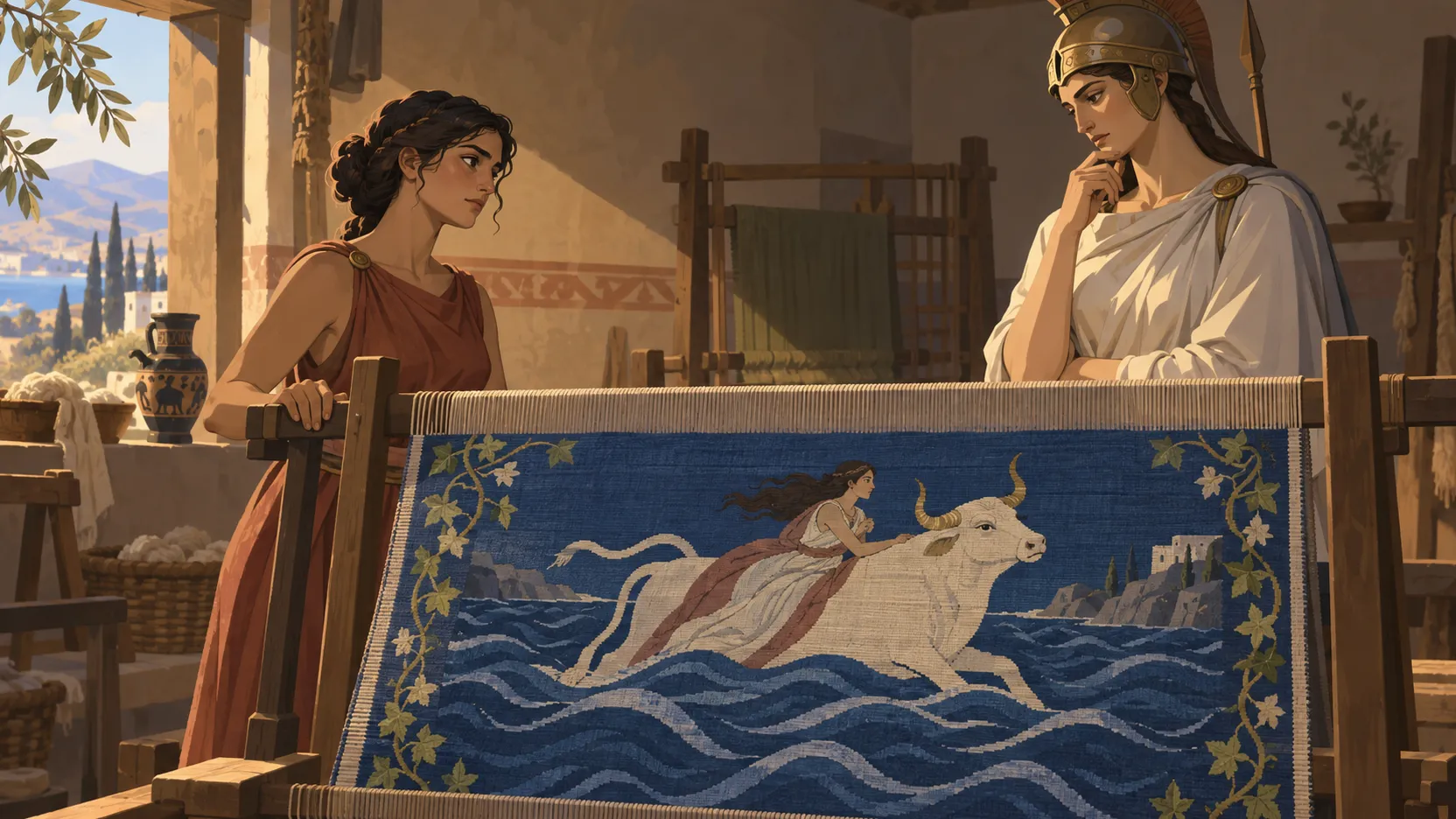
She wove the sea.
Along its edge stood a distant shore, with small figures reaching toward a girl who could no longer reach them. The girl was Europa, carried out over the water on the back of a white bull. Her fingers gripped a horn. Her feet drew away from the spray. Arachne worked the turn of her head carefully, until the girl seemed to be looking back at something she would never see again.
The bull was Zeus.
Arachne chose a darker strand for the water beneath him.
Elsewhere in the cloth, an eagle stooped upon Asteria. A swan spread its white wings beside Leda. Gold fell into Danae’s chamber. She wove gods hidden in the shapes of animals, gods wearing borrowed faces, and women who had trusted what they saw. Each had her own face. Each stood in her own country, beside a particular tree or river or stretch of shore.
The watchers moved nearer. No one spoke now of who had taught her.
Across the room, Athena surrounded her work with olive branches.
Arachne made a border of ivy and flowers. She joined the last curling stem to the first and ran her fingers along the edge. The tension held. Europa’s little hand still reached backward; the white bull still carried her away.
She set down her shuttle.
The sudden quiet made her hear the ache in her shoulders as a pulse. A strip of sunlight had crossed the floor while they worked. It lay now between the two looms.
Athena rose.
Arachne stood beside her tapestry, holding her hands still so that no one would see them tremble. She watched the goddess examine the border, the changing colors of the sea, the frightened girl upon the bull. There was no misplaced thread to hide. The figures lived in the cloth as Arachne had meant them to live.
Athena moved closer.
Arachne waited for her to point to something: a clumsy join, an uneven edge, a hand that did not belong to its arm. She could have answered that. She could have bent to the place and looked.
The goddess found nothing.
“Tell me where it fails,” Arachne said.
Athena took hold of the cloth.
At first Arachne thought she meant to lift it to the light. Then came the sound of tearing.
It was louder than either loom had been.
The sea split. Europa’s face crumpled in the goddess’s fist. Arachne reached for the falling cloth, but Athena tore it again, wrenching the woven figures apart. Flowers and fragments of white wool dropped at their feet.
“Stop.”
Athena snatched up the boxwood shuttle and struck her. Arachne raised an arm. The blows came again, brief and hard, before the goddess let her go.
The watchers had drawn back against the wall.
Arachne knelt among the pieces. She lifted a scrap with a blue edge and tried to fit it to another. The threads would not meet. A little of the ivy border lay across her knee. She had known exactly where that leaf belonged.
No one came forward.
Overwhelmed by the ruin and the public shame, Arachne tried to end her life by hanging herself.
Athena caught and supported her before she died.
For an instant Arachne felt the goddess’s hand holding her weight. She could draw breath again. Beyond Athena’s shoulder stood the loom, bare in places where the cloth had been torn away.
“You will live,” the goddess said. “But you will hang. And those born from you will hang after you.”
She sprinkled Arachne with the juice of Hecate’s herbs.
The hand beneath Arachne seemed to widen. The floor fell away; the loom beams towered above her. She tried to speak, but her voice was gone. Her body drew into a small dark shape, and slender legs reached for a hold where her fingers had been.
Athena withdrew her hand.
A thread held.
The spider hung above the scraps of colored wool. A breath of air turned her, bringing the empty loom into reach. She caught the timber with one delicate foot, climbed, and drew a new strand after her.
Between the bare beams, the first line shone.