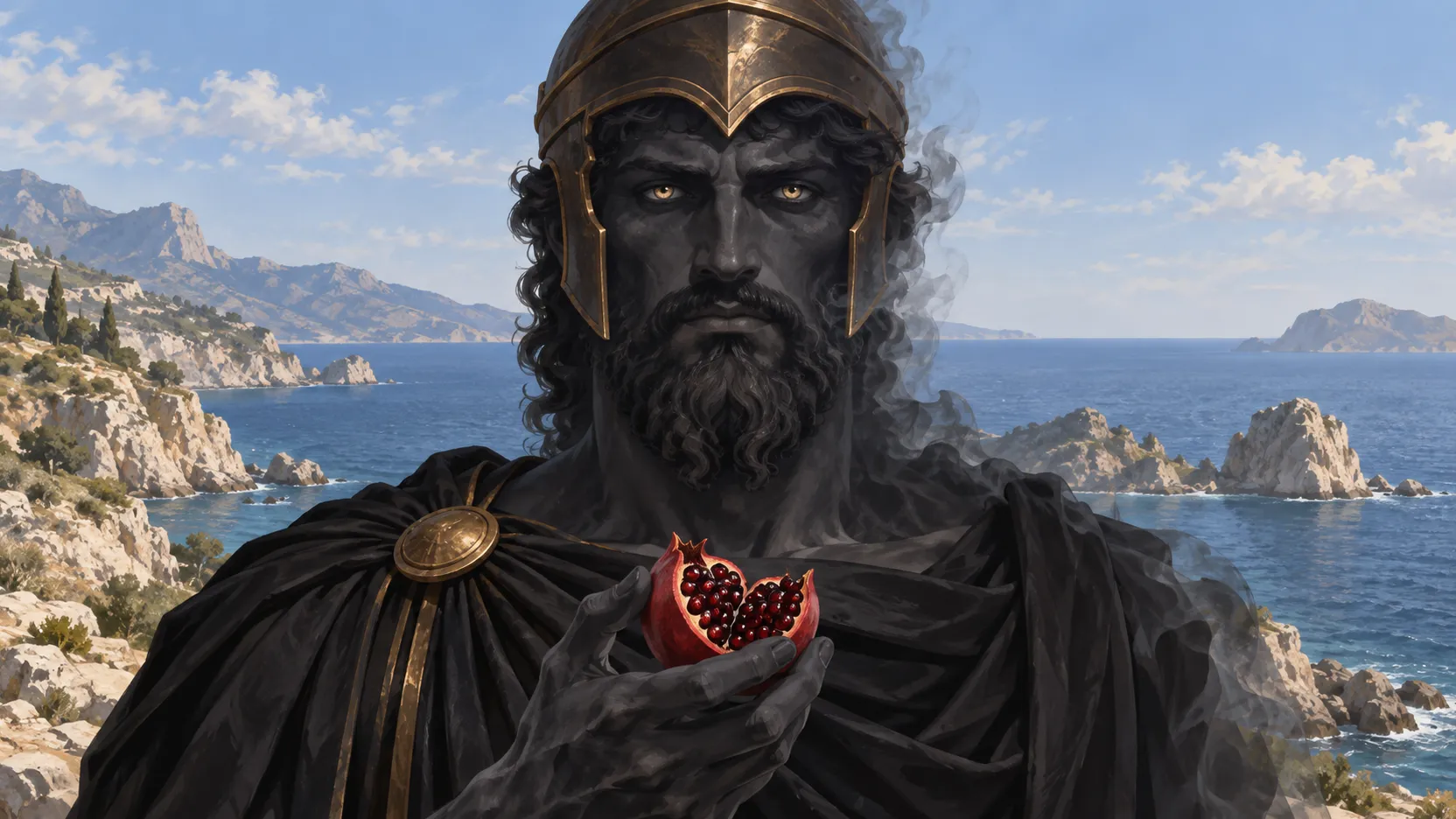
The Unguarded Road
The woman slipped past Hades while he was watching his dog climb toward the daylight.
She moved quickly, gathering a skirt that no longer brushed the stones. Ahead of her, Heracles had both arms locked around Cerberus. Three muzzles strained uphill. The serpent of a tail struck at his greaves, and the scrape of bronze against rock came down the passage in sharp, diminishing bursts.
Hades set his sceptre across the woman’s path.
She stopped so suddenly that her hands went forward as though to save a tray of falling cups.
“Wait,” she said. “Please. I can smell the fires.”
A thin draught came down the road. Woodsmoke, sun-warmed dust, something green crushed under a sandal. Cerberus had never let the dead stand here long enough to notice such things.
“You are going the wrong way.”
“No. Mine is the last house before the olive press.” She pointed past the sceptre, impatient with the mistake. “There is a fig tree against the wall. The branches have to be tied back or you cannot get a cart through.”
Hades said nothing.
Her pointing hand sank. She looked at it, turned it over, and pressed a thumb into her palm. The thumb met no resistance.
Above them, one of the hound’s heads barked. Heracles shouted something. Then both sounds were gone.
The woman took another step.
Hades did not move the sceptre.
“He has gone out.”
“He came here alive.”
“The dog, then.”
“The dog is coming back.”
“So will I.”
She offered it promptly, like a tradeswoman agreeing to return a borrowed measure. Hades had given Heracles leave to take the hound if he could master it without his weapons. The man had done so. The bargain was fulfilled; only the empty place at the gate remained.
“Before dark,” she added.
For the dead behind her there was no dusk to wait for. They had begun to gather where the passage widened, drawn by the sounds of the struggle. Hades could distinguish a sailor with a split lip, two grey-haired women holding hands, a youth still trying to stand without favouring a leg he no longer possessed in flesh.
The woman followed his glance.
“I need only a little time.”
“What for?”
“The kiln.”
She said it with such relief that he understood she had been waiting for a question she could answer.
The Last Firing
Her son had never opened the kiln alone. There were jars inside it, thirty-seven of them, and a row of small bowls along the top. She had promised him that he could lift out the first bowl this time.
“He rushes things,” she said. “He will see the fire has died and pull away the bricks. He will burn his hands.”
Hades looked at hers. A pale rim of clay remained under one thumbnail. She saw him looking and folded her fingers inward.
“How old?”
“Twelve.” She corrected herself. “Thirteen after the harvest.”
There were more shades at the foot of the road now. They stood without breathing. Far above, the daylight lay across a shelf of rock no wider than a doorstep.
“I could send word,” Hades said.
“To whom?”
“Hermes goes among the living.”
“Will he know our house?”
“You have described it.”
“And will he open the kiln? Will he tell the boy which jars have cracked by tapping them? There is one with a handle I put on badly. He mustn’t lift it by that handle.”
“Someone else can help him.”
Her face changed. Until then she had been afraid of losing an hour. Now she understood how much the god was asking her to leave unfinished.
“There is no someone else in that house.”
A man at the back began to call out directions to his own home. Another voice broke across his. The sailor wanted a debt repaid. One of the old women wanted a word carried to her sister. Names of villages passed from mouth to mouth; fields, wells, a house with a red door. They pressed closer, each trying to be heard before the god departed.
The potter turned on them.
“I was speaking.”
They quieted. She faced Hades again, keeping the others behind her as firmly as if she had shut a workshop door.
“Not a message. Let me go myself.”
He lowered his sceptre until its end rested against the rock.
“You cannot turn a latch with those hands.”
“Give me hands that can.”
The request stood between them. She had stopped pretending to have lost her way.
Hades could have passed out of her sight. His helm lay against his hip, hanging from its strap. He had only to put it on. The road would still close at his command; the woman would have darkness to accuse instead of a face.
He caught the strap in his fingers.
She noticed.
“Your wife goes back.”
His hand tightened.
“Persephone is a goddess.”
“And has a mother waiting.”
No one behind her spoke. Hades could hear the river moving through its channel beneath the stone.
He remembered Persephone at the chariot, already turned toward the upper world. He had offered her honours in his house. She had been listening for the horses.
“This road will close,” he said.
The woman looked past him at the small bright shelf.
The Threshold
She ran.
Hades stepped into the passage, but she flung herself sideways, trying to squeeze between his body and the wall. Her shoulder passed into the rock. She pulled it free and reached beyond him with both hands.
The shades surged after her.
It was not an army. There were no weapons, no lifted fists. They came with their hands out, the lame youth pushing forward among the old, the sailor calling a name that broke apart as he repeated it. Each had seen one woman move toward home.
Hades struck the threshold with the foot of his sceptre.
A deep note travelled through the stone. High in the passage, two slabs began to turn inward. Dust sifted from their edges into the daylight. The crowd stopped.
The woman was still reaching around him.
“Move.”
He held his place.
“Move!”
Her fingers caught at the fastening of his cloak. They slid through it. She tried again, then pushed both palms against his chest with all the strength of a body she had lost.
The slabs ground closer. The strip of daylight narrowed.
Hades let go of the helm’s strap.
He bent until she could look directly into his face.
“No,” he said.
She struck him. Her hand passed through his cheek, and the force of the useless blow carried her to her knees.
He did not look away.
Beyond the closing stone a bird called twice. She lifted her head at the sound. For a moment her mouth moved, shaping something he could not hear. Then the slabs met, and the draught ceased.
The potter stayed on her knees.
Behind her, someone began to weep. The sailor turned first, making his way back through the gathering. Others followed him. The youth lingered until one of the old women took his arm. Their footsteps made no sound.
Hades stood with the sceptre in his hand and the unused helm against his thigh.
“You could have,” the woman said.
He gave her no answer that would make her thank him.
At the Gate
She sat beside the road after the others had gone. From time to time her fingers moved, turning an invisible bowl, smoothing a rim. Once she held it out as if someone small were standing before her. Then her hands fell into her lap.
Hades rested his sceptre against the wall.
“What is your name?”
She looked up at him with naked hatred.
He waited.
“Thaleia.”
He repeated it.
“That won’t open anything.”
“No.”
She turned her face away. He sat on the opposite side of the passage. Between them lay the marks Cerberus had worn into the threshold with his claws.
They were still there when Heracles brought the hound back.
The stone opened to a noise of panting and scraping. Cerberus came down awkwardly, hauling the hero after him for the last few paces. There was dry grass caught in his coat. Heracles released his grip and leaned against the wall, too spent to speak.
Hades rose. He took hold of the hound beneath its central jaw and ran his other hand down its neck. Cerberus pushed hard against him, then shook itself so violently that the grass scattered over the stone.
One pale seed came to rest beside Thaleia’s foot.
She put out her hand. It passed through the seed.
Cerberus turned a head toward her. She held still. The hound sniffed the place where her fingers lay, circled once, and folded its great body across the entrance. One muzzle settled beside her knee. The other two watched the ascending road.
Heracles looked from the woman to Hades. The god lifted his sceptre, leaving room for the living man to pass.
When the passage had closed again, Hades returned to his place against the wall. Thaleia was looking at the seed. He set his helm on the stone beside him and stayed.