
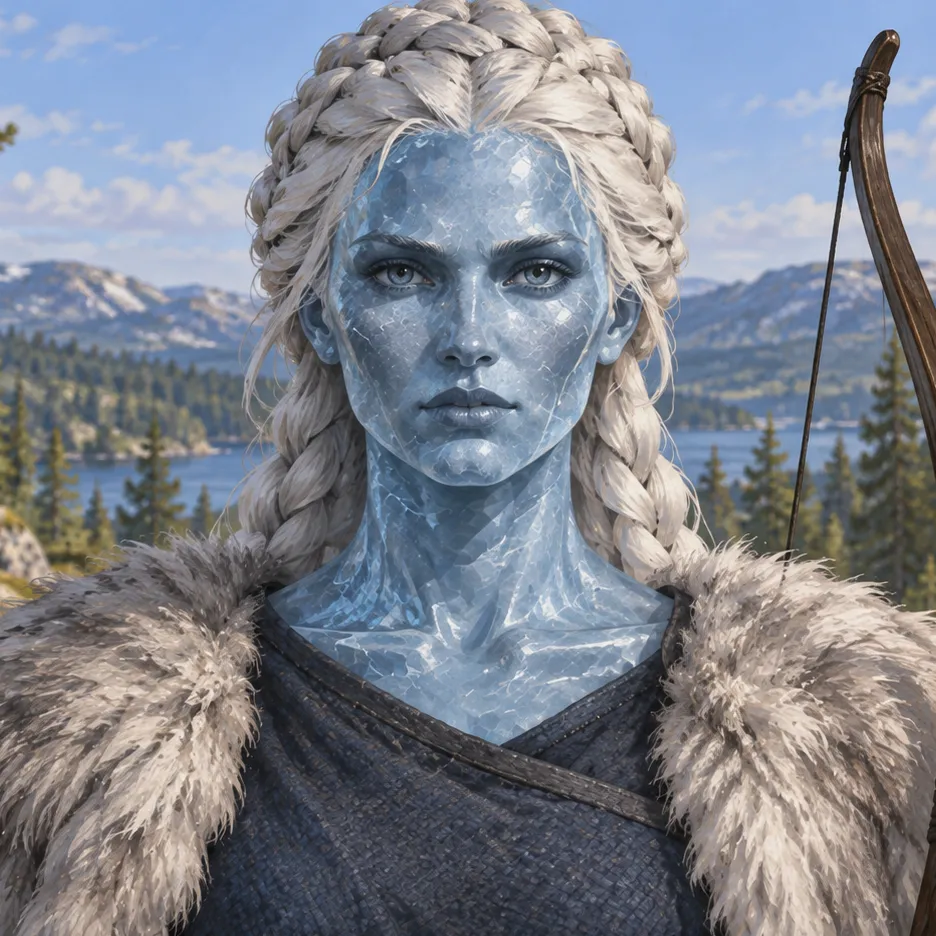
The Price of a Father
Skadi found a burnt feather between the paving stones and put her foot over it before anyone could see her looking.
Across the courtyard, Thor stopped with one hand on his hammer. The others spread out behind him. They had been coming to meet a traveler. Now they were counting the distance to her bow.
She had an arrow on the string.
“Which of you?” she asked.
Nobody answered at once. Smoke had blackened the wall beside the gate. Her father had struck there, or fallen there, or tried to rise there. She kept her eyes above it.
Loki stood near the door of the hall. He had no weapon in his hands.
“You,” she said.
“He was chasing me.”
“Then you can stand still now.”
She drew until the string touched her cheek. Thor took a step, and she shifted the arrow toward him without lowering it. The gods stopped spreading out.
Odin came through them. He looked first at the bow, then at the helmet under which she had bound her hair. Her mail was still cold from the mountain road.
“Thjazi took Idunn from us,” he said.
“I have not come to ask what he did.”
“Then say what you have come to ask.”
She had rehearsed his death through every mile of the descent: an eagle too large for the gate, fire climbing the flight feathers, a body on these stones. She had not rehearsed this. At Thrymheim she had taken down her weapons while his place by the hearth stood empty. There had seemed nothing to decide.
The bow pressed hard against her palm.
“Give him back.”
Odin did not pretend to consider it.
Behind her foot, the burnt feather moved in the wind. She could hear it scrape the stone.
“What else?” he asked.
She let the string forward a finger’s breadth. Not enough for Thor to move.
There was gold inside their hall. There were horses in their stalls and rings on their arms. They could heap the courtyard with things her father would never touch. Then she would go home, carrying the price they had set on him.
“Kinship,” she said. “A husband from among you. Let his place bind your houses to mine.”
Odin turned his head. The gods looked at one another. A few who had met her arrow without flinching looked away from that.
“You may choose,” he said at last. “But you will see only their feet.”
She studied him. There was a trick in the restriction; of course there was. Yet Baldr stood in the doorway, bright-haired in the light, his face free of the quick calculations passing across the others. She had seen him before. She could know him from less than a face.
“Agreed.”
Odin held out his empty hand toward her bow.
“There is another condition.”
His hand remained where it was.
“Make me laugh.”
Loki glanced up.
Skadi looked at each of them in turn, allowing them to see exactly what she had brought down from the mountains. Let them offer their cleverness to that. Let them discover one thing they could not turn aside.
Then she eased the arrow off the string.
What the Eye Cannot See
They hung a cloth across the hall, its lower edge just above the floor. Men shuffled into place behind it. Someone struck a bench with his heel and swore.
Skadi laid her arrow beside her cup. She had not drunk from it.
The first pair of feet was broad, the second scarred. A third shifted whenever her shadow reached it. She went slowly. On a hunting slope, the smallest mark could give away what lay beyond the ridge: a hoof sunk deeper on one side, a broken crust, snow brushed from a branch. Here there was no trail to follow, only the last small piece of each hidden man.
Halfway along, she stopped.
These feet were clean and finely shaped. They stood without fidgeting. She bent a little, bringing them closer to the light from the door.
Baldr, she thought. Surely.
Behind the cloth, someone drew a breath and held it.
“This one.”
Odin reached for the hanging.
“I have chosen,” she said, before he could ask her again.
The cloth fell. Njord stood before her, barefoot and entirely visible. Baldr was three places farther down.
For a moment she kept looking at Njord’s face as if the mistake might still be corrected there. He did not smile. That was the first thing she noticed after the shock.
“You expected another,” he said.
“Yes.”
“So did I.”
A laugh started at the far end of the hall. Skadi turned, and it stopped.
She could demand another choice. They had given her a rule designed to defeat her, and she had walked into it. But she had spoken clearly. The words were still in the room, heard by everyone, including the man who had not asked to be mistaken for someone else.
Njord picked up his shoes.
“My hall is by the sea,” he said.
“Mine is in the mountains.”
“I know.”
“You have not been there.”
“No.” He sat to put on his shoes. “There will be much I do not know.”
She watched him fasten the leather. He made no claim that he could please her, or that she had chosen better than she understood. She could not decide whether his restraint was kindness or merely good sense.
When he stood again, she moved her cup to make room beside it.
“The other condition remains,” she told Odin.
“It does.”
She took the bench nearest the door, her bow across her knees. From there she could see the blackened stones outside.
The Knot
The first attempts made the silence worse.
A story that had amused the gods the previous evening lost its way under her attention. The teller hurried to the ending. No one helped him with a laugh. Another began a boast about a drinking contest, caught sight of her face, and discovered he had forgotten which contest it was.
Skadi could have let them go on until dark. She felt almost calm now. They had won the choice of husband; they would not win this.
Then Loki came through the door with a goat.
The animal planted all four feet and refused to cross the threshold. Loki leaned forward and whispered to it. The goat began eating the end of the cord in his hand.
“A difficult audience,” he said.
Nobody answered.
He pulled the cord out of its mouth, inspected the wet end, and tied it to the goat’s beard. The other end he fastened to himself beneath his belt. He straightened with the careful dignity of a man who had made an excellent arrangement and wished everyone to notice.
The goat backed away.
Loki’s dignity broke in the middle. He made a high, thin sound and followed it three quick steps toward the door.
Thor put his fist against his mouth.
Skadi did not move.
Loki planted his heels and pulled. The goat gave an outraged bleat and came skidding back. Now each stood with legs braced, accusing the other. Loki tried a little sideways step. The goat took a larger one. He caught the edge of a bench with both hands.
“Release it,” Odin said.
“I am trying to improve its disposition.”
The goat pulled again.
This time Thor made a noise he could not swallow. It spread down the hall. The goat, alarmed by the sudden uproar, sprang away from the benches, dragging Loki with it. He hopped, stumbled, recovered, and attempted a bow to the company while still clutching his belt.
Skadi felt something lift painfully under her ribs.
She pressed her teeth together.
Loki saw her. For the briefest moment his face lost its foolishness. Then the goat lowered its head to investigate the cord once more, and he raised one finger as if beginning a stern explanation.
It jerked its head up.
His feet left the floor. He fell backward across Skadi’s knees, one arm flung over his eyes, while the goat stood chewing beside her boot.
She laughed.
The sound came out sharp and unfamiliar. She tried to stop it, which made it worse. Loki peered between his fingers. His expression sent a second laugh through her before she could turn her face away.
Then she saw the courtyard beyond the door.
Her hand closed on the bow. The laughter hurt as it left her. She pushed Loki upright and rose so abruptly that the goat skipped aside.
No one spoke.
They had done it. She had set the terms, and they had met them. There was no honest way to take back the sound they had all heard.
But neither could she walk out of this hall while they thought her father’s death had ended in a joke.
“He is still dead,” she said.
Loki was bent over the knot. His fingers stopped.
“Yes,” Odin said.
She looked at Njord. He had risen with her, but he kept his distance.
“You will not tell this as though he were nothing.”
“No,” he said.
She bent the bow against her boot and slipped the string free. The wood relaxed. Only then did she realize how long her hands had been cramped around it.
She held it out to Njord.
He took it carefully, as he might have taken a weapon still drawn.
“Now,” she said, “bring me that cup.”
Two Lights
By evening, the goat had been led away and the cloth folded. Skadi stood outside while Njord fetched her bow. She had refused an escort. The first part of the road would be clear enough, and above it the snow would carry her.
Odin came to the gate.
“There is something more.”
She turned wearily. She had no wish to learn another condition.
He opened his hand.
Her father’s eyes lay in it.
She reached before she knew she had moved. Odin lifted his hand beyond her fingers and cast them into the darkening sky.
For an instant she hated him more fiercely than she had that morning.
Then two lights appeared above the ridge.
She kept her hand raised. The new stars shone steadily while the first evening wind came down from the heights. She could see the notch in the mountains that marked the way to Thrymheim, and above it those two small, unyielding points.
Behind her, Njord waited with her bow.
“I will come,” he said.
“Bring warm things.”
She took the bow from him and fastened it over her shoulder. At the edge of the snow she set down her skis, shook the grit from one binding, and put her foot into it. The second strap had stiffened in the cold. She worked it loose with her thumb.
When she pushed away, the runners made the sound she had known since childhood. She took another stroke. Ahead, the track climbed toward the two stars.
