
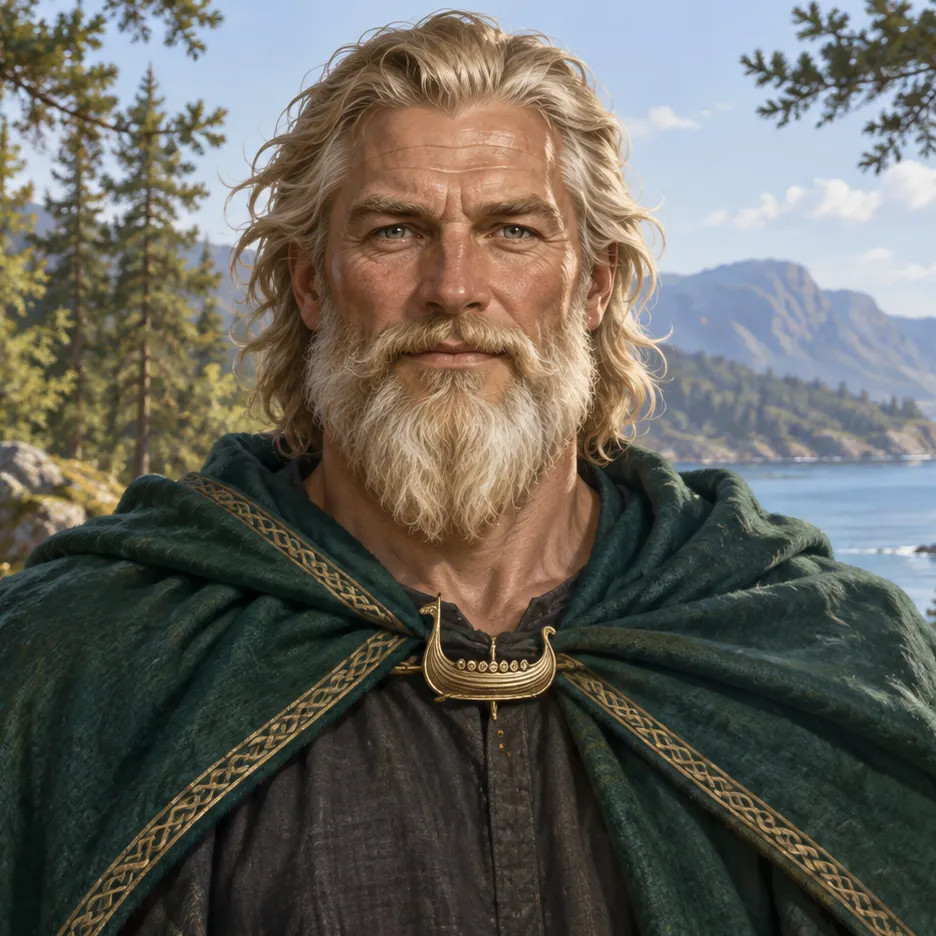
Njord had his boots on when Skadi woke.
She looked at them, then at the grey light beneath the door.
“The ninth night is not over.”
“I know.”
Outside, a wolf began again. Its cry travelled down the mountain, caught against another ridge, and returned thinner. Njord pressed his heel against the floor until it settled properly into the boot.
Skadi sat up. She had slept with one arm thrown beyond the edge of the bed, her hand open toward the cold. He had spent the night drawing that same cold out of the blankets and wondering how there could be so much of it when the hearth still held a fire.
“You could have woken me,” she said.
“To tell you about a wolf?”
“To tell me you were leaving.”
He pulled his cloak off the peg and folded it across his knees.
“I am waiting.”
She watched him for a moment, then reached for her own boots.
There were nine cuts in the small piece of wood beside the bed. He had made them with his knife, one each morning, and had turned the cut side toward the wall after the fourth. Skadi had turned it back.
Now she picked it up.
“At Nóatún,” she said, “will I have one of these?”
He could have told her that she would not need it. He nearly did.
“If you want one.”
She set it beside his folded cloak.
“Come outside. There is something I want you to see before we go.”
The Mountain Path
The snow had hardened overnight. Skadi moved across it without breaking the crust, her bow over one shoulder. Njord followed in the hollows where her feet had been, though her steps were longer than he expected and the path narrower than he liked.
Below them, Thrymheim lay against the rock. From its doorway the mountains had seemed to stand across every possible road. Up here he began to see the passages between them.
Skadi pointed out a saddle in the nearest ridge.
“In summer, the animals cross there.”
He looked where she pointed. The slope was bare and white.
“How can you tell?”
“The grass grows differently. You will see it when the snow goes.”
She said it easily, making room for another season with him in it. He wanted to answer as easily.
His foot slid.
The crust broke under his heel, and the loose snow beneath it carried him toward the edge. He caught at a jut of stone. His fingers scraped over ice.
Skadi seized the back of his belt.
“Stop reaching. Put your knee down.”
He obeyed. She held him while he found a place for his boot, then hauled him onto the path. For a moment they remained bent together, breathing into the same patch of cold air.
Njord looked down at the long slope beneath his feet.
“Those have caused enough trouble,” Skadi said.
He turned toward her. She was looking at his boots.
He laughed before he could prevent it.
She had chosen those feet from beneath a screen, certain such beauty must belong to Baldr. Njord remembered the change in her face when the screen came away. He had spent more time remembering it than he cared to admit.
“I might have warned you,” he said.
“You were meant to be quiet.”
“I have been trying to make up for it ever since.”
Her grip loosened on his belt. She brushed the snow from his shoulder, but she did not laugh again.
“Do not do that.”
“What?”
“Spend our lives paying for a choice I made.”
From the ridge came a small cracking sound. A shelf of snow dropped, broke apart, and vanished into a gully. Skadi listened until it had finished.
Njord could see how completely she belonged here. She knew which noises mattered. The wolf that had kept him awake was no more alarming to her than a gull settling on his roof.
“I cannot sleep in your hall,” he said.
“I know.”
“I thought I could learn.”
She took his hand and turned it over. A little blood had gathered where the ice had scraped his fingers. She pressed clean snow against the cuts.
“Then we shall try yours.”
He closed his hand around the cold she gave him.
They went down together. At the hall, Skadi fetched her travelling things. Njord picked up the tally before she could leave it behind.
Nine Nights by the Sea
At Nóatún, he heard a loose mooring before he saw the boat.
The rope struck its post whenever the swell lifted the hull. Njord stepped off the path, shortened the slack, and rested a hand on the gunwale. The boat settled. Beyond the harbour mouth the water lost its broken white edges.
When he turned back, Skadi was watching him.
“You did not have to look,” she said.
“At what?”
“To know what it needed.”
He smiled and took her bundle.
For their first meal he opened the shutters facing the water. Sunlight reached across the table; the drinking cups shone. He had brought out the better cloth and a chest whose hinges had scarcely been used. Inside lay arm-rings, folded linen, and enough worked silver to purchase farms that Skadi had never seen.
She lifted a length of cloth between her fingers.
“It is fine.”
“Take what you like.”
She put it against her cheek, testing its softness, and he felt an unreasonable burst of hope.
“I will use this,” she said.
That night she folded it beneath her head.
Before dawn, a gull landed on the roof and called.
Skadi sat upright as if someone had shouted through the door. Njord reached for her, still half asleep. The bird called again. Others answered from the water.
She lay down slowly.
By morning, the linen was twisted into a cord beneath her hands.
On the third night they moved the bed to the inner wall. On the fifth, Njord hung a heavy covering across the shutters. Skadi helped him lift it, holding one corner while he fixed the other. In the darkened room they could no longer see the water, but they heard the birds just as clearly.
He woke to find her sitting by the cold hearth with the tally in her hand.
She had made no cuts.
“You need not pretend,” he said.
“I was trying your way first.”
The words stung. He deserved them, but that did not make them easier to hear.
He knelt beside the hearth and stirred the embers to life. Skadi held out her hands. There was warmth here whenever she wanted it, food, shelter, every comfort he could think to give. None had taught her to sleep.
“Tomorrow,” he said, “I can have another room made.”
“Where?”
“Behind the hall. Farther from the water.”
“How much farther?”
He stopped stirring.
She leaned forward and took the poker from him. A coal fell from its tip onto the stone.
“Come back to bed, Njord.”
On the last evening he went down to the shore alone.
The wind was bringing the sea against the rocks below their window. Each wave lifted, broke, and dragged small stones back with it. Higher up, the gulls wheeled over the roofs.
Njord raised his hand.
The wind fell. The next wave reached the stones without breaking. The gulls lost the lift beneath their wings and scattered toward the outer skerries, where the air still moved.
He waited. No cry came from the roof.
When he returned, Skadi was already in bed. He lay beside her and listened to her breathing grow steady. Once she moved toward him in her sleep, laying her hand against his arm.
He did not sleep at all. He kept the wind beyond the harbour, and the water under the window scarcely moved.
The Returning Wind
Morning found him still holding the calm.
A little boat lay beyond the harbour mouth. Its sail hung in folds. Two people were rowing, pausing between strokes to change their grip; even at that distance he could see how unevenly the oars entered the water.
They had been out through the night. Now the wind that should have carried them home ended short of their sail.
Njord stood at the window.
Behind him, a buckle clicked.
Skadi was kneeling beside her bundle. She had rolled the linen neatly and laid it on the bed.
“You slept,” he said.
“Yes.”
She drew a strap through the buckle.
“I can keep it quiet.”
“For how long?”
He looked back at the boat. One of the rowers had stopped. The other kept pulling, turning the bow a little with every stroke.
Njord let a breath of air cross the harbour mouth. The sail stirred. From the skerries came a gull’s cry.
Skadi’s hands stopped on the strap.
He held the air still again.
She rose and came to the window. For a while she watched the rowers with him.
“Let them in,” she said.
“They will get here.”
“Then why are you watching them?”
He had no answer he could bear to give. The room was quiet. For the first time since their arrival, she had slept until morning. He had found a thing he could do, and now it stood between a boat and home.
Skadi went back to the bed.
“I am going to Thrymheim.”
He turned quickly.
“We could build between them. Below the snow. Above the shore.”
She bent to lift the bundle.
“I can give you the whole valley.”
“Will you come there?”
“Yes.”
“And when you hear a rope beating against a post, where will you go?”
Njord looked toward the window despite himself.
Skadi saw.
He remembered coming among the Aesir as a pledge. No rope had been needed then either. Men could call a place yours, give you a seat and put a cup in your hand, and still you would know why you had been brought there. He had stayed. Peace had held. For a long time those two things had seemed inseparable.
Now Skadi stood in his hall with her belongings at her feet, waiting for him to stop offering her things.
Her bundle had caught on the bedpost. One strap was looped beneath the carved end, and when she pulled, the knot tightened.
Njord crossed the room.
She let go of the strap as he knelt. He worked a finger under the knot, loosened it, and lifted the loop clear. He could feel her watching the crown of his head.
Outside, the sail snapped full.
He had released the wind without raising his hand. It ran across the water, reached the stones, and came through the window smelling of salt. The heavy covering stirred against the wall.
Njord stood and handed her the bundle.
“The upper path will still be frozen,” he said.
“I know.”
“Of course you do.”
She touched the healed scrape on his palm.
At the door she paused beside the folded linen. He thought she might leave it. Instead she tucked it beneath the strap of her bundle.
Then she went out.
Njord walked with her as far as the place where the mountain path left the shore. She did not need help there. Within a few steps she was moving faster than he could follow, finding firm ground in places that looked no different from the loose stones beside them.
Once she turned and lifted her hand. He lifted his own.
By the time he returned to Nóatún, the little boat was coming between the posts. Someone aboard called to him, and he took the rope they threw.
He held it while they stepped ashore. Their legs were stiff, their hands raw. One began to thank him for the wind.
Njord bent over the mooring and made it fast.
Later, in the hall, he found the tally beside the door. Nine cuts on one side. The other smooth.
He put it away, took down the heavy covering, and opened the shutters to the sea.
