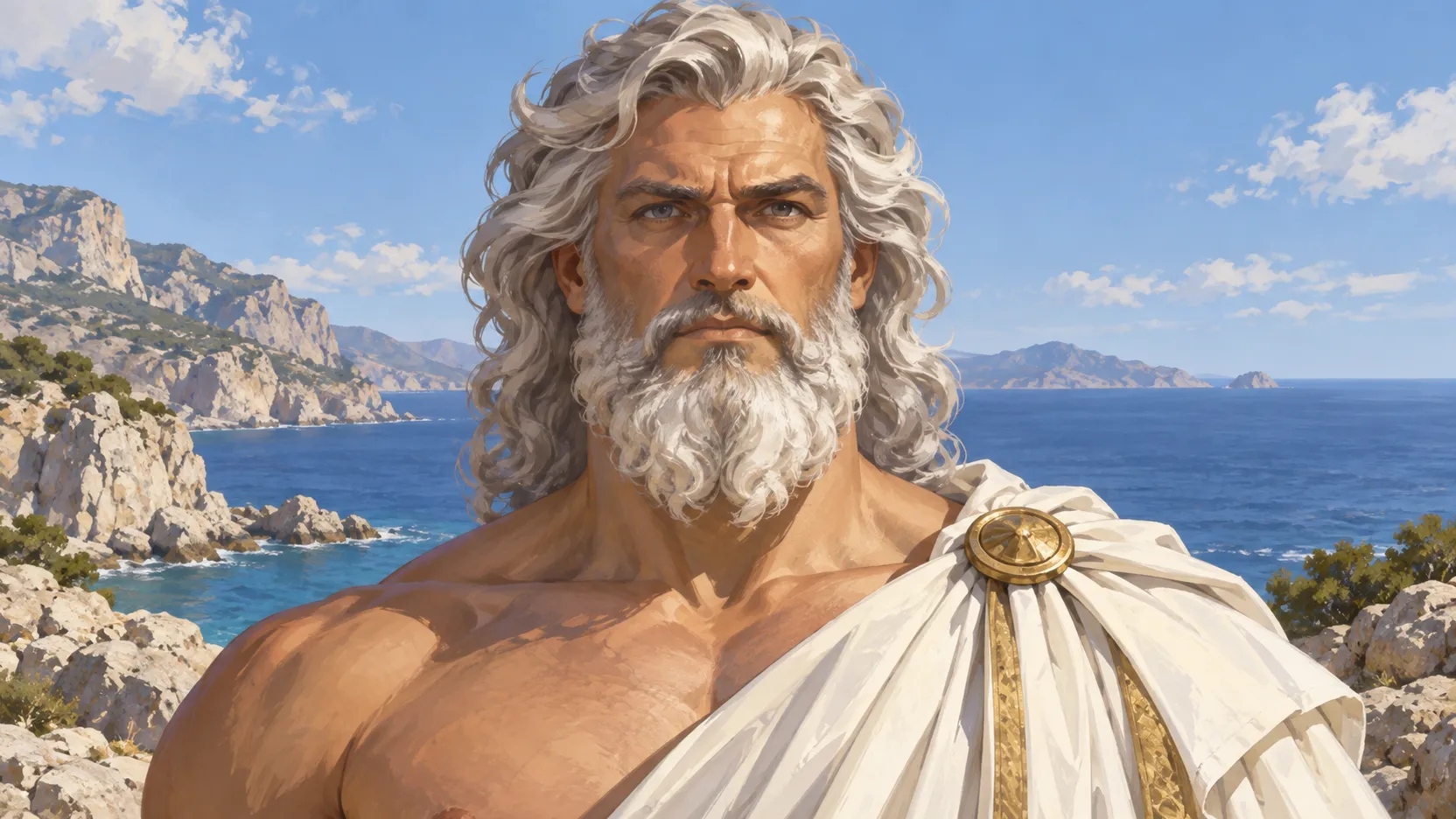
The Son Beneath the Sky
Sarpedon jumped from his chariot, and Zeus reached for the wind.
Below the wooded slopes of Ida, the Trojan plain churned with men and horses. Dust hid whole companies. Through it came the bronze shoulders of a man wearing Achilles’ armour, and before him the Lycians broke and ran.
Zeus knew the man inside the armour. That morning Achilles had poured wine into the earth and asked two things: victory for his companion, and his safe return. Zeus had granted the first. Now Patroclus stood among the men he had killed, searching for the next man who would face him.
Sarpedon stepped into his path.
A wind slipped between the trees below Zeus. It could cross the plain before a spear flew. It could wrap his son in dust, lift him beyond the shouting, carry him over the sea. In Lycia there were fields untouched by this war. There was a door through which Sarpedon might still walk.
“Where will you put him?” Hera asked.
She stood beside him on the mountain. Zeus kept his eyes on the plain.
“At home.”
“And when the others ask?”
“They may ask.”
“They will take.”
The wind pressed through the pines. Far below, a rider turned his face against it.
Hera came nearer. “Aphrodite has a son down there. So does Ares. So do others whose children you have watched fall. Will you bring them all home?”
“Sarpedon is mine.”
For a moment she said nothing. On the plain, Sarpedon shouted to his fleeing men. Two stopped. Then a third planted his spear and turned with him.
“Yes,” Hera said. “He is.”
Zeus looked at her then, angry at the gentleness more than he would have been at mockery.
“Do you think I need their leave?”
“No. That is why you must hear this.” She pointed down the slope. “Save him, and tell them why your grief is worth more than theirs.”
His fingers closed. The tops of the pines bent towards Troy.
He could already see the quarrel: gods snatching their sons from spear-points, gods striking the sons whom other gods had spared. Every battlefield would become a struggle over which father could reach furthest. He would have to permit it, or forbid them what he had taken for himself. Hera would remember. All of them would remember.
Below, Sarpedon raised his shield.
Zeus remembered a smaller hand against a doorpost. His son, still a boy, had been trying to stand tall enough for a mark cut above his head. He had lifted his heels when he thought no one was watching. Zeus had watched. When the boy turned, solemn with the height he had stolen, Zeus had said nothing.
There would be no clever theft of height now. No little indulgence kept between them.
“Let his people have him afterwards,” Hera said. “Let them bury him in his own country.”
“Afterwards.”
The word tasted of earth.
Patroclus advanced. Sarpedon’s companion moved with his king, shield forward, and the three figures closed in the dust.
Zeus opened his hand.
The wind ran out among the trees.
The Rain That Fell
The first red drop struck Sarpedon’s shield.
Another darkened the dust beside his foot. Men glanced up. Across the plain, on Greek helmets and Lycian spears alike, blood fell from the sky.
Sarpedon looked at the stain on his shield. Zeus waited for him to raise his face. There was still time for that much. One glance, even if his son could not see him.
But Patroclus moved, and Sarpedon had to move with him.
The Greek’s spear struck Sarpedon’s companion. The man fell between the chariots. Sarpedon hurled his own spear past Patroclus and into a horse; the animal collapsed, dragging at the harness, and the other horses reared against the tangled traces.
For a moment the chariot could not move.
Zeus leaned forward.
Patroclus’ driver sprang down with his sword. He cut the dead horse loose. The surviving pair lurched clear, and Patroclus came on again.
Sarpedon took another spear. He planted his feet in the blood-speckled dust, drew his arm back and threw.
The point passed over Patroclus’ shoulder.
Zeus saw the miss before his son did. Saw the answering spear settle in the Greek’s hand. There was no confusion in that small space now, no dust thick enough to hide the distance between them.
He could still close it.
A gust under the spear. A cloud between the men. His son lifted bodily from the earth. None of it would be difficult. The power was there, as near as his own breath.
Beside him Hera stood still.
Patroclus threw.
Zeus kept his hand open.
The spear struck beneath Sarpedon’s breast. His shield dipped; his knees gave way. For an instant he seemed to be kneeling to lift his fallen companion. Then his whole weight went down, and the rim of his shield struck the earth.
Zeus heard it above the shouting.
Sarpedon dragged one hand through the dust. He called for Glaucus.
His friend was close enough to hear, too far away to help. One arm hung wounded at his side. He tried to raise his spear and could not.
“Keep them back,” Sarpedon said. His voice reached Zeus thinly, broken by the effort of breathing. “Glaucus. Don’t let them take—”
He tried again. The words came urgently now, as if the thing that mattered was to leave his friend a task he could finish.
“Bring the men. Hold here.”
Glaucus stumbled towards him.
Sarpedon’s hand stopped moving.
The red rain continued for a little while. It gathered in the hollows of shields and slid from the noses of frightened horses. Then it ceased, and the armies closed over the place where he lay.
Zeus could still see him.
He wished, for one moment, that he could not.
What Could Be Carried Home
Glaucus turned away from the body and called upon Apollo.
He pressed his injured arm against his chest. The wound had weakened him until even standing was an effort, but he shouted the prayer as though the god were across a river and must be made to hear.
“Sarpedon is dead. His father has not saved him. Give me strength enough to fight for him.”
Zeus heard every word.
Below, Glaucus straightened. His hand opened and closed. He lifted the spear he had been unable to hold, and then he was running among the Lycians, calling them back. Apollo had answered.
Sarpedon’s men rallied. Hector came with the Trojans. Across the body, Patroclus beckoned to the Greeks.
Zeus drew darkness over them.
The sunlight left the bronze. Men crowded closer to distinguish friend from enemy, and spear-points appeared out of the gloom at the distance of a thrust. A Greek bent to seize the body; Hector struck him down. Patroclus charged to avenge him. Another man fell across Sarpedon’s legs.
Zeus wanted them driven away from his son. He wanted the armour left upon him, the shield returned to his hand. Sarpedon had asked for so little at the end.
The fighting thickened.
A Lycian reached the body and caught its wrist. A spear drove him back. He fell without letting go, and for a moment the two men lay hand in hand beneath the moving shields.
Hera had withdrawn a few paces. She did not speak again.
Zeus watched Hector force his way forward, watched Patroclus meet him, and considered how easily the Greek could die there. Sarpedon beneath him, his own armour stripped, his triumph finished before it had time to reach Achilles’ ears.
But Patroclus’ path ran further yet. Zeus had opened that path himself.
He looked beyond the ring of fighters. There were men coming to join it who had not seen Sarpedon alive. They ran because their captains called, because someone they loved was already in the crush. The dead gathered around his son, and still his son did not rise.
Zeus turned the battle.
Fear caught Hector in the act of advancing. The Trojan checked, looked towards the city, and stepped back. The man beside him saw it. A gap opened. Patroclus drove into it with a shout, and the line broke.
Glaucus tried to hold the Lycians. He struck at a pursuing Greek, dragged a wounded comrade upright, shouted Sarpedon’s name until his voice cracked. Men were running on either side of him. At last he went with them.
The Greeks knelt beside the body. They undid the straps, pulled away the breastplate, lifted the helmet from the dust. Patroclus gave the bronze to his companions to carry towards the ships.
Sarpedon lay uncovered.
Zeus waited until the last pair of feet had passed him. Then he called Apollo.
His immortal son came to the mountain, bright and unwearied. The contrast struck Zeus with such force that he could not at first give the command. Apollo stood before him, alive beyond the reach of all the spears upon the plain.
“Bring your brother out,” Zeus said.
Apollo looked down.
“Where shall I take him?”
To me, Zeus almost said.
But there was nothing on Ida for Sarpedon. No hearth belonging to him, no women who would wash him, no brothers who would know where he wished to lie.
“To the river first. Clean the battle from him.”
Apollo bowed his head.
“Anoint him,” Zeus said. “Give him garments fit for the journey. Then call Sleep and Death. They will carry him to Lycia.”
The words had come steadily. The last would not.
“Home,” he said at length.
Apollo descended.
He passed among the fighting men unseen and lifted Sarpedon from the trampled ground. The head fell back against his arm. Apollo supported it, adjusted his hold, and carried his brother beyond the spears.
At the river he knelt. Water loosened the dust in Sarpedon’s hair. Apollo washed his face and hands, worked the dirt from beneath his nails, and cleaned the wound. Nothing stirred beneath his fingers. He anointed the body with ambrosia and wrapped it in fresh clothing, laying each fold flat.
Zeus watched until there was no trace of the battlefield on his son.
Then the twins came.
Sleep took him beneath the shoulders; Death lifted his feet. Together they raised him with the care of men carrying someone who must not wake. Apollo drew a trailing corner of cloth clear of the stones.
They went over the sea.
Zeus followed them with his sight, past the coast and the long fields of Lycia, to the house his son had left. A man in the courtyard saw them coming. He stood motionless, then dropped the tool in his hand and ran to open the door.
The bearers turned sideways at the threshold.
Sarpedon’s hand slipped from the cloth. His kinsman caught it, held it for a moment, and laid it back upon his breast.
Above the house the sky remained clear. Zeus watched the door close gently behind his son.