The Backward Tracks
The hoofprints led into the meadow. The cattle were gone.
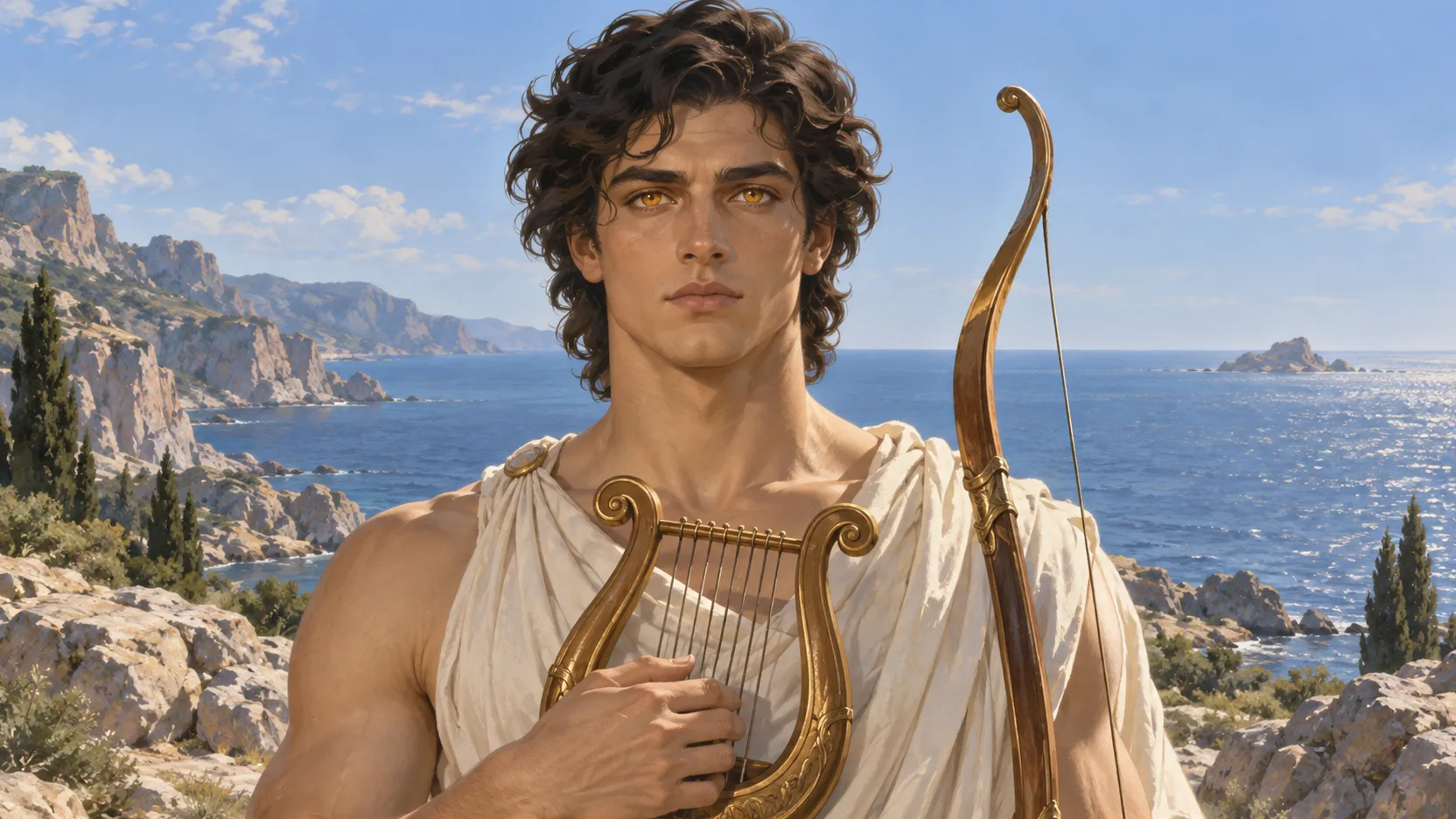
Apollo knelt beside the last clear impression in the sand. Fifty cows had passed this way, crowding one another, their weight driven deep into the damp ground. Every print pointed toward the grass where he had left them. Beside the trail ran a pair of shapeless marks, as though someone had uprooted two small bushes and walked away on their roots.
Behind him the black bull called again. Four hounds nosed the empty pasture. None had followed the cows.
Apollo stood. Whoever had done this had taken time to make the theft an insult.
At Onchestus he found an old man cutting weeds between his vines. The man saw the silver bow and straightened too quickly, one hand pressed against his back.
“Fifty cows,” Apollo said. “Who drove them past you?”
The old man looked down the road, then toward his house.
“People pass here all day.”
“These passed at evening.”
The knife turned in the man’s fingers. “You will think I have drunk too much.”
“Tell me what you saw.”
“A child. With a stick.” He spread his free hand, trying to show how small. “The cows faced him. They were walking backward. I watched until they were gone, and afterward I wasn’t sure I had watched at all.”
Apollo’s fingers tightened around the bow.
Above the vines a bird wheeled, its long wings cutting across the morning light. He followed its flight. In that movement the sign became clear: a child of Zeus, born in Maia’s mountain cave.
His own brother.
The old man was still explaining how little wine he had drunk when Apollo left him.
The Child in the Cradle
The cave smelled of cedar and clean wool. A cradle stood in its deepest chamber. At Apollo’s step, something small disappeared under the bedding.
He searched the chambers first. Maia watched him open the stores of nectar and ambrosia, lift a folded garment, examine a shadow that could not possibly hold a cow. Her silence made each movement feel larger than it needed to be.
At last he stood over the cradle.
“Come out.”
One eye appeared above the wool.
“Where are they?”
The child pushed the covering down. His cheeks were soft with newness. Under one arm he held a curved object Apollo could not quite see.
“Where are what?”
“My cattle.”
Hermes considered the word with an air of patient interest.
“I was born yesterday.”
“You have been busy since.”
“I have been sleeping.”
“With fifty cows?”
The child looked around the chamber. “Where would I put them?”
Apollo bent nearer. The little face did not flinch. He knew the theft, knew the thief, and still the child offered him the smooth, unmarked surface of innocence.
“You will take me to them. Or I will find a darker place for you than this cave.”
“Tartarus?”
The word came much too readily.
Apollo said nothing.
Hermes sat up. “You would throw your brother into Tartarus over animals he has never seen?”
“Stand.”
“My feet are tender.”
Apollo lifted him from the cradle. The child clutched his hidden object and wriggled until Apollo set him on the floor. He landed squarely on those tender feet.
“Then let our father hear us,” Hermes said.
For the first time Apollo hesitated. He could drag this creature through every valley between Cyllene and the sea. He could make the mountains echo with commands. But Hermes had named the judge whose word both of them must obey.
The child was watching him now, no longer pretending to be sleepy.
“To Zeus, then.”
Hermes gathered the bedding around his shoulders and came willingly.
The gods were assembling when they arrived. Apollo brought the child to their father’s knees and told what had happened: the emptied pasture, the backward trail, the tracks that belonged to no creature, the little liar in the cradle. He kept his voice level. He would not make a spectacle for them.
Hermes waited until he had finished.
“I have never driven a cow into my mother’s house,” he said.
Apollo turned toward him.
“Listen to what he is denying.”
“I am trying to answer you.”
“You are trying to answer a question I did not ask.”
The child’s eyes widened. He appealed directly to Zeus. “He came with a bow. I was in bed.”
Their father laughed.
The sound passed through the assembly. Apollo felt it strike harder than another denial. The theft was real. Somewhere his cattle were shut away, and here the gods were enjoying the account of how he had lost them.
Zeus leaned forward. His laughter ceased, though pleasure remained in his face.
“Enough. Hermes, show him where they are.”
The child opened his mouth.
“Where they are.”
Hermes closed it.
Apollo waited for more: a rebuke, a punishment, something that would put the morning right. Zeus had already settled back. The order was given.
Apollo took his brother by the shoulder and turned him toward the road.
What Could Not Be Returned
At Pylos, near the Alpheus, Hermes led him to the cattle shelter. The cows pressed against one another in the dimness, turning their broad heads at Apollo’s approach.
Relief loosened his grip on Hermes. He called to the herd and began counting as they came out.
Then he saw the hides spread on the rock.
One bore the pale mark at the neck that he knew. Beside it lay a horn with a shallow scrape near the tip, made against a stone trough long before this morning.
“Two,” he said.
Hermes did not answer.
“You killed two.”
“They had their portions.”
Apollo looked past the rock. The remains of a fire lay beneath a scatter of sand. Here the child had made a sacrifice, dividing what he had stolen as though he already had the right to apportion it among the gods.
The other cows were moving toward the river. Apollo caught the leading animal at the neck and turned her back. When he faced Hermes again, the child had edged toward the shelter.
“No.”
He seized a handful of willow withes. They bent in his hands without breaking. He twisted them into a cord and reached for his brother’s wrists.
The cord slipped.
Its cut ends struck the earth. Roots drove into the soil; pale shoots sprang up between his fingers. Apollo let go, and the willow climbed over itself in a rush of leaves. Another strand dropped, rooted, thickened. In moments a living tangle stood between him and the cattle. A cow lowed from behind it.
Hermes had retreated to a stone with the curved object held against his chest.
Apollo reached over his shoulder for an arrow.
The child’s hand moved.
A string sounded.
Apollo stopped with his fingers against the feathering.
Another note followed, lower than the first. Then several together: a sound with a hollow warmth beneath its brightness, unlike a flute, unlike the voices of the Muses, though he heard at once where a voice could enter it.
Hermes watched him and touched the strings again.
“Put that down,” Apollo said.
Instead the child began to sing.
The Price of a Song
He sang of the earth before its paths were made, of the birth of gods and the portions that fell to each. His fingers moved over seven strings stretched across a tortoise shell. The small instrument answered every change in his voice.
Apollo had heard glorious music. He had stood among the Muses while their singing filled the halls of Zeus. Yet this sound drew him nearer before he had decided to move. He could hear what the strings would do under a different touch: a longer pause here, a note allowed to deepen there, his own voice lifted against the answering shell.
Hermes sang of Memory. Then the elder gods took their places in the song, one after another, each distinct. The boy who would not answer a plain question could give the whole company its due.
Apollo’s hand came away from the arrow.
The song ended. Beyond the willow, a cow tore at the leaves.
“Who taught you?” he asked.
“No one.”
“Who gave you that?”
“I made it.”
Apollo looked at the shell, the crosspiece, the taut strings. He believed him. That was the most astonishing part of the answer.
“Play the beginning again.”
Hermes settled the instrument more firmly in his arm. “Are you still taking me to Tartarus?”
“You are still a thief.”
“Yes,” said Hermes, and struck the first note.
Apollo laughed before he could prevent it. Here, at last, was a confession, offered when it could no longer give him the satisfaction he had wanted.
He listened until the phrase was complete. Then he reached for the lyre.
Hermes drew it back. The strings fell silent under his palm.
Apollo could have taken it. The child’s grip would not stop him; nor, in the end, would the willow. He could carry the instrument away with the surviving cows and leave Hermes staring after him.
He looked at his outstretched hand. It had been ready to close around a gift as though around a prisoner’s wrist.
He lowered it.
“What do you want for it?”
Hermes glanced toward the herd.
“The cattle?” Apollo said.
“And to be their keeper.”
“Having demonstrated your care for them?”
“To have something that is mine to care for.”
The child did not smile. Apollo heard the gap in the song now: the gods receiving their honours, and the singer, born yesterday, waiting to be counted among them.
He uncoiled the shining herdsman’s whip from his belt.
“You will have the herd. You will lead it and tend it. And I will acknowledge your skill before our father.”
Hermes looked at the whip, then at the lyre. For once he seemed unwilling to let a thing go.
Apollo waited. He made himself wait.
At last Hermes held it out.
Two Promises
“First,” Apollo said, “an oath.”
The lyre remained between them.
“You will not steal it back. Nor my bow. Nor anything else of mine.”
Hermes drew breath.
“Do not tell me which door you will not carry it through.”
The child shut his mouth. Then he nodded, with the weight of a god’s promise behind the small movement of his head.
“I will not steal from you.”
Apollo laid the whip in his open hand.
“And I will stand as your friend,” he said. “Before Zeus and the others.”
Hermes’s fingers closed around the handle. Apollo accepted the lyre. Its shell was lighter than he had expected, the strings still warm where his brother had touched them.
“And the things Zeus tells you?” Hermes asked.
Apollo looked up.
“The things that have not happened yet.”
“No.”
The answer came without anger. Hermes studied him, measuring whether there was room for another approach.
“I have sworn to keep that counsel,” Apollo said. “I will not break one promise to make another.”
The child lowered his eyes to the whip. Apollo shifted the lyre into the crook of his arm.
“There are other ways to seek an omen. I can show you where to begin.”
Hermes looked up again. This time he listened.
Apollo set a finger to the first string. The note rang against his ribs. He tested the next, then found the interval he had heard while Hermes played. The melody came readily, but he slowed it, letting the shell carry the last sound before he touched another.
Beyond the willow the herd stirred. Hermes slipped through the leaves and opened a way for the cows. He walked beside them with the whip loose in his hand, using his voice to turn them toward the road.
Apollo followed, playing.
At the edge of the sand his brother stopped to listen. The leading cow nudged him between the shoulders, and he stumbled forward, protesting. Apollo missed a note, laughed, and found it again.
Their footprints ran beside the hoofprints, all pointing the same way.