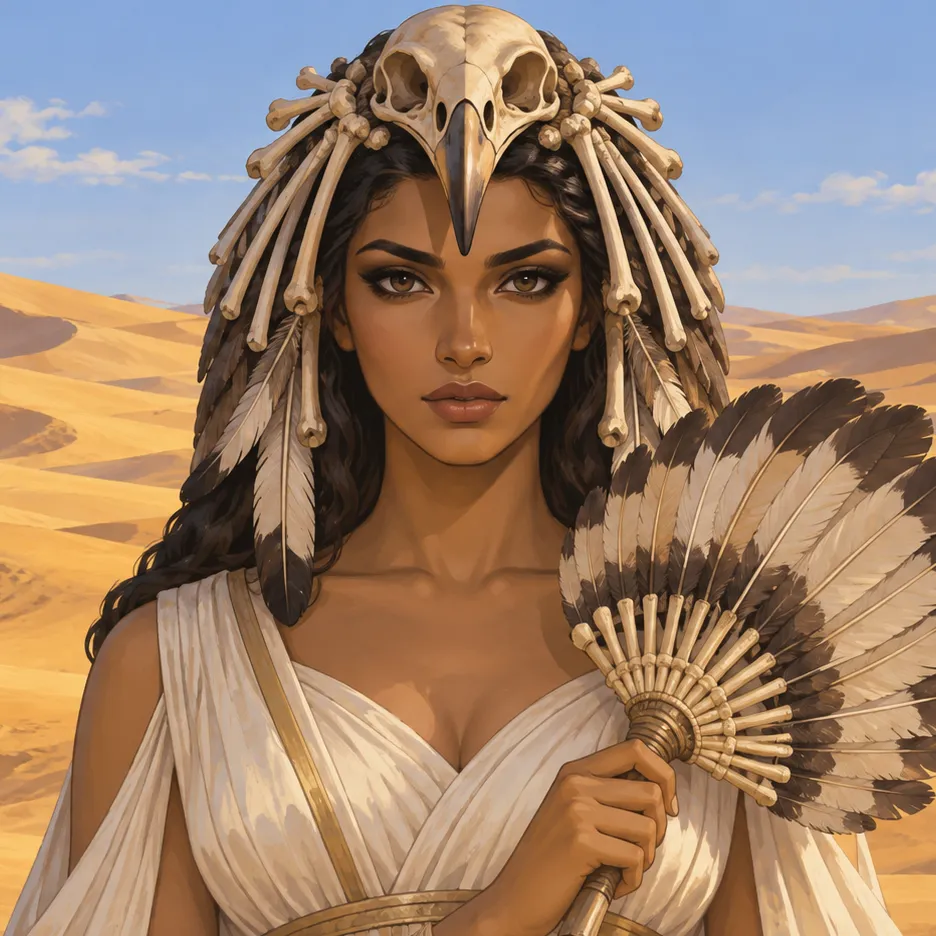
The king caught a handful of Nekhbet’s feathers and would not let go.
Beneath her wing, his mouth moved without sound. He had lost his crown somewhere between the burning quay and the royal boat, and blood from a cut above his ear had dried into the dust on his cheek. He was trying to speak the prayer he had known as a child. She could feel each failed word against her breast.
“Breathe first,” she told him.
The rowers bent their backs. Water slapped the hull. Beside them, lashed to the royal vessel by two thick ropes, the prisoner barge struck something beneath the river and shuddered. Its stern swung inward. A brazier toppled under the awning.
Flame ran up the dry reed matting before anyone reached it.
“Cut her loose,” the captain said.
Nekhbet lifted her head.
The prisoners had stood when the boats collided. Now they fell against one another, dragged down by the chain that joined their ankles. A man near the stern tried to stamp out the fire, could not move his foot far enough, and began beating it with his bound hands.
“Your Majesty.” The captain had his knife out. “We cannot tow fire.”
The king looked past Nekhbet’s wing. For a moment she thought he had not understood what he saw. Then his fingers tightened in her feathers.
“Do it.”
She drove her beak into the gunwale between the captain’s knife and the rope. A sliver of wood struck his lip.
“Bring them across.”
“They burned his landing place,” the captain said. “They killed men trying to get him aboard.”
“Then put guards over them.”
“With what hands?” He showed her the benches. One rower was pulling for two; the man beside him lay folded over his oar. Another had tied his wrist to the handle because his fingers would no longer close. “If we stop rowing, we go back into the quay.”
Behind them, smoke hid the town. The river carried scraps of reed matting, an overturned basket, a sandal turning slowly with its thong upward. Nekhbet had flown above the king’s advance into that town. She had spread her wings above his retreat. Through both, she had watched the narrow space in which a spear might reach him.
She looked properly at the other boat.
A gray-haired man was trying to lift a boy over the chain. Each time he raised him, the boy’s ankle jerked backward. He was not a boy, she saw next, but a slight young man with a beard just beginning at his chin. His tunic had caught fire at the hem.
Nekhbet spread her free wing across the gap and smothered the flames against the deck.
The young man screamed. The gray-haired prisoner gripped the edge of her wing and pulled until she lifted it enough for him to beat the last sparks out with his palms.
A cobra rose from the chain between his feet.
Its hood opened, green-dark in the firelight.
On the king’s diadem they had stood side by side: Nekhbet, the vulture of the south, and Wadjet, the cobra of the north. Now one sheltered his body while the other rose among the men he had chained.
“Now you see them,” Wadjet said.
The Other Boat
Nekhbet kept one wing over the king and the other over the prisoners. Between the two boats, the feathers stretched and slipped against the ropes.
“Help me move them,” she said.
“I have been keeping the fire from their faces.”
Wadjet turned her head. Along the deck behind her, flame recoiled from a narrow strip of planking. Beyond it the awning collapsed, scattering embers over the prisoners’ shoulders.
“Tell him to release them.”
The king had heard. He pushed himself upright beneath Nekhbet’s wing.
“One of those men opened the river gate to the rebels.”
“Which one?” Wadjet asked.
No one answered. The captain looked toward the smoke behind them.
Nekhbet felt the king’s breath quicken again. She knew that breath. Long ago, when he had been small enough to sleep with both feet beneath his mother’s palm, he had woken choking on river water after falling from a landing stage. He had clung to Nekhbet then, too. She had held a wing above him until the cough passed and he slept.
Now a kingdom’s boats waited on the same frightened grip.
“Nekheb is upriver,” he said to her. “Your temple. Get me there.”
The southern cliffs rose pale beyond the smoke. Home lay among them: cool stone, the odor of offerings, hands raised when her shadow crossed the courtyards. She could lift him out of this boat. He would be heavy, but not too heavy. She could leave the river and its quarrel beneath her.
On the other deck the gray-haired man had torn away the young prisoner’s burning hem. His own palms were blistering. He held them apart, unable to touch anything, while the younger man tried to blow on them.
“Your temple,” Wadjet repeated. “And what shall I take back to the north?”
The king turned from the cobra. He looked at the place where Nekhbet’s wing enclosed him, the close, unbroken shelter he had carried through the fighting.
She could not take that shelter to the other boat while he remained inside it.
“Give me the key,” she told the captain.
He covered the little bronze key at his neck.
“Ask him.”
Nekhbet looked down at the king. She waited through the breath he drew, and the next.
A gust drove the burning awning against the forward lashing. The captain saw the flame catch beneath the royal rail. Before either deity could move, he cut the rope.
The prisoner barge’s bow swung away.
Nekhbet’s outstretched wing slid across faces, hands, the rising edge of the hull. The gap opened too far. She pulled back before the twisting vessels tore the feathers from her shoulder.
The captain stamped fire from the royal deck. He had saved the boat. Across the widening strip of water, the prisoners understood what that meant.
They began calling to the rowers by name.
Beyond Her Wing
The second rope snapped taut. Its fibers creaked above the water, holding the burning stern alongside the royal vessel while the prisoner barge swung broadside into the current. Water climbed its lowered rail.
Nekhbet climbed onto the king’s gunwale. His hands followed her feathers.
“Stay,” he said.
She turned her head until one eye met his.
“I am going there.”
“They will kill me.”
“They may.”
The answer hurt him. She saw it before his mouth hardened. He had wanted her to make the risk untrue.
She lowered her head and touched the blood-caked place above his ear with the side of her beak. Then she drew her wing out of his hands.
For an instant he stood in the open, small between the rails.
Nekhbet leaped.
Her shadow swallowed the burning deck. She grew into it, talons closing on the barge’s timbers, wings spreading from rail to rail. The air beneath her filled with frightened breathing. She gripped the low rail and hauled it level. Water stopped pouring over the side, though it still seeped through the damaged planks.
Fire climbed the outside of her right wing.
She held still.
Across the water, the captain raised his knife to the remaining towrope. The king caught his wrist.
Nekhbet could not hear what they said. She saw the captain shake his head, saw the king point to the chain, then seize the cord at his neck. The cord broke. The key flashed once in the king’s fist.
The captain caught him by the belt as he stepped onto the rail.
This time his words carried.
“Let the bird take you. We will pull the others out.”
The king looked at Nekhbet. Beneath her wing a prisoner was trying to lift another man’s face out of the rising bilge water. She could feel the barge’s damaged ribs giving under her talons. If she left, it would roll.
He took a loose rope from the deck and knotted it around his waist. The captain watched his hands, then reached out and corrected the knot with a savage tug.
“Keep it above your hips.”
The king put the key between his teeth and dropped into the river.
The current took him under the angle of the burning hull. Nekhbet jerked toward him. Timber cracked beneath her left foot; the barge tilted and the chained men slid together.
She stopped.
She had to stop.
A hand broke the surface. The king struck the hull with his knuckles and sank again.
Wadjet slipped over the side.
Nekhbet saw the cobra’s body vanish into the brown water. Then the king’s face came up beneath the lifted hood. He spat river water but kept the key clenched in his teeth. Wadjet held the place between his head and the hull as the boat swung, giving him room to catch a protruding timber.
The gray-haired prisoner crawled to the rail. His ankle chain stopped him short. He lay flat, reaching with his burned hands.
“Further,” the king gasped.
“Come nearer.”
“I cannot.”
The prisoner looked back at the young man. Together they dragged the chain forward, pulling three others across the deck. He reached again.
The king caught his wrists.
Pain made the prisoner bare his teeth. He did not let go. The young man hauled at his tunic, and between them they pulled the king over the side.
Nekhbet lowered her head to shelter all three from the falling embers.
The Last Fastening
The key shook so badly that the king missed the lock.
The gray-haired man steadied his wrist. The key went in; the lock turned. He pulled the long pin from the first set of fetters and dragged the chain free.
“Can you swim?” the king asked.
“I ferried this reach before your soldiers took my boat.”
“Then tie that.”
He pointed to the rope around his waist. The man untied it and secured it to a deck post. On the royal vessel, the captain drew the other end tight. A line now crossed the gap above the current.
The ferryman put the young prisoner’s hands around it.
“Face the boat. Hold with both hands. They will pull you.”
The young man looked down.
“Look at me.”
He did.
“Now go.”
He slid over the side. Men at the royal rail reached for him as he worked along the rope. When his hands slipped, the captain caught his forearm and hauled him aboard by the armpits.
The ferryman sent the next man after him.
Nekhbet heard a sharp little crack inside her wing. A flight feather broke; its burning end fell into the water. She shifted the wing closer to the deck. There was less shelter now, and more of the heat reached the men working below her.
The king moved along the chain. Unlock, pull the pin, move. He had stopped looking at the faces before deciding whether to release them.
At the last pair of ankles, opening the lock was not enough.
The captive sat against a cask, one leg bent awkwardly beneath him. The lock had already been opened, Nekhbet saw. One cuff hung loose. The other had been riveted to repair a broken fastening, and its short chain passed through a ring bolted into the deck.
The king pulled at the ring.
“Leave it,” the man said. “My foot is broken.”
The king braced both feet and pulled harder. The ring did not move.
A plank split beneath Nekhbet’s talon. The whole stern sagged. Water surged around the captive’s hips.
“Your Majesty!” the captain shouted from the other boat.
The ferryman had one hand on the crossing rope. He looked at the royal vessel, close enough now to hear the young man calling for him. Then he looked back at the king.
“Stop pulling upward.”
He took a broken length of steering oar from the deck and thrust it through the ring.
“Push sideways. With me.”
The king put his shoulder against the wood. Together they bore down. The old deck groaned around the bolt.
Nekhbet could feel the barge coming apart. She loosened one talon and drove it deeper into a sound crossbeam, drawing the failing hull against her breast. Her scorched wing struck the water. Steam rose around her face.
The men pushed again.
The ring tore out with a strip of planking attached.
Water burst through the hole.
The ferryman seized the captive under the arms. The king took his legs. They carried him to the rope, stumbling as the deck dipped under their feet.
Nekhbet bent her great head across the gap. The captain laid hold of the rope and pulled the royal vessel closer; for a breath the two rails nearly touched. Hands reached over them. The injured man went first, the torn plank still dragging from his ankle. The ferryman followed.
The king remained on the sinking deck.
Nekhbet opened her beak to call him. He was reaching for the key, which had fallen between his feet.
“Leave it.”
He looked up.
She struck the rail beside him with her beak. He jumped.
The captain caught his tunic. The ferryman caught his arm. Both dragged him over as the last towrope parted in the fire.
Nekhbet released the hull.
It rolled away beneath her. She beat her wings once, hard enough to scatter burning reeds across the river, and rose through a cloud of steam. Below, the barge turned its blackened belly to the sky.
When she landed on the royal vessel, no one knelt. There was no room. The benches and the spaces between them were full of coughing men.
The king sat on the deck with his back against the captain’s legs. Wadjet coiled beside his bare head. He looked at her for a long time before closing his eyes.
Nekhbet folded her good wing. The other would not close.
The ferryman came toward her carrying a bowl of river water. The young man followed with a strip torn from his tunic. When the ferryman touched the scorched feathers, she hissed and drew away.
He waited, his blistered hands open.
The king opened his eyes. He rose unsteadily, came to her side, and held the damaged wing so its weight no longer pulled at her shoulder.
This time, when the ferryman reached beneath the feathers, Nekhbet let him.