The ship was coming back without him.
Poseidon felt its keel pass above his hand, lightened of a sleeping man and the weight of bronze and gold. All night it had cut through his waters. Now dawn lay along its wet oars, and the men on the benches were laughing at something their helmsman had said.
He rose beneath the stern. Through the timbers he could hear a loose cup rolling where Odysseus had slept.
Already ashore. Already beyond the reach of a wave.
Poseidon closed his fingers. The water tightened around the hull, and every oar struck against it as though the sea had thickened into pitch. Laughter stopped. A man cursed the strap that had torn across his palm.
From the steering platform the shipmaster looked astern. There was no weed about the rudder, no reef beneath the clear water. He raised his hand to the rowers.
“Easy. Together.”
The blades entered again. The ship moved a little.
Poseidon let it go.
Ahead lay Scheria, where those men would beach their vessel, wash the salt from their arms, and eat beneath roofs that had never heard Polyphemus calling for his father.
He left the ship its course and went to Zeus.
The Last Crossing
Cloud lay under his brother’s feet. Through an opening Poseidon could still see the vessel, a pale scratch on the blue.
“They have put him on Ithaca,” he said. “Asleep. They carried him out like a child.”
Zeus looked down.
“With gifts,” Poseidon added.
“I granted him his homecoming.”
“And I have left him his home.”
A drop fell from Poseidon’s sleeve. It passed through the cloud and was lost.
His son had stretched his hands toward the stars with the burned hollow of his eye turned upward. The prayer had reached Poseidon through stone, through the great salt distances. Let the man come late. Let him come broken. Let him learn what it was to be helpless before a power he had mocked.
Yet the Phaeacians, his own descendants, had laid Odysseus beneath a fine coverlet and carried him over the sea without so much as waking him.
“Would they do this across your sky?” Poseidon asked.
Zeus turned toward him then.
“The man is home. The ship is yours to meet.”
“And their city?”
Far below, the vessel rounded the last headland. Sunlight found its oar blades one after another.
“Let them see what you do,” Zeus said. “A wreck sinks. Make a stone of it, with the shape of the ship still in it. They will remember.”
Poseidon looked beyond the vessel to the hills enclosing Scheria. Their deep roots lay within his reach. He could draw them together across the harbor, lift a mountain where the sea road opened. Every guest who had passed unharmed through those waters would become a tale of something the city could no longer do.
He descended before the ship reached the shore.
This time he stood in its path.
The master saw him first. His hands jerked the steering oar; the prow swung, then stopped turning. Water lay smooth on either side. The ship’s wake ran forward along the hull and died against it.
“Back water.”
The men obeyed. Their blades bent. Nothing moved.
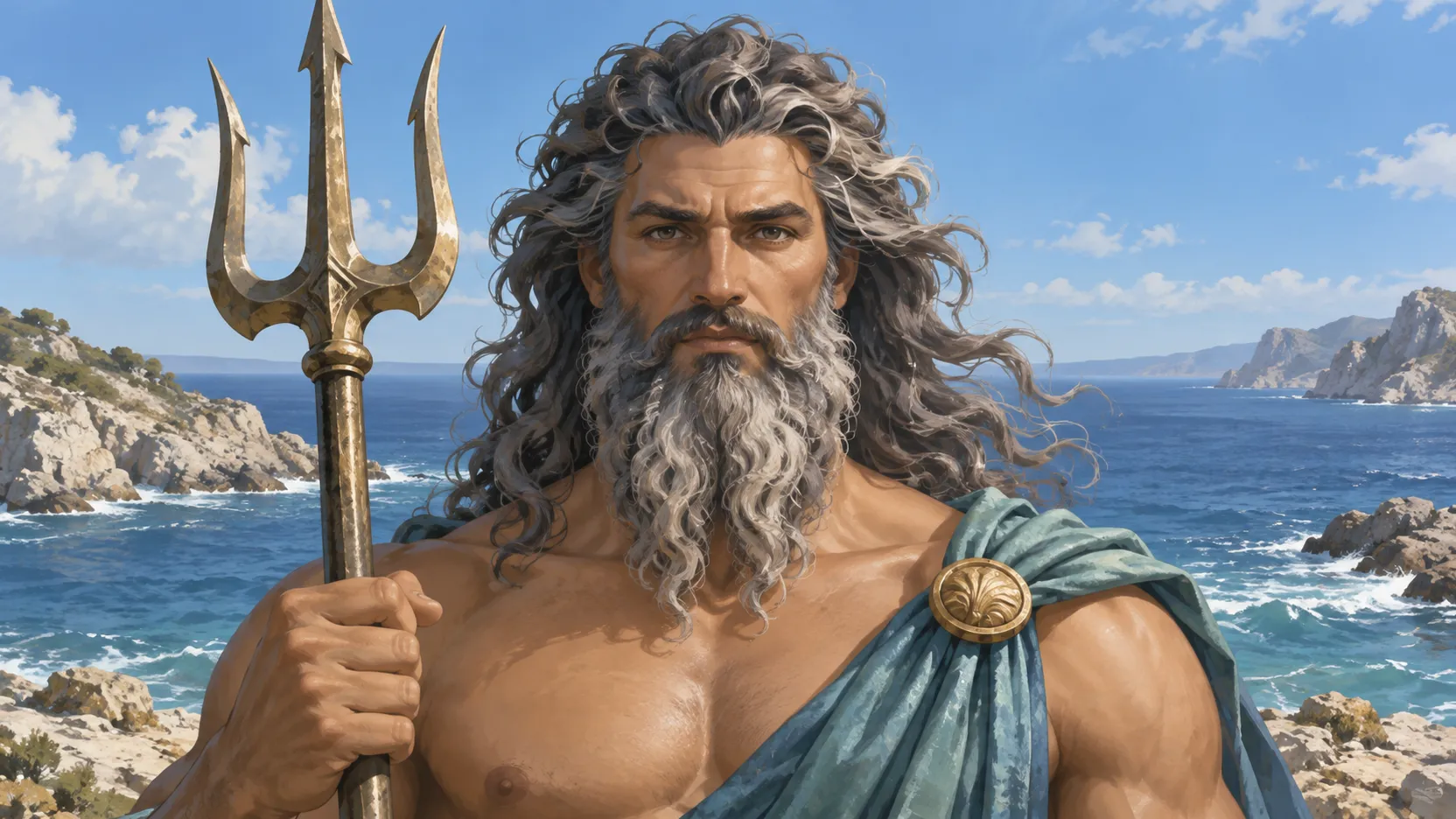
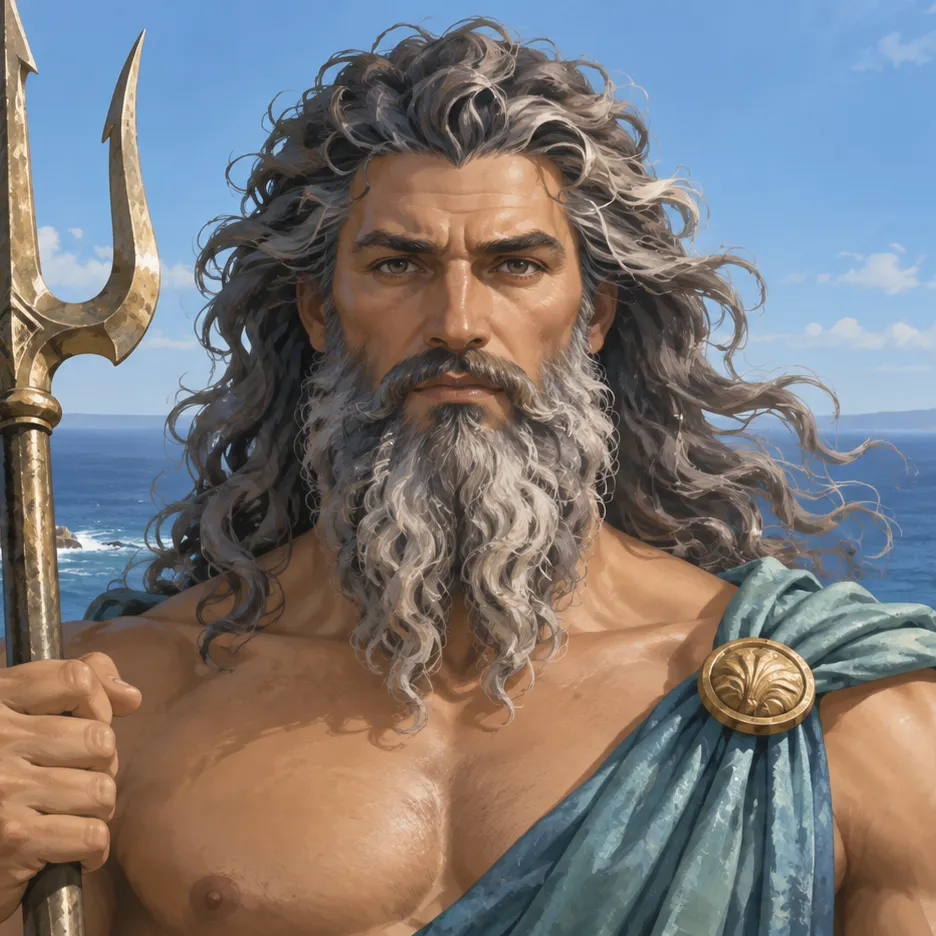
Poseidon walked toward the prow over the surface. Where his foot came down, the sea held it. He carried the trident upright, its points higher than the mast.
One of the rowers slid off his bench onto his knees.
The shipmaster took the wine jug from beside the steering platform. He came forward carefully, stepping over the feet of the men who had turned to watch him.
“Lord,” he said.
He poured. The wine spread darkly, but Poseidon did not let it sink. It remained between them in a thin, red skin.
“Whom did you carry?”
The jug clicked against the rail.
“Odysseus of Ithaca.”
“Did he tell you my name?”
The master looked down at the offering. “He told us of your son.”
“And afterward you gave him passage.”
“Our king promised it.”
The trident lowered until its middle point rested against the prow. A little curl of paint peeled from the wood.
The master’s eyes followed it. Behind him a younger man was trying to free an oar from its loop without making a sound.
Poseidon pressed. The prow dipped; cold water ran over the master’s feet.
“Is your king lord here?”
“No.”
“Then call him.”
The man looked toward the harbor. People were gathering at the landing place, their bodies small and bright beyond the water. Someone lifted a rope. They were still too far away to hear what was being said.
The shipmaster set down the jug.
“We found a man who wanted his house,” he said. “We knew the road.”
“You knew whose road.”
“Yes.”
The answer came without haste. Poseidon lifted his eyes from the peeled paint.
“When a stranger steps aboard,” the master said, “we ask you to bring him through. We asked last night.”
The younger rower had freed his oar. He laid it across the benches and edged toward the stern.
“And because I did,” Poseidon said, “you believed I would.”
The master opened his mouth, then shut it. Water shifted around his ankles. His king’s landing place was near enough now for Poseidon to see the coiled rope in the waiting man’s arms.
“Take back the gifts,” the master said. “Let me fetch them. I will cross to Ithaca again, and bring you everything we carried.”
“You will not cross again.”
Poseidon put his open hand against the bow.
The Ship That Stayed
The wood grew cold beneath his palm.
Its grain rose in narrow ridges. The pitch between the planks paled, and the iron fastening nearest his thumb disappeared into a seamless gray surface. He spread his fingers. Stone followed them.
The master staggered as the bow settled. He caught the rail, pulled his hand away, and stared at the skin scraped from it.
“Astern!” he shouted. “Get clear!”
The rowers crowded backward. One tried to pull his blade from the sea, but the shaft had stiffened in his hands. He hauled until his shoulders shook. The man beside him struck his fingers loose and dragged him toward the stern.
Poseidon held the ship while it changed.
The weight of it entered the water. A low swell ran out toward the quay. The carved prow, which had lifted through a hundred passages, stood motionless beside his wrist.
The master pushed a man over the side. Another jumped after him. Their splashes sounded small against the grinding inside the hull.
At the stern the young rower was crouched beneath a bench, pulling at a cloth bag caught around its leg.
“Leave it.”
He pulled harder.
The master seized him by the back of his tunic and hauled him upright. The bag tore. A handful of shells fell onto the deck, bright, common things that someone had gathered on another shore.
The young man reached for them.
The master shoved him into the sea.
Now the gray was moving across the last bench. The master climbed onto the stern rail, and for a moment he stood above Poseidon with the empty harbor behind him.
He did not pray again.
He jumped.
Poseidon turned his palm downward.
The keel lengthened into the seabed. Far below, rock answered rock. What had been a vessel struck its roots into the earth, and the force came back through the god’s arm. Water climbed its sides and broke white over the fixed oars.
He withdrew his hand.
The ship stood at the entrance to the harbor, high enough for every person on the quay to see. Its prow still leaned toward home.
Between it and the shore, men were swimming.
Alcinous had come down from his house. Poseidon saw him push through the gathering crowd and stop at the edge of the landing place. The king’s lips moved before his voice came.
“My father told me.”
A woman beside him called a name across the water.
“He said one of our ships would be broken on its return. He said the mountain would come over us.”
Beneath the harbor, Poseidon set his hand against the roots of the hills.
A crack ran through the landing stones.
The crowd drew back. The woman did not. She went down on her knees and stretched the mooring rope toward a swimmer who was still too far away to take it.
Alcinous caught her shoulder.
“Fetch the bulls,” he said to the men behind him. “Twelve. The best. Bring them to the altar.”
The stone under his feet tilted.
“And no more passages. Hear me. We will carry no more strangers.”
The shipmaster reached the quay. He tried to lift himself, slipped, and the woman caught his wrist. Together she and Alcinous dragged him up. He lay on the stone coughing seawater while the king repeated his command to those who had not heard.
“No more.”
The master raised his head.
“There are men still out there.”
“Bring our men in.”
“And the next one?”
Alcinous looked at him.
The master wiped his mouth with the heel of his hand. Behind him, his crew struggled toward the ropes. Beyond the stone ship lay the open water they had crossed in darkness, knowing the places where a lost man might wait beside a fire.
“The next man on a beach,” he said.
Alcinous bent to take a rope from the woman. He threw it past the nearest swimmer.
“No more,” he said again.
Poseidon felt the hills begin to yield. Deep seams loosened. He had only to lift, and the entrance would close above the ship; the city would hear the sea through a wall of rock for as long as it stood.
Across the quay, men were dragging a light boat down to fetch the last swimmers. The hull struck a stone and scraped. At the sound, the shipmaster turned sharply. He got to his feet and went to help them, holding one arm close against his ribs.
Poseidon knew the prayer that should have accompanied the launch. He had heard it at this shore through generations of small departures. He waited for it now.
The men pushed. The boat floated. No one spoke.
He held the weight of the hills a moment longer.
Then he eased it down.
The fissure in the quay remained, but it widened no further. The boat passed out between the landing place and the petrified prow. A swimmer caught its side.
Poseidon went beneath the surface before the bulls reached the altar.
Above him the stone keel was cold and firm, joined to the earth. He passed under the line where the ship’s shadow ended.
On shore, the man who had come to catch its rope began to coil it. He worked slowly, shaking the water from each length, and carried it back unused.