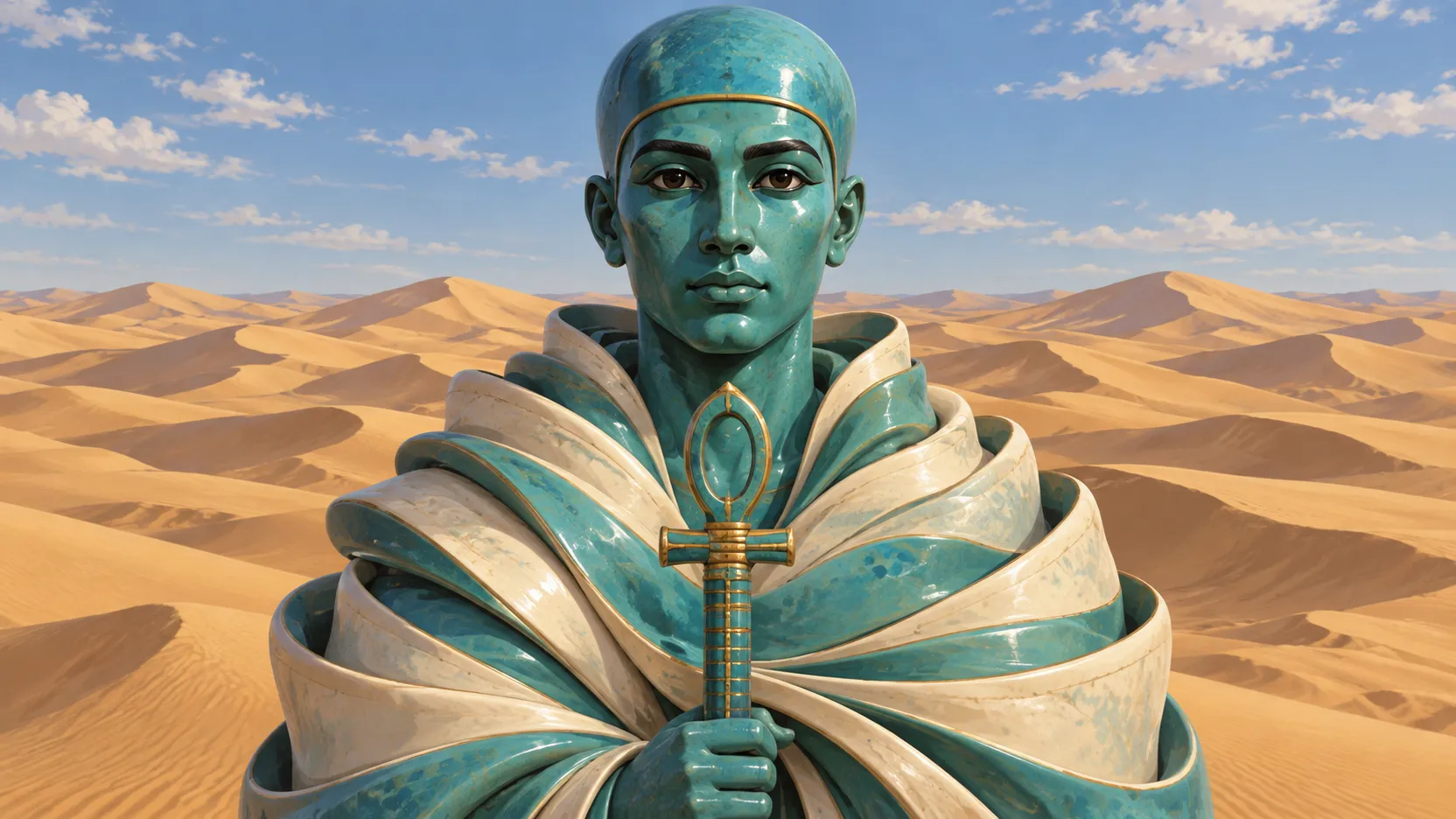
The Last Stroke
“Do not touch the mouth.”
Ptah stopped in the workshop doorway. The sculptor had spoken without turning, his chisel braced beneath the lip of a limestone man. White dust covered his knees. Beside him stood a bowl of untouched bread, its surface hardening in the morning heat.
“I have not touched it,” Ptah said.
“You were going to tell me to.”
The sculptor glanced back. His chisel struck the floor.
Ptah waited while the man scrambled to his feet, knocked over the bowl, and tried to kneel among the bread. Then he caught his elbow.
“Show me.”
The statue sat with its hands flat upon its thighs. One ear was slightly higher than the other. The mouth held the beginning of a smile, or the effort of concealing one. Ptah passed his fingers over the stone without touching it. He could feel where the sculptor had taken too much from the cheek and worked the other side to match, then returned to the first.
“My father,” the man said. “He carved the doorway you came through.”
Ptah looked up. Along the lintel, a procession of small birds stepped through reeds. One had turned its head against the direction of the others.
“He said that one heard something,” the sculptor added.
“And your name?”
“Dedu.”
“Your father taught you well.”
“Then help me finish him.” Dedu retrieved the chisel. “Every time I correct a thing, something else goes wrong. The mouth was his yesterday. Now I cannot find it.”
Outside, a donkey objected to its load. From the river came the knocking of an oar against a hull. Memphis was at work, and every blow of every tool reached Ptah. He knew the intention before the hand moved: the curve of a bowl held in a potter’s heart, a joint fitted in thought before the wood was cut.
Dedu held out his chisel, handle first.
“One last stroke,” he said. “Let it be finished.”
Ptah did not take the tool. He received the man’s longing instead, shaped it within his own heart, and found the statue as Dedu wished it: every surface resolved, nothing left to trouble the hand.
“Be complete.”
The mouth changed.
It was a movement no wider than the shadow of a fly, yet Dedu made a small, wounded sound. He reached for the cheek. His hand stopped a finger’s breadth from it.
“Father?”
The statue did not answer. Ptah had given no such command.
Dedu tried to lower his arm.
He could not.
The Finished City
Ptah caught the sculptor’s wrist. It was warm, and beneath the skin the pulse continued. But the hand had become part of the completed work: the son reaching, the father waiting, the distance between them exact.
“Step back,” Ptah said.
Dedu dragged one foot across the floor. The other would not follow.
At the doorway, the donkey fell silent.
Ptah turned. A basket-maker sat across the lane with a strand bent between her fingers. A boy was pouring water into a trough; the stream hung from the jar in a bright, unbroken curve. Beyond him a woman tried to call, but her lips held their open shape.
Ptah had conceived a finished work. In his heart the statue had not stood alone. It belonged to a workshop, a street, a city whose hands and trades came from his making.
He felt his intention travel along those connections.
“Move,” he told the water.
It leaped from the jar, struck the trough, and became still again. The boy’s arm had not lowered. Ptah could command another motion, then another, forever, giving each falling drop its separate instruction. All the while the larger intention remained: nothing left to change.
Behind him, Dedu began to breathe in short, frightened pulls.
“Take it back.”
Ptah closed his eyes.
The city lay within reach of his thought. He could gather the command back into himself, take with it everything he had bound into completion, and speak Memphis anew.
He began with the doorway.
The birds upon the lintel lost their edges.
Dedu cried out. “Not that!”
Ptah opened his eyes. The bird with the backward glance had almost vanished. Beneath it, the shadow of the doorway thinned, and through the stone showed a grayness in which no street had ever stood.
He released his hold. The bird returned.
“What did you do?”
“Began again.”
Dedu looked from the lintel to the god. His free hand tightened around the chisel.
“He will never carve another.”
“No.”
“And if you make me again?”
Ptah looked at the white scars across the sculptor’s knuckles, the bread he had neglected, the patch on his shoulder sewn with a different thread. He could make a man who resembled Dedu. That was not what the man had asked.
From the river came a long wooden groan. A boat was still moving against water that had ceased to yield.
Ptah went to the doorway. The stillness had reached the far bank. At the edge of hearing, a hammer struck once and did not strike again.
What the Hand Could Do
“Break the mouth,” Ptah said.
Dedu stared at him.
“Take away the thing you wished me to finish.”
“You can break it.”
“Yes.”
“Then do it.”
Ptah could already feel that answer taking shape: a broken statue, a grieving son, every fragment settled in its appointed place. Another finished arrangement. He let the thought go before it reached his tongue.
“If I decide every stroke for you, your hand will still be waiting on mine.”
Dedu’s eyes went to the face. For the first time since Ptah had entered, he could look at it without searching for an error. The father he remembered was there, lips pressed against a laugh, cheek lifted a little on one side.
“I will lose him.”
Ptah knelt beside the fallen bread. One piece had rolled into the dust. It should have been crawling with ants. An ant stood against its crust, legs lifted, caught in the journey toward it.
He had made the heart that wished, the tongue that spoke, the limbs that carried intention into the world. Yet he had listened to Dedu’s wish as though the man were another block to be brought to rest beneath his hand.
He set the bread upon the bench.
“Your father left a bird looking the wrong way.”
“It was not wrong.”
“No,” Ptah said. “It was his.”
The boat groaned again. This time something split.
Dedu put the edge of the chisel against the statue’s mouth. His free arm shook. He could not reach the mallet with the other.
“Hold this.”
Ptah took the chisel. Its small handle disappeared within his fist.
“Here?”
Dedu moved the point a little to the left.
“There.”
The correction entered Ptah’s heart before it reached the stone. He had not chosen it. He did not draw it back toward his own intention.
Dedu lifted the mallet.
Then he lowered it.
For a moment Ptah thought he had refused. But the sculptor was changing his grip, sliding his palm nearer the head for a shorter, surer blow. His father had taught him that. Ptah waited.
The mallet fell.
A white chip jumped between them.
Dedu gasped. The finished smile was gone; a raw notch cut through the lip into the cheek. His trapped hand dropped, striking the bench, and he clutched it to his chest.
Around the broken mouth, the stone began to smooth itself.
“Keep it,” Dedu said fiercely. “Leave what I did.”
Ptah felt the old completion pulling at the damage. Within his heart he held the chisel, the man, the city—and now the stroke that had come from a will he had made without needing to make each of its choices. He conceived their work continuing beyond the limits of his own finished picture: the potter changing a rim, the boatwright replacing a plank, Dedu deciding where the next cut belonged.
He let that intention reach his tongue.
“Make.”
The chisel kicked in his hand.
Water crashed into the trough outside. The donkey brayed so violently that Dedu flinched. Across the lane, the basket-maker cursed a strand that had snapped in her fingers. From the river came splashing, shouts, an oar beating hard against the current.
The notch remained.
Dedu touched it. Dust caught in the moisture beneath his eyes.
The Join
By evening the workshop floor was white again.
Dedu had cut a small recess around the damaged mouth. Beside the statue lay a new piece of limestone, paler than the old block. It would never disappear completely into the face.
He turned it between his fingers, testing the angle.
Ptah stood beside the bench. The sounds of Memphis came to him unevenly now: a saw stopping while its owner considered, a woman taking apart the edge of a basket, children arguing over the shape of something made from mud.
Dedu reached for the lamp. His bruised wrist gave way, and oil rocked toward the lip.
Ptah caught it.
“A little higher,” Dedu said, his eyes on the recess.
Ptah raised the light.
The sculptor leaned close and began to cut.