
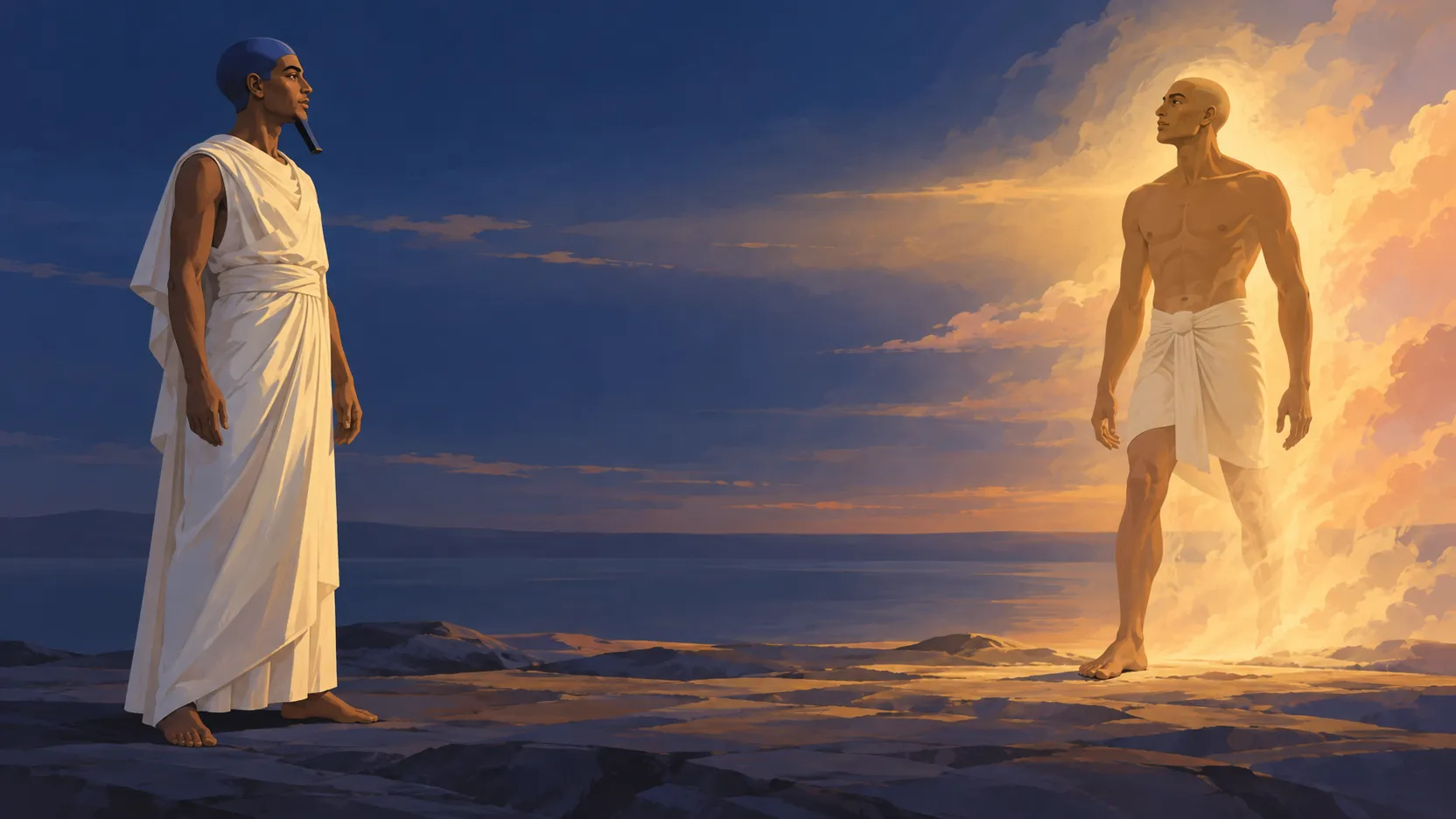
Ptah held a name behind his closed lips.
Within his heart, its bearer already had a face. He knew the shape of the brow, the weight of the limbs, the place where breath would stir. Nothing stood before him yet. There was no answering gaze, no footfall, no sound but the silence into which he was about to speak.
The form was complete in his thought.
“Atum.”
His tongue gave the name its shape. His lips released it.
Before him, a face turned. Eyes opened. A chest rose with its first breath, and Ptah felt the silence change. The being he had conceived now looked back at him.
He spoke again.
Shu came forth. Tefnut followed. The names did not fall away into emptiness; each brought a presence with it. Where Ptah directed his thought, another face appeared, another voice joined those already sounding. The divine company gathered before him, distinct from one another, alive.
He heard them breathe.
The sound entered his heart. There he held what he had made, together with all that would sustain it: the food not yet tasted, the paths not yet trodden, the places where these voices would one day be heard.
He began to give them names.
The Work of the Word
Earth lay beneath the gathering gods. Water found its course through it. Along the wet margins, stalks rose and unfolded, and the wind bent them together.
Ptah watched the reeds bow. He had conceived their yielding and their return; now they moved beyond him, brushing against their neighbours with a dry, delicate sound.
His next words carried life farther.
A creature lowered its head to drink. Ripples broke against its muzzle. Nearby, something small moved between the roots, disappeared, and emerged again into the light. Human voices rose among the other sounds. Feet pressed into soft ground and left tracks behind them.
The world had acquired hunger.
In Ptah’s heart were the grain and its ripening, the hands that would gather it, the bread that would pass from one person to another. His tongue gave expression to what he had conceived. Fields stood ready to feed the living. Food filled waiting hands. Offerings found their places before the gods.
Then came the work of those hands.
A wrist turned; fingers closed firmly around a tool. A foot shifted to bear the body’s weight. Wood parted along a chosen line. A vessel rose beneath moving palms, its hollow deepening, its rim held steady.
Ptah heard the first clear stroke of a craftsman at work. Another answered it farther away. Between the strokes came a voice directing the labour, then the scrape and press of hands carrying out what the heart had planned.
He listened. His own command lived in these small movements too.
Places took their shape around the living. There were paths with destinations, houses with thresholds, towns whose voices could be heard from their approaches. Beyond them lay other settlements and stretches of cultivated earth. The gods looked out across a world in which there was room to dwell.
Ptah turned his thought to their dwellings.
The Waiting Forms
Within the shrines, bodies stood ready.
Some were wood, carrying its quiet scent. Some were stone, cool even where the light reached them. Others were clay. Each had been made in a form pleasing to the god who would inhabit it.
Ptah stood before an open doorway. Beyond its threshold a stone face waited in the dimness. Light touched one cheek and left the other in shadow. The eyes were fashioned; the mouth was still.
The god approached.
Ptah watched the presence pass into the waiting body. The shrine was occupied. Before the face, the appointed offering lay ready, and the doorway opened upon the land that would provide it.
Through the other thresholds the gods entered their own forms. Wood, stone and clay received them. Each found a dwelling; each had a place among the others. Their living powers gathered with them, and none stood outside the completed work seeking a home.
Ptah looked upon them.
The thought that had once rested within him surrounded him now. It had voices, weight and movement. It could be approached along a road. It could give shelter. It could be carried in two hands to someone waiting for food.
He had spoken all that his heart conceived.
Ptah was content.
He closed his lips. Beyond the shrine, a craftsman’s tool struck wood, and the reeds beside the water went on moving.