
The Flower in the Meadow
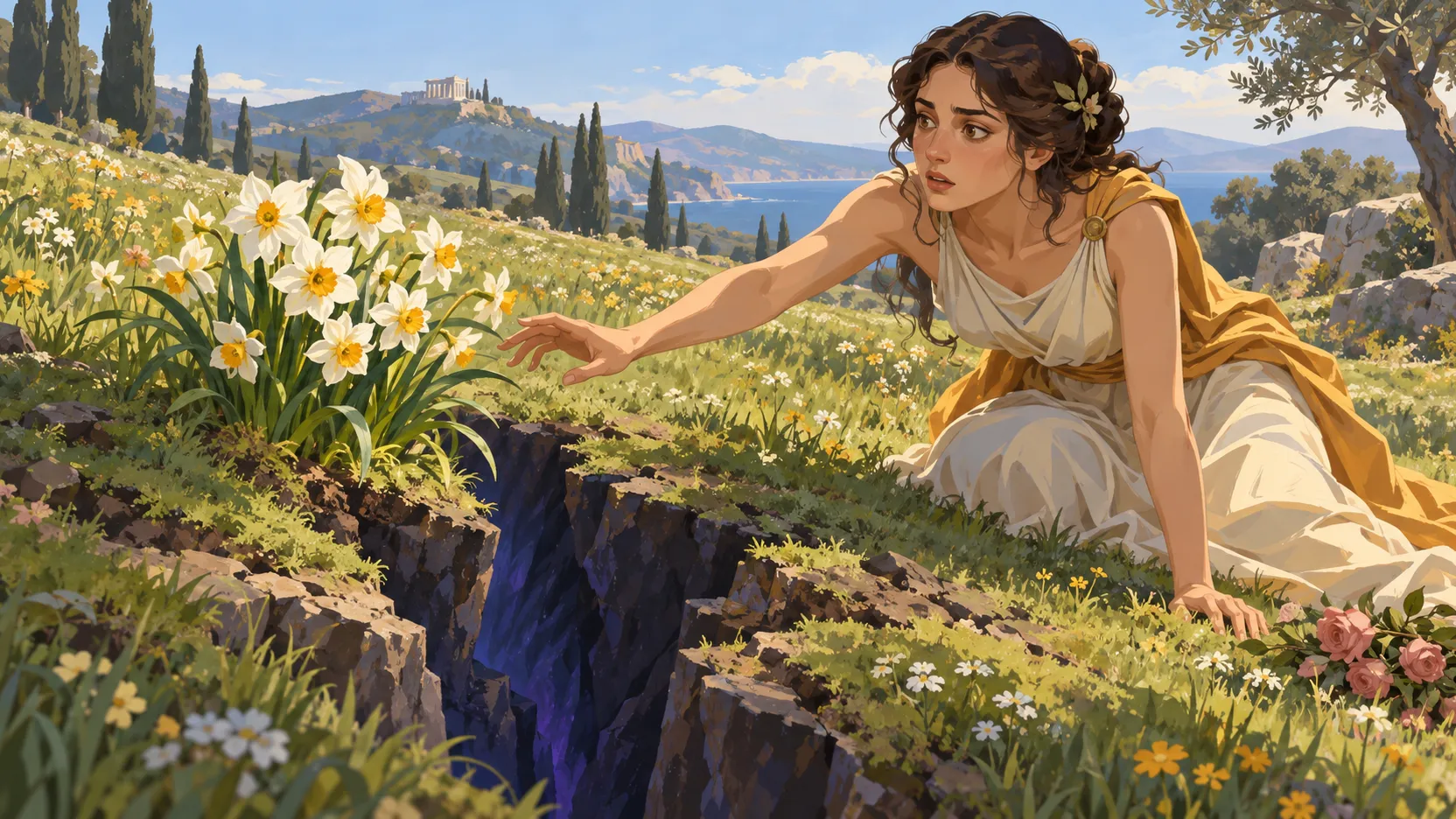
Persephone had almost more flowers than she could carry when she saw the narcissus.
It grew a little apart from the others. A hundred blossoms crowded one root, bright above the grass, and their fragrance reached her before she knelt. Behind her, the daughters of Ocean called to one another across the meadow. She meant to call them over. First she wanted the flower in her hands.
She laid down her armful of roses and reached.
The ground opened.
Grass tore beneath her knees. Out of the darkness came horses, their hooves striking where there had been no road, and a golden chariot rose into the sunlight. A hand seized her. Before she could find anything to hold, she was lifted from the meadow.
“Father!”
The chariot turned. Persephone caught its rim with both hands and saw the flowers she had gathered falling into the cleft. Beyond them were the blue sky and the sea, still bright, still there. While she could see them, she could believe that someone would come.
The driver did not loosen his hold.
Hades had come for her with her father’s leave. Zeus had permitted it; Earth had grown the flower to draw her near. Persephone knew none of this as the daylight narrowed overhead.
She cried out again, and this time her mother heard.
The Torches
Demeter stopped where she stood.
There had been her daughter’s voice, sharp with terror. Now there was wind. She listened so fiercely that the rustle of leaves seemed an intrusion, something she must put aside to hear the sound again.
“Persephone?”
She tore the covering from her hair and went towards the cry.
She crossed fields and mountain slopes, shores where the water erased each footprint, paths on which people moved aside from her without knowing why. She questioned those she met. No one gave her daughter back. No one told her where to look.
At night she carried torches. Their flames bent as she hurried, lighting the stones just before her feet. She did not eat. She did not wash the smoke from her hands. Whenever she reached the edge of one stretch of darkness, another lay beyond it.
Nine days passed.
On the tenth morning Hecate came to her with a torch of her own.
“I heard her,” Hecate said.
Demeter gripped her arm.
“Who was with her?”
“I did not see.”
For a moment Demeter’s hand remained there. Then she let go. Hecate had brought her almost nothing, but it was the first true thing anyone had offered.
Together they went to Helios, whose light passed over sea and land. Demeter stood before his horses.
“You look into places no one else can see,” she said. “Tell me where she is.”
The sun god looked down at her. His horses shifted in their harness.
“Hades has taken her below.”
Demeter waited. Helios had not finished; she could hear it in the space after his words.
“Zeus gave his consent.”
The torch crackled in her hand. Her daughter had called to her father. Somewhere beneath the earth, perhaps she was calling still.
Helios spoke of the kingdom Hades ruled, the honours Persephone would possess there, the greatness of the husband chosen for her. Demeter stepped away from his horses. Nothing he said required an answer.
She would not go back to Olympus.
The Child at the Hearth
At Eleusis, four young women found an old stranger sitting beneath the shade beside the well.
Her cloak was dark, her face drawn. She watched them lower their vessels and lift them full. At last one of the sisters asked why she did not seek shelter in the town.
“My name is Doso,” the stranger said.
Demeter had laid age upon herself until no mortal eye could recognize her. She told the sisters of Crete, of pirates who had carried her away, of an escape along an unfamiliar shore. She asked whether a household might need an old woman who knew how to nurse a child.
“Our mother has a little son,” one of them said.
They went to ask permission and came hurrying back for her.
In the house of Celeus, Metaneira sat with the baby against her breast. She rose when the stranger entered. For an instant the doorway seemed filled with a light that did not belong to the afternoon, and the old woman looked taller than she should. Then there was only a tired traveller waiting to be seated.
Demeter would not take the fine couch offered to her. Iambe, who served in the house, brought a stool and spread a fleece across it. There Demeter sat, holding her veil before her face.
The household tried to welcome her. She could not bring herself to answer.
Iambe stayed near. She talked as she worked, teasing and coaxing, refusing to be driven away by silence. At last something she said broke through. A laugh escaped Demeter before she could prevent it.
It ended quickly. Still, when Metaneira offered a cup, Demeter spoke.
“No wine. Water, with barley meal and mint.”
Metaneira had it mixed. Demeter drank, feeling the crushed mint cool against her mouth. Then the woman brought her the child.
“His name is Demophoon. He came to us when I had almost stopped hoping.”
Demeter put out her arms.
The baby settled against her. One hand opened on the fold of her garment, closed, and held it. She looked down at that small, unthinking grip.
“I will care for him,” she said.
Under her care he grew wonderfully. She anointed him with ambrosia and held him close, breathing upon him. His parents watched his strength with joy. They did not see what she did at night.
When the house lay quiet, Demeter carried him to the hearth.
She placed him in the heart of the fire.
The flames gathered around him. He did not cry. Demeter watched over him while the light moved across her face; night after night she worked to take the mortal frailty from him, to make him beyond age and death.
Then Metaneira woke and came to look for her son.
From the doorway she saw the old nurse bending over the hearth. She saw her child among the flames.
“Demophoon!”
Her scream filled the room.
Demeter snatched him from the fire and cast him down upon the floor. His cry followed his mother’s. Metaneira stood unable to move.
“He would have lived without growing old,” Demeter said. “I would have kept death from him.”
The old voice was gone.
Age fell from her. Golden hair loosened over her shoulders; light spread through the room until the ordinary hearth seemed dim. Metaneira could scarcely bear to look at the woman before her.
“Now he must die when his time comes. But he will have honour, because I have held him.”
The baby cried on.
“I am Demeter.”
Metaneira sank where she stood.
“Tell your people to build me a temple above the well. There I will teach them how to honour me.”
Then the goddess left the house.
Demophoon’s sisters came running. One lifted him, another tended the fire, another hurried to their mother. They washed him and held him, passing their frightened hands over his living limbs. He would not be comforted.
By morning Celeus knew what had happened. He called his people together, and they built the temple as the goddess had commanded.
When it was finished, Demeter went inside alone.
The Empty Furrows
The ploughs crossed the fields. Barley fell into the opened ground.
Nothing came up.
Men broke the soil between their fingers and searched for a shoot. They harnessed their oxen again, sowed again, waited again. Beneath them the seed remained hidden. Demeter would not let it grow.
In her temple she heard the sounds of Eleusis changing. The movement of work gave way to waiting. Grain jars grew lighter. The hands that had built her walls could not coax a green blade from the earth outside them.
She knew what she was withholding.
Still she sat apart.
Iris came first, bright at the temple entrance, carrying the summons of Zeus.
“He calls you to Olympus.”
Demeter looked past her at the bare land.
Iris waited, then went back without her.
Other gods followed. They brought promises, offered gifts and honours, named things that could be hers if she would rise and take her place among them again. Their voices filled the temple where her daughter’s voice should have been.
At last Demeter answered.
“I will see Persephone.”
They spoke again of Zeus.
“I will see her with my own eyes. Until then, no harvest.”
The message went back to Olympus. Below it, the earth lay empty. If the people died, no hands would remain to heap the altars, no smoke would rise from offerings, no voice would call the gods by their names.
Zeus sent Hermes down into the dark.
The Seed
Persephone saw the messenger come into the hall of Hades and stood up before he spoke.
He had come from above. Somewhere beyond the long descent, the sun was moving over the world. She searched his face.
“Your father has ordered your return,” Hermes said.
Then he addressed Hades. Demeter was keeping the seed beneath the soil. Mortals would perish unless her daughter was brought back to her.
Persephone scarcely heard the rest. Her mother had not ceased looking for her. The thought made the vast hall seem suddenly passable: there was a way through it, a road out, and someone waiting at its end.
Hades smiled.
“Go to her,” he said.
Persephone turned towards the messenger.
“Remember the honours you have here,” Hades continued. “You will rule beside me.”
She wanted the door. She wanted the air that had touched her mother’s face.
Before she left, Hades made her taste a pomegranate seed. She had not asked for it. She had not chosen to eat. Its sweetness entered her mouth against her will.
Then the horses were brought to the golden chariot, and Hermes took the reins.
Persephone climbed aboard.
Through the hidden ways of the earth the horses carried them. She held the chariot’s rim as she had held it when she was taken, but now the darkness lay behind her. Light widened ahead. Air struck her face, moving, full of distance.
They came to Eleusis.
Her mother was already running from the temple.
What Could Be Returned
Demeter saw her daughter spring down before the horses had quite settled.
She caught her so hard that neither could speak. There was Persephone’s hair beneath her hand, Persephone’s shoulder, her cheek pressed close. Demeter drew back only far enough to see her face, then held her again.
For a little while there was nothing else.
Then fear returned.
Demeter’s hands tightened on her daughter’s arms. Hades had let her go. Had he let her go entirely?
“Did you eat?” she asked.
Persephone looked at her.
“Anything, while you were below?”
There was still sweetness in the memory of her mouth.
“A pomegranate seed. He made me taste it.”
Demeter closed her eyes.
She had imagined bringing her daughter home and shutting the door upon everything that had happened. But food from that place had made a claim upon her. The ground beneath their feet was no longer simply ground.
“If you had eaten nothing, you could stay,” she said. She opened her eyes again; Persephone was watching her, waiting. “Now you must go below for a third of every year. The other two parts you will be with me.”
Her daughter’s fingers caught her cloak.
“When the spring flowers come,” Demeter said, “you will come up again.”
Persephone told her what had happened: the meadow, the flower, the sudden opening in the earth. She spoke of calling to her father. Demeter listened without releasing her. When the words faltered, she waited; when they came again, she heard them.
Hecate found them together. She embraced Persephone, and from then on would remain her attendant and companion. Demeter watched the two who had once been separated by a cry draw close enough to touch.
At last Rhea came down from Olympus.
Demeter’s mother crossed the barren plain to meet her daughter and her daughter’s child. She brought the settlement Zeus had confirmed: one third of the circling year below, two thirds above. He had bound his word to it. Demeter could choose honours among the gods and return to them.
“The fields,” Rhea said. “Let them live again.”
Demeter looked out over the furrows. Seed lay there that had never failed for lack of rain or labour. Beyond the fields stood the houses of people who could not descend to fetch their children back from death.
Beside her, Persephone was warm in the sunlight.
Demeter let the grain grow.
Beneath the soil, roots stirred. Green points broke through the dark clods, then leaves unfolded across the earth. The bare places filled with flowers.
Before she left Eleusis, Demeter called Celeus and the other leaders to her. She taught them the sacred rites they were to keep, things to be guarded in reverence, never carried into idle speech. Those who had built her temple received what she had promised them.
Then mother and daughter went together towards Olympus.
Below them, wind moved through the grain.