
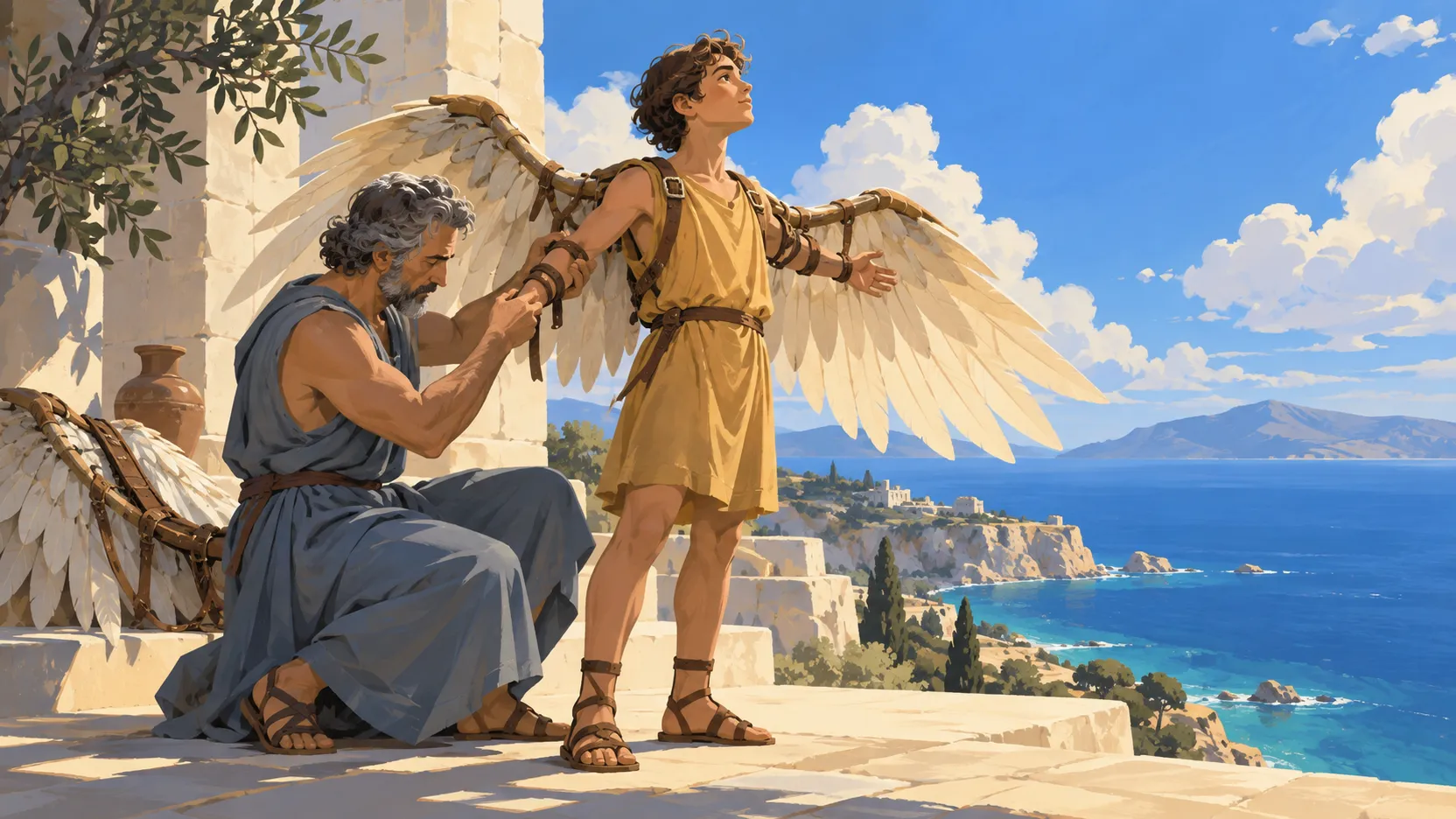
Daedalus laid a feather on the stone beside him. The wind took it at once.
Icarus caught it before it reached the doorway and brought it back, laughing. His father held out his hand, but the boy lifted the feather above his head and let it go again. It turned once in the air between them.
“Keep that one,” Daedalus said. “We shall need it.”
“Only that one?”
“All of them.”
Beyond the doorway lay Crete, and beyond Crete the sea. Somewhere past that brightness was the country Daedalus longed to reach. Minos ruled the roads and the harbours. No ship would carry them away against the king’s will. Daedalus had spent too many evenings watching sails vanish where he could not follow.
Now he watched the feather descend into his son’s palm.
He cleared a space on the stone.
For days he sorted feathers, fitting the short ones beside the long, arranging their edges until the rows rose in a smooth slope. He bound them with thread and worked warm wax around their bases. The wings spread wider than his arms. He bent them carefully into curves, lifted them, set them down, and began again where the shape displeased him.
Icarus sat close enough to get in the way. He caught the down that drifted from the work and pressed his thumb into the yellow wax until it held the shape of his thumb. Sometimes Daedalus took a feather from him without looking up. Sometimes he had to take it twice.
“Is that mine?” Icarus asked when a second pair lay beside the first.
“If it will carry you.”
The boy went still. He looked from the feathers to the open sky.
Daedalus fastened the larger wings to himself. Their tips brushed the stone. He stood for a moment with his arms spread, feeling their unfamiliar weight, then brought them down against the air.
Dust moved at his feet.
He tried again, harder. The wings caught, his heels lifted, and the floor dropped away beneath him. For a few heartbeats he hung above it, awkward and astonished, his own shadow trembling below.
Icarus shouted.
Daedalus landed heavily. He knelt at once to examine the bindings. Thread held. Wax held. He ran a finger beneath each row, searching for a loose shaft, while his son crowded against him.
“Again,” Icarus said. “Do it again.”
Daedalus looked up at him. Then he drew the smaller wings across his knees.
“Your turn.”
He fitted them to the boy slowly, settling the weight at his shoulders, tightening what must not slip. Icarus stretched out his arms. A pale fan of feathers opened on either side of him, and he turned his head to look along them.
“Listen before you move.”
His son stopped.
“Stay between the sea and the high sky. If you go too low, the water will weigh these feathers down. If you climb too far, the sun will soften the wax.”
Daedalus pressed a binding with his thumb. It was firm now. He could remember how readily it had yielded to the warmth of his hands.
“Watch me. Follow where I fly.”
“How far?”
“As far as we must.”
Icarus moved his arms a little, testing the pull across his shoulders. Daedalus caught his wrist.
“Tell me.”
“Not near the water. Not near the sun. Behind you.”
His father released him. There was another fastening to check, though he had checked it already. His fingers would not settle to the work. He wiped his cheek with the back of his hand and bent to kiss the boy.
Icarus leaned impatiently into the kiss, his wings half raised.
They went out into the wind.
Daedalus rose first. He climbed only far enough to clear the ground, then turned, beating his wings to hold his place. Below him Icarus stood with his face lifted. The boy’s first stroke sent the feathers shivering; the next lifted him clear.
For a moment his feet searched for the earth.
Then he was flying.
Daedalus called him forward. He watched until the boy drew level behind him, then turned towards the sea. His wings fell and rose. Icarus copied their motion. Between each stroke came a brief, breathless stillness in which the air carried them both.
The shore slipped beneath them.
A fisherman looked up from his line. Farther inland a shepherd stood motionless beside his flock, and a man at his plough let his hands fall from the handles. The two winged figures crossed the fields above them. No road led there. No footprint remained. The men gazed after them as if gods were passing overhead.
Daedalus kept looking back.
Each time, Icarus was there.
The boy had never known such room. On the ground a wall or a hill had always ended his sight; now one island opened beyond another. He could see the pale shallows edging their shores, and boats that seemed scarcely larger than the scraps of wax left on the work stone. When he tilted his wings, the whole shining sea tilted with him.
His shoulders had ached at first. Now he scarcely noticed them. He had found the rhythm.
Ahead, his father flew steadily. Icarus followed through the wide stretches of water. Delos and Paros fell behind; other islands rose ahead, blue at their edges. The air moved cool across his face.
He pressed down more strongly with his wings.
He rose.
His father’s course lay below him now, a little lower, easy to return to. Icarus spread his wings and felt them bear him. There was no stone above his head, no king’s door waiting to close. Beyond him the sky kept opening.
Another stroke carried him higher.
He turned his face into the light. The feathers shone along his arms. Far below, his father was a small shape moving over the water, but up here there was nothing between Icarus and the sun.
Something warm touched his wrist.
He looked down. A yellow bead slid along a binding. As he watched, it stretched and fell away.
One feather lifted crookedly from the row.
Icarus lowered his arm, trying to bring the wing back into the angle his father had shown him. The loosened feather spun free. Two more followed it.
He began to sink.
He struck at the air. For an instant the remaining feathers caught and checked him; then their bases pulled through the softened wax. The wing opened into pieces.
Icarus reached across to hold them, but his other wing was coming apart too. Feathers crowded around his face. He could not see his father.
“Father!”
His arms made the motion they had learned. There was nothing left to carry him.
The sea rushed towards him, darkening as it came. His cry broke against the water, and the water closed.
Daedalus looked back into an empty sky.
He turned so sharply that one wing dipped towards the waves. He steadied it and called his son’s name.
No answer came.
He circled, searching above him, searching the brightness where the sun lay on the sea. Perhaps the boy had fallen behind. Perhaps he had turned towards an island. Daedalus called again and listened between the beating of his wings.
A white feather floated below.
He descended. There was another, and farther off a spreading scatter of them, rising and falling on the small waves. He knew their lengths. He knew the grey mark near the tip of one he had fitted with his own hands.
“Icarus.”
He searched until he found his son, and brought him to land.
There he tore off his own wings and flung them down. He cursed the feathers, the wax, the patient work of his hands. The boy lay silent beside him. Daedalus reached to move the wet hair from his forehead, as though it troubled him.
On that shore he dug a grave.
His hands, which had measured and fitted and fastened, lifted the earth and let it fall. When the grave was covered, he stayed kneeling beside it. The sea moved below him. Behind him the wind stirred the wings, and he did not turn.