
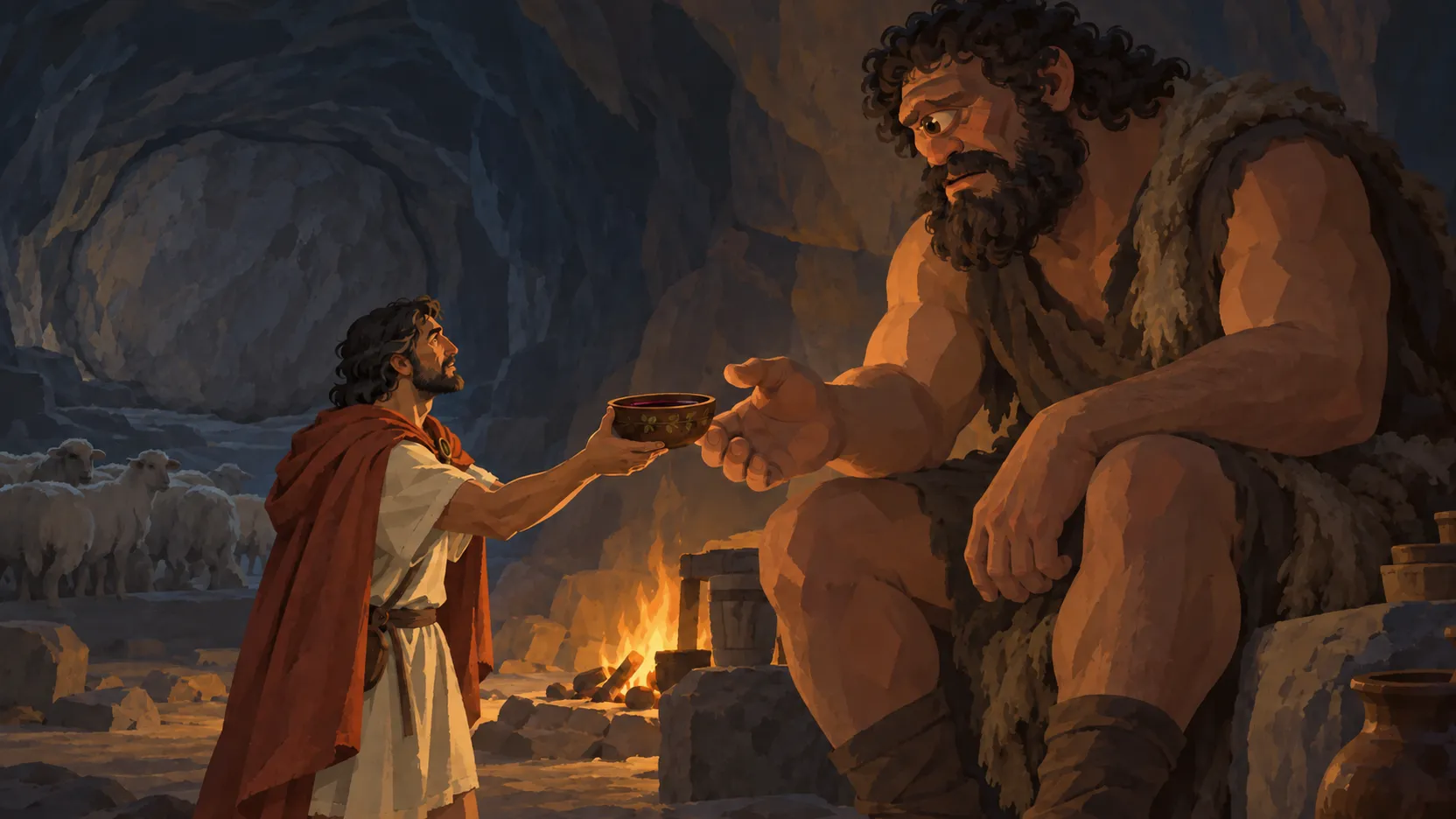
The cave was empty, and the men wanted to leave before its owner came home.
They stood among baskets of cheese and pens crowded with lambs. Milk shone in bowls so large that Odysseus could have washed his shield in one. Outside, beyond the stone enclosure, the sea lay open. Their ship waited below the headland; the rest of the fleet lay at a neighbouring island. After the war at Troy and the long, uncertain voyage, here at last was food they could carry away.
“Cheese first,” one of the men whispered. “Then the lambs. We can be aboard before dark.”
Odysseus set down the skin of strong wine he had brought with him.
“We will wait for our host.”
He wanted to see what sort of man lived here, and what gift such a wealthy shepherd would give a traveller. The men looked towards the daylight, then back at him. They lit a fire and ate.
The light vanished beneath a moving shadow.
Sheep pressed through the entrance. Behind them came a giant with a load of firewood across his shoulders. He flung it down, and the crash drove the strangers into the farthest darkness. One eye looked out beneath his brow. Without glancing their way, he rolled a boulder across the entrance.
Odysseus watched the stone settle. No hands aboard his ship could have moved it.
The giant milked his animals and put the young beside their mothers. He worked patiently, placing each bowl within reach. Only when he stirred the fire did he see the men.
“Who are you?”
“Travellers from Troy,” Odysseus said. His voice sounded small in the cavern. “We are trying to reach our homes. We ask the welcome owed to strangers. Zeus watches over those who seek shelter.”
“Then let Zeus welcome you.” The giant leaned closer. “Where is your ship?”
“Broken on the rocks. We alone escaped.”
Odysseus kept his eyes on the great face. Behind him, nobody contradicted the lie.
The giant reached past him and seized two men. Their cries ended against the stone. He ate them beside his fire while the others crouched beyond its light. Afterwards he drank milk and lay down among his flock.
Odysseus drew his sword.
He could reach the sleeper. He could drive the bronze beneath the ribs before that terrible hand closed on him. He took one step, and saw the boulder again.
If the giant died, the doorway would never open.
He slid the sword back into its sheath. Around him, the men who remained were shaking. He had made them wait for a gift.
At morning the giant ate two more. Then he rolled aside the stone, drove his flock out and shut the survivors into darkness.
For a while they listened to the bells growing faint on the hillside.
Odysseus rose. Beside a pen lay a length of green olive wood, cut for the giant’s staff. He measured a piece against his own height and called the men to help him. Together they cut it free and scraped it smooth. He sharpened one end, hardened it in their small fire and hid it beneath the litter on the floor.
They cast lots for the four who would lift it with him.
Nobody asked what would happen if their strength failed.
That evening the whole flock came inside. Again the stone closed the cave; again the giant took two men. When he had finished, Odysseus approached with a bowl of wine.
“Try what we brought for you.”
The giant took it. He drank, lowered the empty bowl and held it out again.
“More.”
Odysseus filled it. This was the dark wine given him by Maron, a priest whose household he had spared. Even through the smells of smoke and sheep, its sweetness rose from the bowl.
“Your name,” the giant said. “Tell me your name, and I will give you a gift.”
A third bowl followed the second. Odysseus watched the giant’s hand grow loose around it.
“Nobody,” he said. “My name is Nobody.”
“Then Nobody shall be eaten last.”
The bowl tilted. Wine ran across the floor. The giant’s head fell back, and his breath deepened into a snore.
Odysseus pulled the stake from its hiding place.
The four chosen men gathered beside him. They laid the point in the embers until it glowed. Then, together, they lifted the timber and drove it into the giant’s single eye.
His cry filled the cave. They let go and scattered. The stake struck stone behind them as he tore it free; his hands swept through the places where they had been.
Outside, other voices answered.
“Polyphemus! Who is hurting you?”
“Nobody!” he roared. “Nobody is killing me by trickery!”
The men held their breath.
“If nobody is attacking you, we cannot help your sickness. Pray to your father Poseidon.”
The voices receded. Polyphemus dragged the stone aside, but freedom did not follow. He sat across the opening, arms stretched out, feeling for anyone who tried to pass.
Odysseus could see the stars beyond his shoulder.
He turned to the rams.
Working silently, he bound them in groups of three with twisted withies. Beneath each middle animal he secured a man; the heavy fleeces on either side hid the shape below. For himself he chose the largest ram. He gripped its thick wool and drew his body up beneath its belly.
They waited there until dawn.
The rams began to press towards the light. One by one they passed between Polyphemus’s knees. His hands moved across their backs, searching the places where he expected a man to ride.
Beneath his ram, Odysseus could see the giant’s feet. A few more steps would carry him past them.
The ram stopped.
“Why last, old friend?” Polyphemus murmured, holding its head. “You always lead the others.”
Odysseus tightened his fingers in the fleece. His arms ached. Dust rose beneath the hooves and settled against his lips.
“Do you grieve for my eye? If only you could speak. You would tell me where Nobody hides.”
The huge hand stroked the ram’s back. Then it pushed him gently out.
Sunlight warmed Odysseus’s feet.
Beyond the enclosure he dropped to the ground and released the others. They drove the rams down to the ship. Those who had waited aboard reached for their returning friends, then searched the shore for the missing men.
Odysseus shook his head. There was no time to mourn aloud. They loaded the animals, pushed off and bent to the oars.
When the cave had dwindled above the water, he stood in the stern.
“Your guests have escaped you, Cyclops!”
Polyphemus appeared on the headland. He lifted a mass of rock and hurled it towards the voice. It struck the sea near the ship, and the wave drove them back towards land. Odysseus seized a pole to fend them off while the rowers strained against the surge.
At last the distance widened again.
“Enough,” a man gasped. “Let him keep the name you gave him.”
But the cave, the stone and the six men who would never leave it were still before Odysseus. He wanted the giant to know whose hands had undone him.
“If anyone asks who blinded you, tell them Odysseus, son of Laertes, of Ithaca!”
The oars faltered.
Across the water Polyphemus cried out. Long ago, he said, a seer had foretold that name. He had expected a mighty conqueror, not a small man carrying wine. He called Odysseus back, offering gifts and his father’s favour.
Odysseus answered with another insult.
Then the giant raised his hands to the sky.
“Poseidon, if I am your son, hear me. Let Odysseus never reach his home. If he must return, let him come late, alone, in another man’s ship, and find trouble waiting.”
Poseidon heard.
A second rock rose above the headland and fell behind the ship. Its wave carried them farther out, towards the waiting fleet. The men rowed on. This time Odysseus stood silent, while the water that bore them away closed over the stone.