
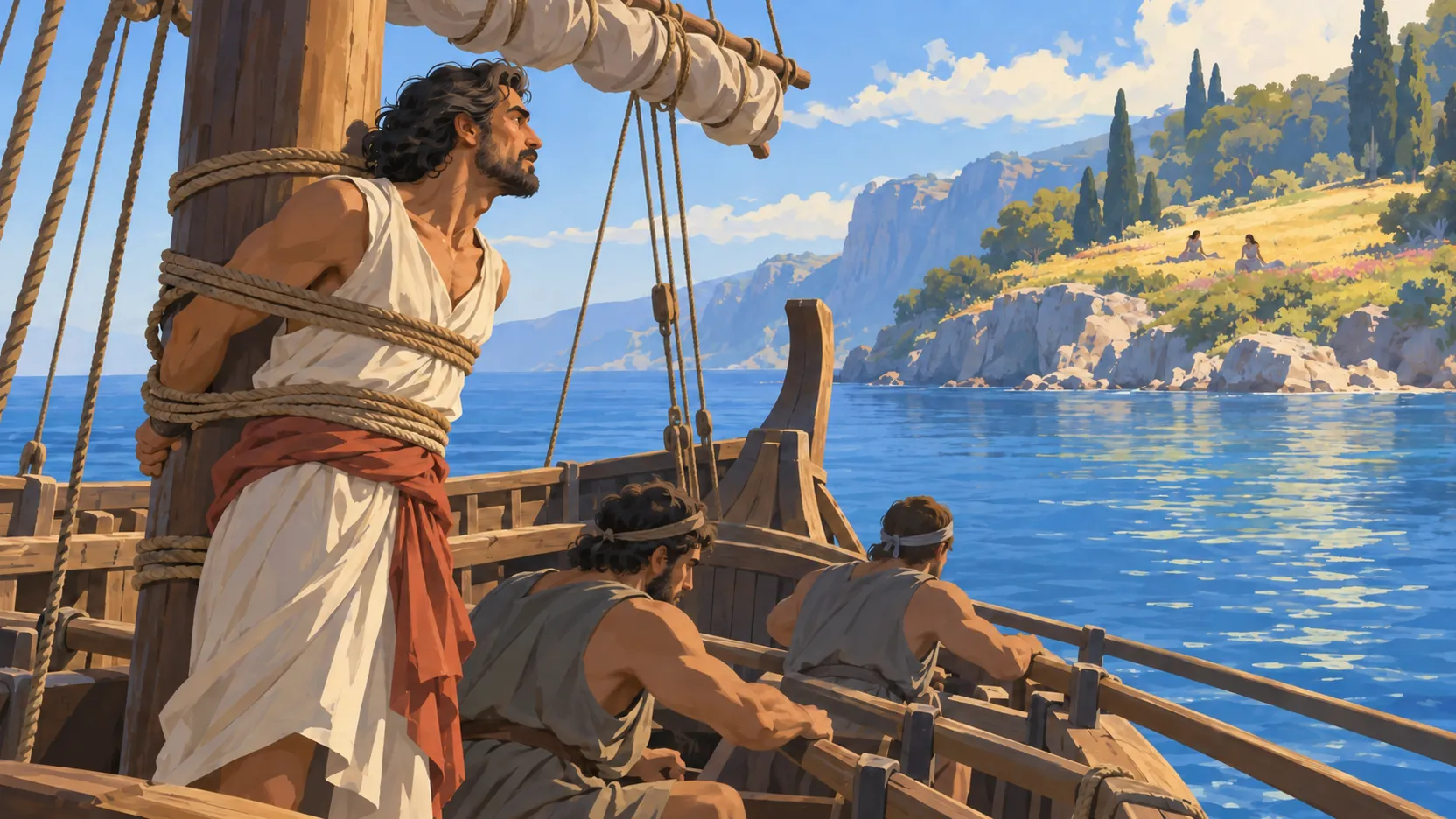
“If I ask you to release me,” Odysseus told his men, “pull the ropes tighter.”
They stood beneath a filled sail. Ahead lay the island of the Sirens; beyond it lay the long sea-road towards Ithaca. Odysseus had survived Troy and the perils that followed it, but the warning Circe had given him required something stranger than a weapon.
The night before, while his men slept beside their ship, the goddess had described a meadow and the voices singing there. No wife or child welcomed home the sailor who drew too near. Bones lay around the singers.
Wax would protect the rowers. They must hear nothing and keep the ship moving.
But Odysseus could listen, Circe had said, if his men bound him upright to the mast and refused to free him until they had passed. Whatever he asked of them then, they must remember what he had asked before.
Now he looked from face to face, making sure they understood.
“Even if I order it.”
The wind died.
The sail hung loose above their heads. Across the water, the bright, broken surface smoothed until scarcely a ripple remained. Men hurried to lower and stow the canvas. Oars went out, struck the sea and drew the ship forward.
Odysseus took a cake of wax and cut it with his sword. He kneaded the pieces between his palms. Sunlight warmed his shoulders; the wax softened under his thumbs.
He went along the benches, stopping each man’s ears. Faces turned towards him. He pressed the wax firmly into place and moved to the next.
Soon no one aboard could hear the quiet creak of the ship except him.
Eurylochus and Perimedes brought the rope. Odysseus stood against the mast and let them bind his hands and feet. They wound the ends around the timber and drew them taut. He tested the bonds. They held.
The two men looked at him. He nodded.
They returned to their work, and the ship advanced under the steady pull of the oars.
The island drew nearer. He could see the meadow above the shore. Nothing moved towards them; no spear flashed, no rock rose in a giant’s hand. Odysseus listened to water falling from the blades.
Then voices called his name.
They knew him.
The sound crossed the distance so clearly that he lifted his head as though someone stood beside him. They called to the man who had fought at Troy, the man whose renown had travelled farther than his ship. They invited him to stop and hear.
They knew what the Greeks had suffered there. They knew what the Trojans had suffered. They promised knowledge of the wide earth, of things beyond everything he had seen.
Odysseus leaned towards the shore.
At Troy he had known his own part: the orders shouted, the faces near him, what he had done and what he had failed to prevent. The voices offered what lay beyond that narrow reach. He need only listen. He need only come closer.
The rope tightened across him.
He pulled against it and looked down at his men.
“Stop.”
The oars rose together. Water shone along their edges and fell away.
He called again, louder. Not one face changed.
Odysseus jerked his head towards the island. He strained forward, trying to make the nearest man meet his eyes. He had led these men through danger; they knew the signs he gave in battle, aboard ship, wherever a spoken order could not carry.
Eurylochus saw him.
He came with Perimedes, and for an instant Odysseus waited for their hands to loosen the knot.
They added another binding.
He fought them. The song was still there, still within reach, and the ship was taking him away from it. He tried to turn his face towards Eurylochus, to make him understand. Eurylochus drew the rope firm against the mast.
Then both men stepped away.
The rowers bent and straightened. Bent and straightened.
Odysseus could do nothing to turn the ship. He listened with his whole body held against the timber while the voices followed across the water. The meadow slipped behind him. He twisted as far as the bonds allowed.
The song grew faint.
He waited for another phrase, another clear word. Water struck the hull. An oar rubbed in its place. The voices were gone.
The men kept rowing until the island lay well behind them. Then they removed the wax from their ears and came to the mast.
Perimedes loosened the first knot. Eurylochus unwound the rope from Odysseus’s hands.
He lowered his arms slowly. Around him the ship had its ordinary sounds again: feet on boards, the pull of the oars, a man drawing breath after work.
The loose rope lay beside the mast. Odysseus steadied himself against the wood and listened to the water.