
Eurylochus came out of the trees alone.
Odysseus rose from beside the ship. Twenty-two men had gone inland with Eurylochus that morning, following the smoke Odysseus had seen above the forest. Now their leader stood on the sand with empty hands, trying to speak.
“Where are they?”
Eurylochus shook his head. Tears moved through the dust on his face.
They had already lost every other ship. Giants had destroyed the fleet in a narrow harbour, and only this vessel had escaped. On reaching the wooded island they had lain for two days beside the water, too exhausted to seek anything. Odysseus had brought down a stag to feed them. Then they had cast lots to choose who would approach the house inland.
Eurylochus’s lot had fallen from the helmet.
Now Odysseus put a hand on his shoulder and waited until he could breathe.
“A stone house,” Eurylochus said at last. “There were lions outside. Wolves too.”
“Did they attack?”
“No. They came up to us like dogs.”
He described the great animals moving between the trees, their tails swaying, their heads turned towards the strangers. From within the house came singing and the sound of a loom. Polites had called to the woman inside. She opened the door and invited them in.
“All of them went. I stayed outside.”
“And then?”
“I waited. Nobody came back.”
Odysseus lifted his sword belt.
Eurylochus caught his arm with both hands.
“Do not make me return. Take the men who are left. We can still get away.”
The sea lay open behind them. Odysseus could order the ship launched, and the oars would carry them from this shore. He looked past Eurylochus to the gap in the trees through which the others had gone.
“Stay here,” he said. “I must go.”
He took his bow and followed the path inland.
The forest shut out the sound of the beach. Ahead, a young man stepped into his way and caught his hand. There was scarcely a beard on his face, but he carried a golden wand, and he spoke as though he had watched everything.
“You cannot rescue them with that sword alone.”
Odysseus stopped.
“Where are they?”
“In Circe’s pens. Their bodies are swine. Their minds are still their own.”
The hand holding his was steady. This was Hermes.
The god told him what Eurylochus had not seen: the food and wine set before the men, the drug mixed into it, the touch of the wand. Their hands had become feet; the words they tried to speak had emerged as animal cries. Circe had shut them away and thrown them food fit for pigs.
Odysseus looked down at his own fingers around the bow.
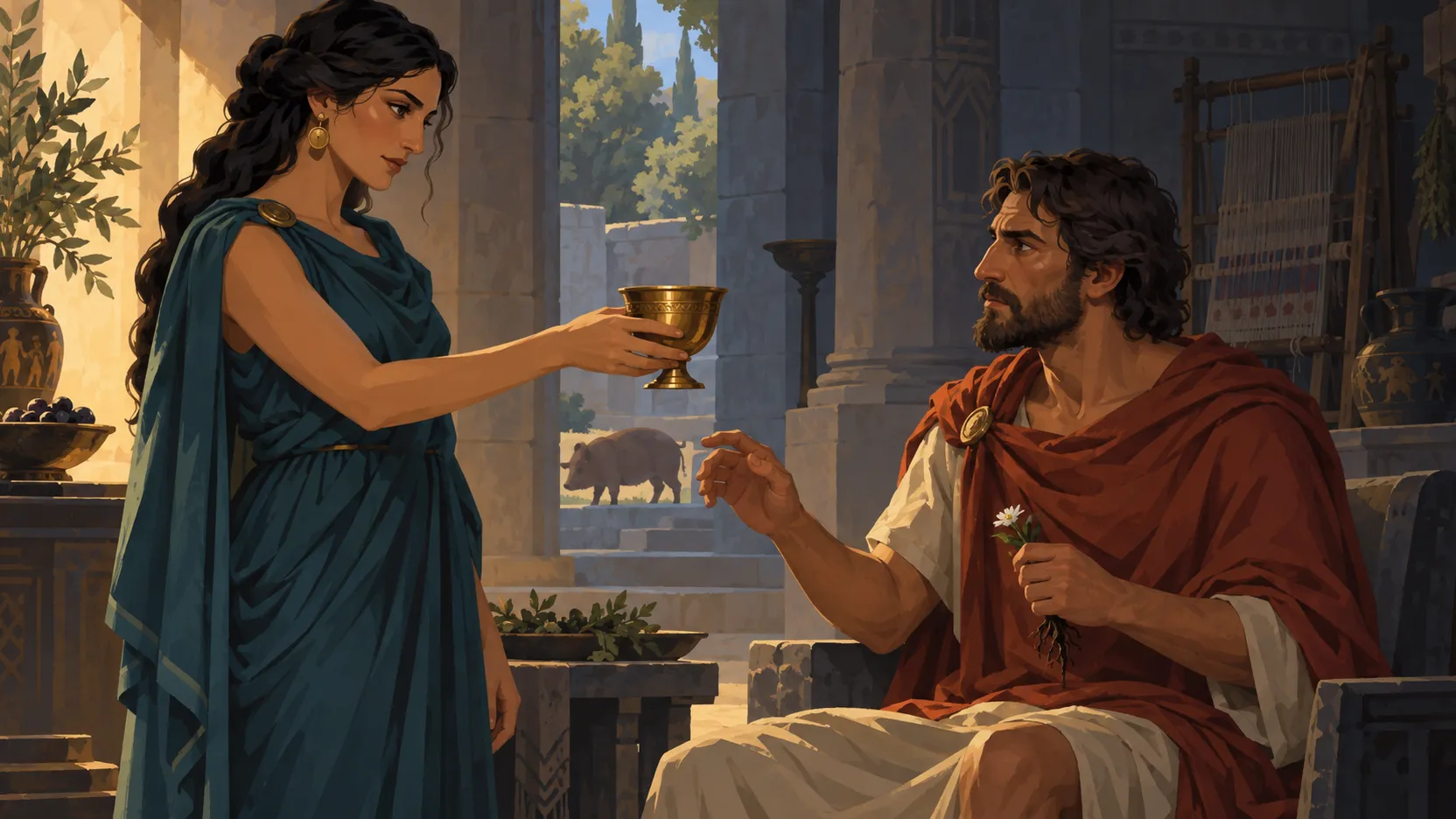
Hermes bent and drew a plant from the earth. Its root was black, its flower white. Soil fell from it as he placed it in Odysseus’s hand.
“Moly. Keep it with you. Her drug will fail.”
Then he explained what must follow. Odysseus must drink the offered cup, withstand the wand and draw his sword. Circe would yield and invite him to her bed. Before accepting, he must make her swear that she would devise no further harm against him.
Odysseus listened to each instruction. When he raised his eyes from the flower, Hermes was leaving through the trees.
He went on alone.
At the house he called out. The singing stopped. Circe opened the doors and stood looking at him, composed and unhurried.
She led him to a chair set with silver. He could hear animals somewhere beyond the hall. He would not turn towards the sound yet.
Circe mixed a drink in a golden cup and brought it to him.
He took it. Honey sweetened the wine; grain thickened it against his tongue. He swallowed, holding the little plant close.
She touched him with her wand.
“Go to the sty. Join your companions.”
His feet remained planted on the floor. His fingers closed on the empty cup.
Circe’s eyes moved from his hands to his face.
He put the cup down, drew his sword and sprang towards her.
She cried out and caught him by the knees. The wand lowered. For the first time since he had entered, her voice lost its certainty.
“No one withstands that cup.”
He kept the blade ready.
“Odysseus,” she said. “Hermes told me you would come from Troy.”
She asked him to put away the sword and share her bed, so that they might trust one another. But Odysseus could still hear the creatures beyond the hall.
“You changed my men into swine. Your invitation is not enough.”
“What would satisfy you?”
“An oath. By the gods. No further harm.”
Circe swore it. He listened until the oath was complete. Only then did he lower the sword and accept her invitation to share her bed.
Later her servants bathed him and brought clean clothing. They laid a table with bread and meat, poured water for his hands and set a cup beside him. The warmth had eased his tired limbs. He had not eaten since leaving the shore.
He sat without touching the food.
Circe came to his chair.
“Do you still fear a trick? I have sworn.”
“My men are still in your pens.”
The cup stood between them.
“Bring them here,” he said. “Let me see them.”
Circe turned away from the table and went through the hall. Odysseus followed her into the court.
She opened the pens. The pigs crowded out, stopping before her wand. Odysseus looked from one to another. He knew the faces of the men he had brought across the sea, the ways they stood and moved; here those things were hidden from him.
Circe took another drug and anointed each creature.
Bristles fell away. Backs straightened. Hands opened where hooves had been. The men stood before him, restored and younger-looking, blinking in the light.
For a moment none of them moved.
Then they recognized him.
They reached for him together, gripping his hands, his arms, his shoulders. He heard his name spoken in voices he had thought he might never hear again. One man tried to say more, failed and held him tighter.
Their crying filled the court and carried into the hall. Circe stood beside the open pens, watching, and her face softened. Odysseus remained among his men, their warm human hands closed around his own.