
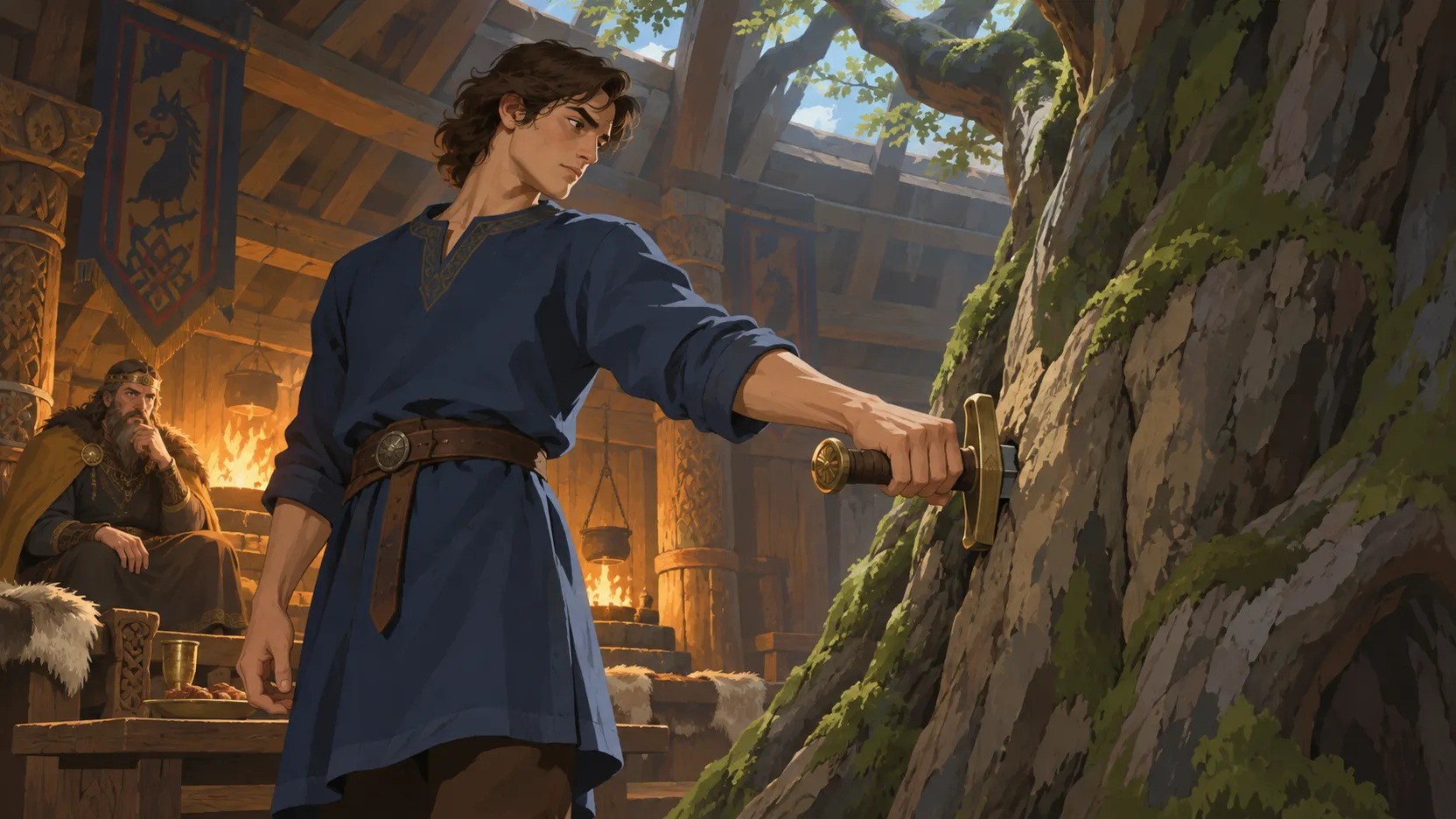
The stranger walked between the fires without greeting the bridegroom.
Sigmund watched him cross his father’s hall. The old man was barefoot. A broad hat shaded his face, and beneath its brim one eye looked out at the wedding guests. His cloak hung in spotted folds. In his hand he carried a sword.
Around the fires sat the men who had come to celebrate the marriage of Sigmund’s sister Signy to King Siggeir. The king had brought a splendid company. Until the stranger entered, the hall had been full of voices.
Now no one spoke to him.
He stopped before the great tree that grew through the middle of the hall. Sigmund had known its trunk all his life: the broad bark beside the benches, the living branches above the roof. The old man lifted the sword.
With one thrust he drove it into the wood.
The blade sank to its hilt.
Sigmund leaned forward. A weapon buried so deeply should have been a ruined thing, trapped until someone cut the tree apart. But the stranger had already let go of it.
“The one who draws it out may keep it,” he said. “No better sword will ever come into his hand.”
He looked at the guests once more, turned, and walked out.
Someone rose as if to follow. Others were already getting to their feet for a different reason. By the time Sigmund looked towards the doorway, the old man had gone, and men were gathering around the tree.
Those of highest rank went first.
One wrapped his hand round the grip and pulled. The hilt remained where the stranger had left it. He set his other hand upon the first and tried again. A flush spread above his collar. At last he stood aside.
The next man planted his feet farther apart.
Sigmund could see the effort in his shoulders. The tree gave a faint creak somewhere high above them, but the sword did not move. This man too released it.
Each new hand approached with a reason the others must have failed: a poor stance, a weak grasp, too little patience. Each left the hilt standing out from the bark as before. The men who had tried stopped offering advice. Those still waiting watched more closely.
Sigmund waited his turn.
When the space before the tree was clear, he stepped into it. He put his hand on the sword and drew.
The blade came free as easily as a sword lifted from a table.
He held it before him. Firelight ran along the steel. Behind him the guests pressed closer, and someone who had been laughing fell quiet.
King Siggeir came forward.
“Let me buy it.”
Sigmund turned towards his new brother-in-law.
The king looked at the weapon. “Three times its weight in gold.”
Gold enough to make the offer worth hearing. Around them, men waited for Sigmund’s answer. The bridegroom had spoken generously, and in a hall full of witnesses.
But the sword had been offered to every hand in the room.
“You had your chance to draw it,” Sigmund said. “So did I.”
Siggeir’s eyes left the blade.
“It is a good price.”
“I am not selling it. Not for that price, or all the gold you possess.”
For a moment the only movement between them was the firelight on the steel.
Then the king turned away as though the matter were too small to trouble him. The guests began talking again. Men moved back towards the benches, carrying the tale of what they had seen to those farther down the hall.
Sigmund kept the sword.
Across the room, Siggeir took his place among the wedding guests. He gave no sign of the anger he carried there. Before the evening ended, he was already considering how to repay the refusal.