
The Wood in the Fire
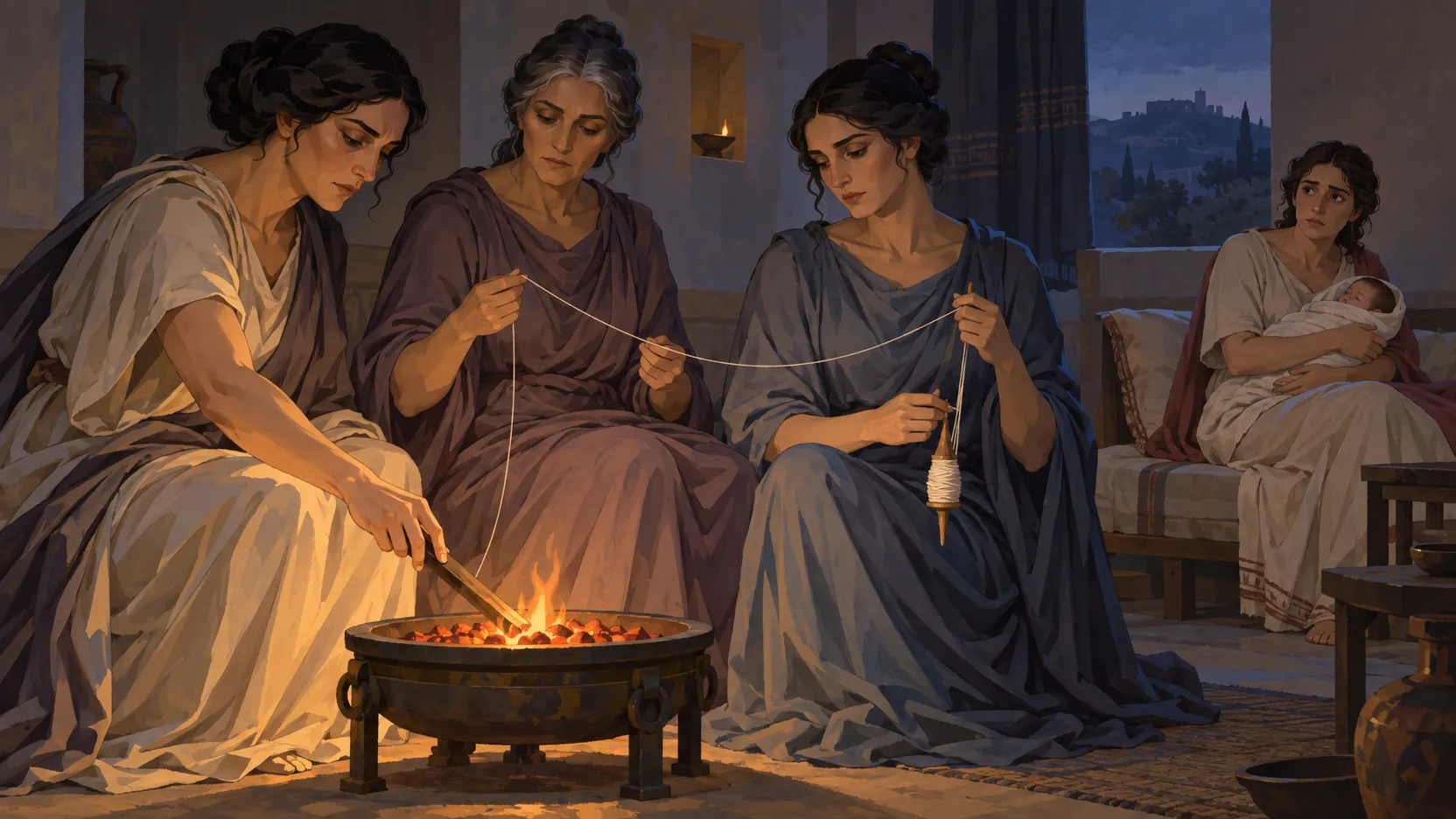
The woman beside the hearth laid a piece of wood across the coals, and Althaea pulled her newborn son closer.
She had not heard anyone enter. A moment before, there had been only the fire, the low bed, the child fumbling against her breast. Now three women stood in the room. One turned a spindle. Another drew the thread between her hands. The third watched the wood begin to burn.
Althaea tried to sit upright. Her arms were strong enough to hold Meleager, but her body trembled with the effort of rising.
“What are you doing?”
The spindle went on turning.
Clotho. Lachesis. Atropos. The names came to her with the cold certainty of waking from a dream and finding someone at the bedside. The three sisters did not look at her. Their attention rested on the small face against her arm.
“This wood and your child,” they said, “have the same time left.”
A flame caught beneath the bark.
Althaea looked from the hearth to Meleager. His mouth had opened. He was searching for milk, impatient already with the world, and one of his hands had closed on the edge of her linen.
“Wait.”
Smoke lifted between the women. Through it she saw the wall, the bare place where their shadows should have been. The thread was gone. The spindle was gone.
The wood remained.
She laid Meleager on the bed and dragged herself towards the fire. Heat struck her face. She caught the unburned end of the brand, pulled it free and thrust it into the water standing beside the hearth. Steam burst against her wrist. She held it under until the hissing stopped.
Behind her, the child began to cry.
Althaea stayed on her knees, gripping the wet wood. At last she turned. His little fists were moving above the linen. He drew another breath, and another, each louder than the last.
She laughed once, shakily, then began to weep.
When the brand was cold, she hid it in her room. No one was to put it on a fire. No one was even to know it was there.
Meleager learned to stand. He learned to run. His voice deepened; he grew taller than his mother. The palace doors opened to admit him carrying hunting spears, with dust on his legs and men calling his name from the courtyard.
Sometimes Althaea would go alone to the hiding place and uncover the wood. The charred end still marked the point where she had stopped the flame. She could lay her thumb beside it and cover the distance the fire had eaten.
Then she would wrap it again and go downstairs to her son.
The Prize of the Hunt
In the year of a rich harvest, King Oeneus offered thanks to the gods. Grain, wine and oil went to their altars. Artemis received nothing.
The boar she sent came out of the hills and broke through the fields of Calydon. It tore the vines from their supports and churned the standing grain into the earth. Herds fled before it. People abandoned their farms and came to the city, bringing what they could carry.
Meleager gathered hunters from across Greece. Among them were his mother’s brothers, Plexippus and Toxeus, and Atalanta, who carried a bow. Her hair was fastened clear of her face; while the others spoke, she watched the ground at the forest’s edge.
Meleager watched her. When she moved towards the tracks, he followed.
They found the boar in a hollow thick with reeds. Dogs entered first. The reeds shook, a dog cried out, and the beast came through them so suddenly that the nearest men stumbled backwards with their spears still raised.
A shaft struck a tree. Another passed over its back. The boar wheeled, scattering the hunters, and Atalanta fitted an arrow to her bow.
She let it go as the great head turned.
The arrow lodged below its ear.
“She has struck it!” Meleager shouted.
The others surged forward. Spear shafts knocked together. Ancaeus pushed through with his axe lifted in both hands, calling for them to stand aside. He meant to show them what a man’s weapon could do.
The boar reached him before the axe fell. He went down, and did not rise.
Meleager’s first cast missed. He took another spear and waited for the heaving back to come clear of the reeds. This time the point struck. The boar twisted towards him, its jaws working, and he ran in before it could gather itself. His next thrust drove into its shoulder.
The beast staggered. Its forelegs folded beneath it. For a moment the hunters stood so still that the reeds could be heard brushing against one another. Then they crowded around Meleager, catching his arms, shouting, reaching to touch the animal they had scarcely dared approach while it lived.
When the spoils were ready, Meleager called Atalanta forward.
“The first wound was yours,” he said. “Take them.”
He gave her the hide and the tusked head. She looked at the prize, then at him, and her tired face brightened.
Plexippus stepped between them.
“We have not come all this way to see a woman carry off the honor.”
He caught the hide. Toxeus moved beside him, and together they took the trophies from her.
Meleager held out his hand.
“Give them back.”
His uncle did not move. The bristles stood stiff between his fingers.
“Choose more wisely where you give your favors.”
Meleager drew his sword and struck Plexippus before he could defend himself.
Toxeus recoiled. He looked at his fallen brother, then at the blade, caught between flight and vengeance. Meleager gave him no time to choose. He struck again.
The hunters drew away from him.
Atalanta stood where the two men had left her. On the ground at her feet lay the hide, its edges folded under, beside the bodies of Althaea’s brothers.
What Althaea Kept
News of the boar’s death reached the city first.
Althaea put on her bright robes and prepared offerings. The roads would be safe again. Her son was coming home. She was on her way to give thanks when she saw the men carrying two bodies through the street.
She knew the hands that hung beside the first litter.
The offerings slipped from her grasp.
She went to Plexippus, then to Toxeus, touching their faces as if one of them might turn towards her. The men bearing them stood with their eyes lowered. Around her, people who had been cheering fell silent.
“Who did this?”
No one answered at once.
“Tell me.”
One of the bearers lifted his head.
“Meleager.”
She heard him explain the prize, Atalanta, the quarrel. She heard each word distinctly. Her son had drawn his sword. Her brothers were dead. The news of his victory was still passing through streets that had not yet seen the litters.
Althaea went back to the palace. She took off her bright clothing and dressed in black. Then she entered the room where the brand lay hidden.
It had waited there through every year of Meleager’s life.
She unwrapped it. The blackened end stained her fingers.
Downstairs, voices were giving orders for the dead. There would be washing and linen, a place prepared for each body. Her brothers would never cross her threshold again. Meleager would. He would stand before her with the hands that had killed them.
She carried the wood to the hearth and laid dry kindling beneath it. She held a torch to the kindling until small flames ran together and rose.
Then she picked up the brand.
Her arm moved towards the fire. Stopped.
She could feel the newborn’s mouth searching against her skin.
She drew the wood back.
Plexippus had lain on the litter with his head turned to one side, as though he had heard her coming. She lifted the brand again. Her fingers would not open.
“He is my son,” she said.
The fire snapped. A spark settled on the stone between her feet.
“And they were my brothers.”
A third time she bent towards the flames. Heat reached the wood. She pulled it against her breast, pressing the rough surface into her black robe.
She had carried him before anyone could see him. She had brought him into the world. When the sisters had left him no more life than a burning stick, she had crawled across this floor and taken it back for him.
And he had used that life to kill them.
Her hands tightened. She held the brand over the fire a fourth time. Below it, the flames leaned and stretched. One touched the charred end.
She snatched it away.
For a while she stood without moving. She could put it back. Fold the cloth over it, hide it, go downstairs. Her son would live. She could hear his name outside, shouted by someone who still believed this was a day for rejoicing.
She looked at the place where the fire had touched the wood.
“Must I keep you safe from this too?”
The question brought no answer. Her brothers lay below. Her son was alive beyond these walls. In her hands, the last dampness of the old rescue had long since dried away.
Althaea turned her face aside and threw the brand into the fire.
The Last Ember
Far from the hearth, Meleager stopped walking.
Heat had seized him beneath his ribs. He put a hand to his chest, then dragged at his clothing. There was no flame. No weapon had struck him. Yet the burning spread, and his knees gave way.
Hands caught him. Someone was calling for water.
He tried to rise. He had faced the boar. He could face an enemy if they would only show him where it stood. But there was nothing to strike, and the men supporting him could find no wound.
In Althaea’s room, fire ran along the old wood. The charred end brightened; a split opened down its length. A low sound came from it, almost a voice.
Meleager called for his father. For his brothers and sisters. For his wife.
The wood settled among the coals.
At last he called for his mother.
As the brand grew smaller, his struggling eased. The people around him bent close, hoping. His breath thinned. The last red fragment darkened, and he was still.
Calydon’s gates filled with mourners. Oeneus fell to the ground and covered his gray head with dust. Althaea, overcome by what she had done, took her own life.
Meleager’s sisters clung to his body until it had to be carried to the funeral fire. Afterwards they held his ashes. They went to his tomb and pressed their lips against the letters of his name.
There Artemis found them.
Gorge and Deianira remained kneeling in the dust. Around them, their sisters’ lifted arms opened into wings. Fingers vanished into feathers. The voices calling Meleager’s name grew sharp and strange.
The birds rose from beside the tomb, beating the air above the two women who remained. Their cries passed over the palace roof and out across the empty fields.