The Water Beneath the Jaw
Runa pulled the steering oar against her hip, but the black reef went on sliding across their bow.
There should have been open water here. She had crossed it with her father in fog thick enough to hide the masthead. Now she could see the white notch in the headland, the pale sky above it, and between their boat and home a ridge of wet stone where no stone belonged.
“Get the sail down.”
Einar looked from the reef to the three barley sacks lashed beneath the thwart.
“We’ll lose the wind.”
“Down.”
He scrambled forward. The sail came rattling into the boat, covering the sacks, and Runa drove her oar deeper. The blade struck the ridge.
The blow jarred her shoulder. Instead of scraping, the blade slid over a broad, smooth plate and caught beneath its edge. She pulled. The shaft bent.
“Help me.”
Einar seized it above her hands. Together they wrenched it free and stumbled backward. A thin shaving of wood remained under the plate.
The plate lifted.
Water streamed out from beneath it. Farther along the ridge another plate rose, then another, each overlapping the next. The movement travelled away across the sea until Runa could no longer follow it.
Einar still held the oar. She could feel him shaking through the wood.
“Whale?” he said.
She looked for a fin, a spout, an end.
“Take the other oar.”
He obeyed without asking again.
They pulled together. The loaded boat answered slowly, turning until it lay beside the immense body. Its wet scales stood higher than their mast. Ahead, the black curve vanished into a blue distance that Runa had mistaken for shadow beneath a cloud.
Behind them it did the same.
Her father had taught her to judge a current by watching foam against something fixed. She watched a white patch slide along the scales. Then she watched their boat overtake it.
They were being carried forward.
“Harder,” she said.
Einar set his feet against the thwart. The muscles stood out in his thin neck. He had wanted to come as a man on this voyage, to help buy the seed and bring it home. She had let him carry the purse ashore, then taken it back when the bargaining began.
His oar creaked.
They passed the patch of foam again.
“Runa.”
“I can see.”
The current was stronger than both of them.
She stopped pulling before he did. He dragged one more useless stroke, staring at her, and the boat slewed sideways. Runa caught its stern with the steering oar.
“We follow it,” she said. “There must be a way through.”
“Through what?”
She had no answer she could give him.
Where the Circle Closed
The body sank ahead of them. Runa saw water shining beyond its lowest curve and felt hope so sharply that she stood to look.
Then something rose beyond the opening.
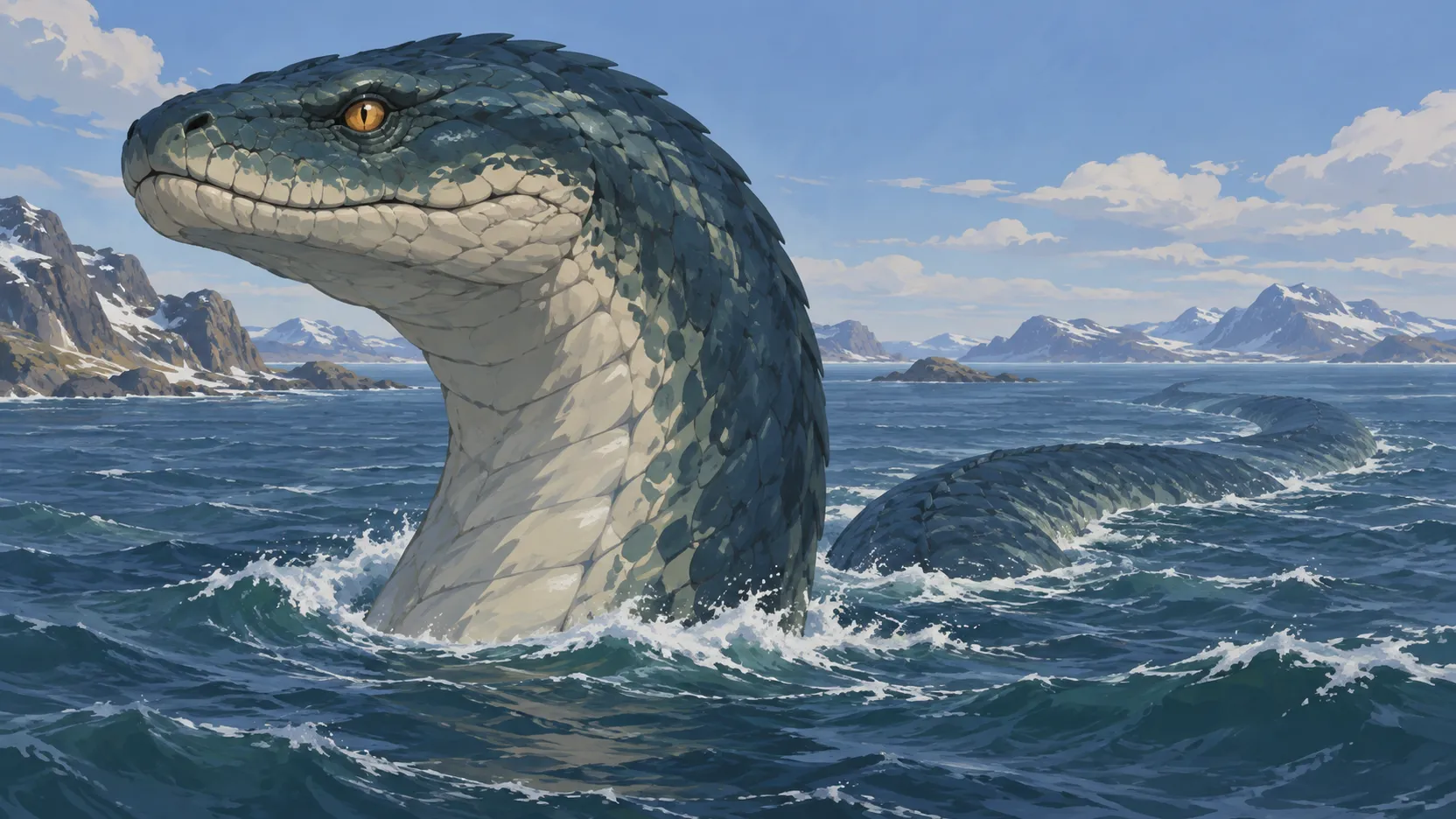
At first she saw only a pale slope, ridged across its breadth. Water poured off it in sheets. Higher up was a dark seam, and above that an eye, amber around a narrow black slit.
The head turned a little toward the boat.
Runa sat down hard.
Between the closed jaws lay another length of scaled flesh. It descended into the water, tapering as it went. She followed its line with her eyes until a swell hid it, and when it appeared again she understood.
The serpent held its own tail.
“Jörmungandr,” Einar whispered.
Their mother had spoken the name by the hearth when waves struck the shore on windless nights. Runa had pictured a snake drawn in a ring around a shield. She had never pictured the water beneath its jaw, or how a boat might move there, or the small noise an oar made when someone was afraid to lift it.
Einar began to row backward.
“Stop.”
He pulled again. The boat turned broadside to the flow, and water climbed over the low gunwale beside the barley.
Runa caught his wrist.
“Look at the foam.”
“I don’t want to look.”
“Under his chin.”
A white streak ran between the descending tail and the thick column of neck. Beyond it lay open water. The serpent’s lower jaw made a roof over the passage, so low that their mast would strike it.
Einar stared at the gap. Then at the mast.
It was a good mast. Their father had shaped it through a winter, scraping it smooth in the doorway while the children carried away curls of pine for the hearth. Near its foot were two shallow cuts where he had marked their heights one spring.
“We can lower it,” Einar said.
Runa looked at the rigging, the furled sail tangled across the cargo, the wedges securing the mast. With time and room, they could. The jaw was growing above them now; she could distinguish the long grooves in its pale underside.
“Not quickly enough.”
She reached beneath her seat for the hatchet.
Einar put his hand around the mast.
“We can turn.”
She pressed the handle into his other hand.
“You cut. I have to steer.”
For a moment he held both the mast and the hatchet, protecting one from the other.
Then he shifted his grip and struck.
The sound was shockingly small. A chip fell against the barley sacks. He struck again, lower this time, making a notch above the thwart. Runa braced the steering oar with both hands and kept the bow toward the white stream.
The amber eye moved. Its dark slit passed over them.
Einar stopped chopping.
“Keep going.”
“Does he see us?”
The head was higher than the house they had left, and only part of it was above the water. Runa could not tell whether its gaze had rested on the boat or gone beyond it.
“Keep going.”
He struck until his breath came in short cries. Pine splinters stuck to his wet sleeves. The mast bent forward, checked by its ropes, and she heard the first long crack.
“Cut the stay!” she called.
Einar ducked beneath the sagging sail. His knife flashed. The rope sprang away, the mast folded, and the broken spar fell across the bow into the sea.
For one instant the boat ran free.
Then it stopped so violently that Runa struck her mouth against the oar handle.
Einar vanished beneath the sail.
The Seed
The fallen mast had swung across the current. A rope stretched from it over the bow and disappeared beneath the cargo. The boat was held sideways, its upstream gunwale dipping under every ripple.
“Einar!”
His head emerged beside the forward thwart.
“My foot.”
He tried to rise and was pulled down again. The sail had twisted around his ankle. Beneath it, the rope that secured the barley had caught the fallen rigging and drawn tight.
Runa jammed the steering oar under the stern thwart and crawled forward.
The nearest sack was wedged hard against the side. She pushed it with her shoulder. It did not move. Water soaked through her knees. Einar caught her sleeve.
“Don’t push. It tightens.”
She stopped.
The jaw filled the sky ahead. Beneath it the strip of daylight narrowed as the boat swung, and the broken mast dragged them toward the descending tail. They would hit it sideways. The water would hold them there.
Runa pulled her knife.
The cargo rope was within reach. One cut would release the sail and the sacks together. She saw the barley as she had seen it on the merchant’s floor: clean, dry grain running through her fingers. She had paid with their wool, their spare iron pot, the last silver their father had kept wrapped in cloth.
Einar’s hand tightened on her sleeve.
“Runa.”
She slipped the knife beneath the rope and pulled the blade toward her.
The fibres opened slowly. She sawed again, keeping the edge away from his leg. The last strands parted with a snap.
A sack rolled against her wrist, went over the side, and vanished. The second followed. The third split on a broken peg, spilling barley across the floor before the current took it.
The boat lurched upright.
Runa tore the loosened sail from Einar’s foot and hauled him toward her. He cried out when he put weight on the ankle. She pushed him flat beneath the thwart.
“Stay there.”
The released mast swung alongside. Its broken end knocked against the gunwale. She caught it, nearly lost it, then drew enough of the spar aboard to press its far end into the water.
The boat began to turn.
Above them the pale jaw shifted downward.
Runa bent over the spar. The end dragged deep; the stern swung past the descending tail with barely room for the blade of an oar. Water hissed against scales beside her shoulder.
Darkness crossed the bow.
She dropped flat.
For several heartbeats there was only the underside of the jaw above her and the sound of water running faster than the boat. She could smell wet pine from the broken mast. Einar’s fingers found hers beneath the thwart.
A pale ridge passed overhead.
Then sky.
Runa raised her head. They had come through into open water. Behind them the gap closed as the serpent settled, slowly enough to seem motionless until the sea covered the place where they had been.
His jaws still held his tail.
Homeward
They bailed with the wooden bowl until the water lay below the floorboards. Einar’s ankle had swollen. Runa bound it with a strip of sailcloth while he watched the headland.
She could not look at the empty space beneath the thwart.
“We’ll have to borrow seed,” she said.
He nodded.
“I don’t know who has any left.”
He opened his fist. A few wet grains rested against his palm. He had picked them from the bottom of the boat while she bound his ankle.
She almost told him they were no use. There were too few; the salt might have spoiled them.
Instead she held out her hand.
He tipped them into it, then reached for an oar.
“Move over,” he said. “I can still row.”
Runa shifted along the thwart and made room.