The little box knocked while Matthes was measuring his father for the coffin.
Three taps. A pause. Three more.
He held the cord against the dead man’s heel and listened. The sound came from beneath the workbench, where his father had kept things neither son was permitted to touch. Matthes had heard it before, on nights when he slept among the shavings. His father had always called it beetles.
Beetles did not stop when you knocked back.
From the doorway Lorenz said, “Don’t open that yet.”
Matthes kept his hand on the box. “Is this what he left me?”
“Yes.”
“And the money?”
His brother looked at the body on the boards.
Matthes had spent the last six winters asking to leave. In the city a master would take him on, if he brought his own tools and the entrance money. His father had promised it at harvest, then at winter’s end, then after the next good order. Now the carrier was leaving the following morning, and Matthes had packed his chisels in a roll beneath his bed.
He lifted the lid.
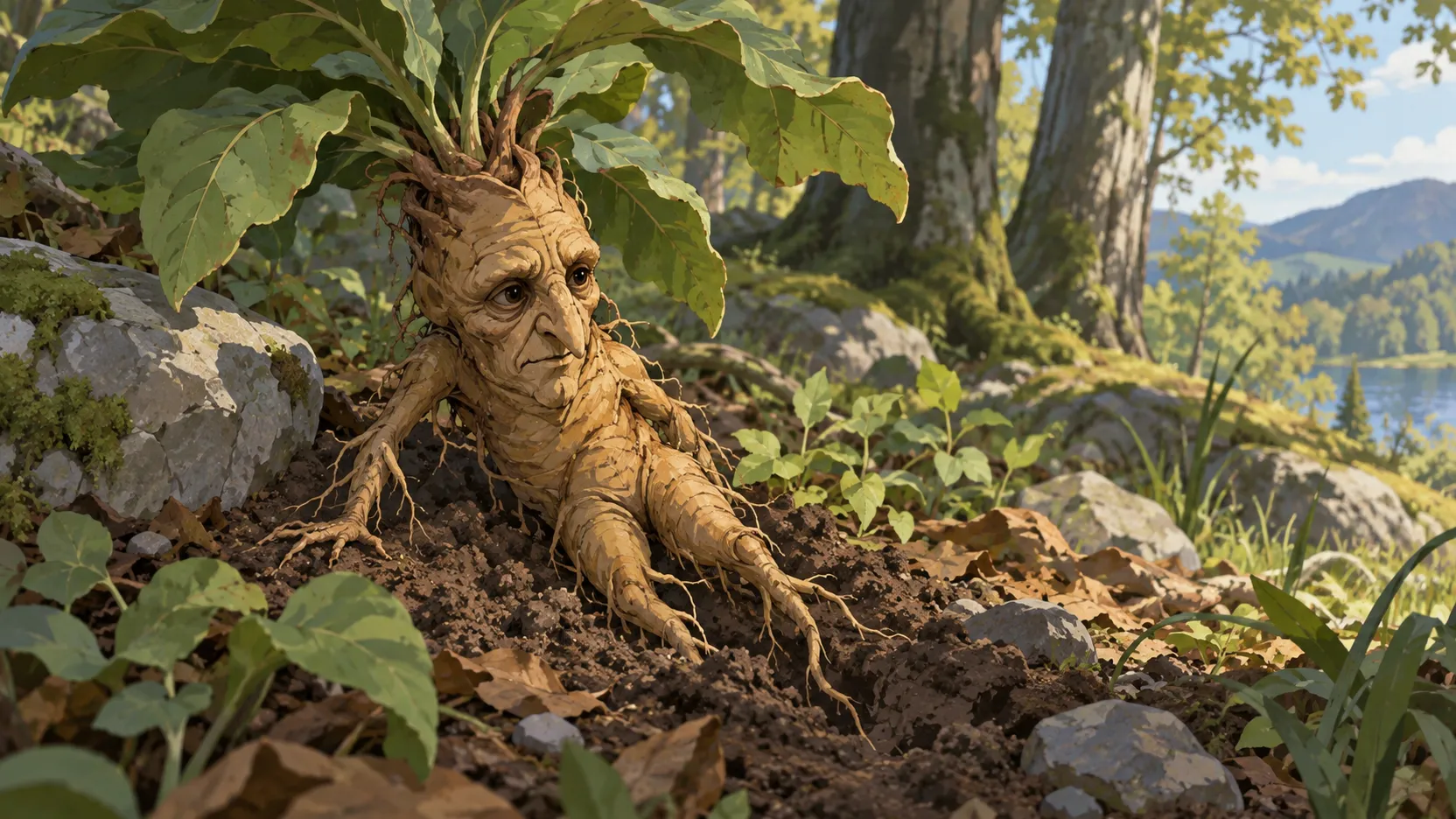
Red silk lay folded around something in a dirty white shirt. At first he thought it was a carved doll. Then the thing turned its head, very slowly, and looked at his thumb.
Its face was root: the nose a crooked swelling, the mouth a split beneath it. Two forked legs bent against the end of the box. The shirt had grown tight around the shoulders. Through a tear showed a tangle of fine roots, grey and brittle as threads pulled from old cloth.
Matthes moved his thumb away.
“An Alraune,” Lorenz said.
The little mouth opened. No sound came out.
“Father said the youngest gets it. You must put bread and a piece of money in his coffin.”
“What did he leave you?”
“The house. The shop.”
“Then you can buy this from me.”
Lorenz shut the door before answering. He put a gold coin on the bench. It landed with a thick, satisfactory sound.
Matthes reached for it.
His brother covered it with his palm.
“That’s all there is.”
The Last Gold
The timber merchant was coming at first light. Lorenz had put the workshop up against a debt, expecting his father to settle it before the reckoning day.
“You signed for it?” Matthes asked.
“He couldn’t hold a pen.”
“So you signed for it.”
Lorenz nodded.
“And you didn’t think to tell me.”
“I thought he’d get better.”
For a while they could hear only the little dry movements inside the box.
Matthes looked at the coin. Enough to clear the debt. Enough, instead, for his place with the master and the journey there. He had counted that sum so often that he knew what it weighed without touching it.
Lorenz slid the box nearer.
“Put money beside it at night. In the morning there’s twice as much.”
Matthes stared at him.
“I saw him do it.”
“How often?”
“Once. He caught me.” Lorenz rubbed a pale notch through his eyebrow, though the blow that had made it was twenty years old. “After that I stayed out.”
Matthes looked past his brother at the racks of seasoned wood, the good planes, the cupboard where their father kept the accounts. As a boy he had thought all of it came from being the first to rise and the last to sleep.
“Then why are we in debt?”
Lorenz’s hand closed over the coin again.
“Ask it.”
Matthes bent over the box. The root smelled faintly of wine and something shut away wet.
“Can you hear me?”
Its lips rubbed together.
He fetched a cup of water, then stopped. On the shelf above the bench stood his father’s wine flask and a shallow saucer stained red. He poured a little into the saucer and dipped a corner of clean linen.
“May I?”
The root tipped its face towards the cloth.
He wiped the dust from its mouth. Its cheek was cool and unexpectedly heavy against his knuckle.
“Can you make another?” He pointed at Lorenz’s fist.
“Gold,” the Alraune whispered.
“Yes.”
“Again?”
The word seemed to reduce the room around them.
Matthes eased the torn shirt away from one shoulder. It stuck. When he freed it, a tuft of dead root came with the cloth. Underneath, the living part was thin as a bent wrist.
“How much did he give you?”
The Alraune moved its eyes towards the cupboard.
“Every night?”
“Yes.”
“Gold every night?”
“Until I could not.”
Lorenz pulled out the nearest stool and sat down hard.
Matthes remembered the final weeks: his father sending him away from the bench, the little box on his lap, the old man’s furious demand for silence. Once Matthes had heard him pleading. He had thought the pain was bad.
He looked at the saucer. The wine was black with dirt.
“We could sell the house,” he said.
“Before sunrise?”
“The merchant might wait.”
“He has waited. He wants the yard. He’s wanted it for years.”
Matthes pictured himself taking down the sign, carrying the planes out one by one. Lorenz would blame him without needing to say it. So would he.
His brother opened his hand.
“One night. Then you go. I won’t ask you to stay.”
That was what made Matthes take the coin.
He laid it on the red silk. The Alraune watched him push it close.
“Can you?” he asked.
A fine root moved across the rim, testing it.
“I can begin.”
What the Box Held
They worked on the coffin while the candle burned down.
Lorenz planed the lid. Matthes fitted the narrow boards, shaving each joint until no light showed through. Neither man spoke of the gold. The box stood open between them, beyond the reach of the curls falling from the plane.
When Matthes looked, the coin lay under the Alraune’s hands. A second yellow edge had appeared beneath the first.
He bent closer. Fine pale fibers ran from the root’s chest and curled around both pieces. The new edge was no thicker than a leaf.
“How long?” Lorenz asked.
Matthes held up a hand.
The Alraune’s eyes were closed. Its mouth moved once, as if trying to swallow.
He turned back to the coffin.
For an hour he made himself attend to the wood. There would be new wood in the city. Different roofs above him. A bed in which he could sleep without listening for his father on the stairs. He imagined arriving at the master’s door, setting down the roll of chisels, being asked what he could do.
Behind him came a tiny crack.
One of the Alraune’s fingers had split lengthwise.
Matthes set his chisel down.
A drop of clear moisture crept from the split and soaked the silk. The second coin had grown thicker. Where its face should have been, something yellow moved like the skin on cooling fat.
“Is it hurting you?”
The Alraune opened one eye.
“Will it stop?” Matthes asked.
It took so long to answer that he thought it had not heard.
“When it is done.”
“And then?”
The eye closed.
Matthes reached into the box.
Lorenz caught his wrist.
“Wait.”
“Look at its hand.”
“I am looking.”
“Then let go.”
Lorenz did not. His grip was the grip Matthes knew from lifting beams together: careful, strong, certain that the other man would take the weight.
“It may finish,” he said. “It may be all right.”
Another fiber parted. Matthes felt the minute recoil against his fingertip.
He tried to pull away. Lorenz held him.
“You have the whole shop,” Matthes said.
“By morning I may have nothing.”
“And I have this.”
They both looked down.
The root was smaller than either of their hands. Its broken finger lay on the gold as if it had been placed there by someone else.
Outside, a cart rattled over the stones. Lorenz’s head turned towards the door.
Matthes twisted his wrist free.
He slid two fingers beneath the Alraune, lifting its shoulders out of the silk. It made a thin, breathless sound. The fibers drew taut. The gold rose with it.
“Put it down,” Lorenz said.
Matthes supported the root against his palm. He could feel a tremor passing through its body, quickening as the half-made coin pulled on it. There was no room for a blade between the fibers and the little chest.
He had to peel the money away.
The finished coin came loose first. It rolled across the bench and struck his father’s foot.
The other clung.
Matthes caught its unfinished edge between finger and thumb. For an instant he could see the face forming on it, the same crowned profile as the coin he had wanted for years. Almost enough. Almost his.
He pulled.
The yellow skin tore. It crumpled against his thumb, leaving a dull smear and three severed fibers. The Alraune went slack in his hand.
Lorenz said his name.
Matthes laid the root on the clean linen. He touched its face with the wet corner. Nothing moved.
He wiped the mouth again, carefully, trying not to press.
Under the tiny shirt, something stirred.
A root finger, the unbroken one, hooked itself into the cloth.
Matthes sat down on the floor. The cloth and its small weight stayed cupped in his hands.
Bread for the Road
The merchant’s knock came before either brother moved.
Lorenz picked up the surviving coin. He rubbed it once on his sleeve, as though the night’s damage might have reached that one too.
“There’s still this,” he said.
Matthes nodded.
“If you take it—”
“Pay him.”
Lorenz looked at the roll of chisels beside the door.
“You could wait till autumn.”
“No.”
“The shop could use you.”
Matthes looked up. For the first time that night Lorenz lowered his eyes.
The knock came again.
“Pay him,” Matthes said.
He heard the bargain from the floor: the merchant’s disappointment, the scrape of a coin on a tooth, the receipt being unfolded. Then the door shut and the workshop belonged to his brother.
They buried their father after sunrise. Matthes put a crust into the coffin and a copper from the bottom of his purse. Lorenz stood beside him while he did it. The copper was dark and worn almost smooth; it made scarcely any sound against the wood.
By the time they returned, the carrier’s wagon had gone.
Matthes cut a clean shirt from the cuff of his own. He made the armholes wide, working around the torn finger rather than pushing it through. The Alraune watched without speaking. Its eyes followed the needle each time he laid it down.
Lorenz brought his brother’s chisels. He had sharpened the smallest one.
“What will you do when you get there?”
“Find work.”
“And the master?”
“I’ll ask him.”
“He may say no.”
Matthes rolled the chisels, tying the cord twice. “He may.”
His brother put a loaf beside them. Then, after a moment, he fetched a second cloth and wrapped it for the road.
Matthes lifted the box. The ruined gold still marked the old silk. He left that lining on the bench and fitted the clean cloth inside, folding one corner beneath the Alraune’s head.
At the door Lorenz reached as if to take the heavier bundle. His hand stopped between them.
Matthes touched it, briefly, with his own.
The road climbed beyond the last houses. Before the first bend he had to stop and shift the tools; the box kept knocking against his hip. He loosened its strap and tucked it against his chest instead.
Inside, something scratched once.
He lifted the lid.
The Alraune raised its unbroken hand into the morning light. Matthes waited while the fingers opened. Then he tilted the box a little, so the sun could reach the other side.