The steering oar stopped in Teti’s hands.
It did not strike bottom. Something beneath the ferry had taken hold of it, and now the polished shaft was turning slowly against her palms.
“Let go,” her father said.
She braced her heel against a grain sack. The ferry had almost reached the landing; she could see the wet rope wound around its post, the three planks that served as a walkway, the little hollow her father’s feet had worn in the nearest one. If she lost the oar now, he would never again let her bring the boat in.
“Let go!”
The shaft broke. She fell backward into the grain. Her father jumped for the landing with the bow rope, and the river rose beside him.
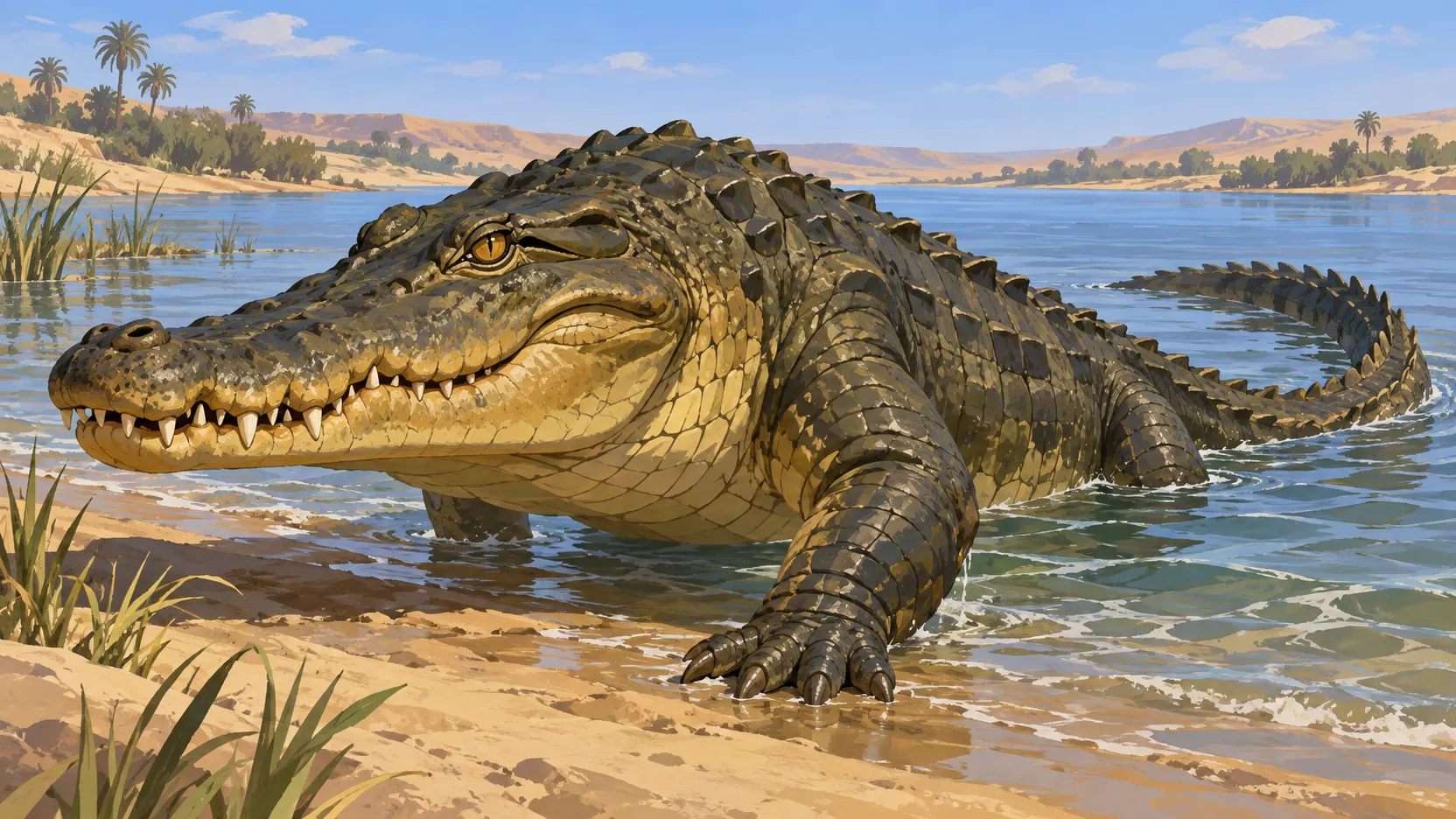
Not a wave. A ridged back.
The crocodile’s tail struck the outer supports. One plank lifted like the lid of a box; another vanished. Her father landed on his knees against the post. He caught it with both arms as the walkway folded beneath him.
The rope snapped taut. The ferry swung broadside to the current.
For a moment there was only the hiss of water against the hull, her own breath, and a grain merchant saying, very quietly, “No.”
Then the head surfaced between the boat and the broken landing.
Teti had seen crocodiles basking with their mouths open, looking almost foolish until a bird moved. This one watched her father. Its eye remained steady while water drained from the plates above its jaw. The broken blade of the steering oar floated past its snout. It ignored it.
Her father drew his feet higher.
“Maga,” he said.
He said it as he might have named a man who had come to collect a debt.
The rope
The merchant pushed past Teti with his knife out.
She caught his wrist before he reached the bow.
“What are you doing?”
“Freeing us.”
Her father was on the river side of the post, separated from the bank by a strip of broken, sinking timber. The bow rope was the only thing holding the ferry near him. Cut it, and the current would carry them beyond the bend before anyone found another pole.
“He can climb,” the merchant said.
“Look at his leg.”
Blood ran from beneath her father’s knee. His right foot hung at an angle she did not want to understand.
The merchant looked. His knife lowered, but his hand did not open.
Teti took up the spare pole. It was shorter than the lost steering oar, meant for pushing away from shallows. She laid it across the gap.
“Father. Take this.”
He reached. His fingers brushed the end.
The crocodile moved with almost no splash. A forefoot swept under the surface; the head slid between pole and post. Teti saw the teeth before the mouth closed on the wood.
The pull threw her chest against the gunwale. Pain burst through her ribs. She released the pole and watched it disappear lengthwise, its far end rising once before the water shut over it.
Her father had pressed his face against the post.
“Under the bench,” he said. “The clay.”
She knew what he meant. Every morning he traced a figure in a smear of clean clay near the bow and spoke over it before taking passengers. She had watched so often that the words had become part of the ferry: the creaking lashings, the scoop for bailing, her father’s voice assuming a weight his ordinary voice did not possess.
This morning the merchant had arrived with more grain than they had agreed to carry. Her father had wiped his drawing away to make room for the sacks.
“Do it,” he said.
She stared at the crowded deck.
The merchant followed her gaze. “We can shift them.”
There was nowhere to shift them. Behind the bench stood his remaining jars. Beneath her feet the sacks rose almost to the gunwale. The ferry was already low, and water kept spilling over its upstream side.
The nearest sack had a red tie. Their payment. Her father had made the merchant fill it twice after catching him pushing his fist into the measure.
Teti hooked her fingers beneath it.
“No,” the merchant said, reaching for her.
She rolled the sack over the side.
It struck the water with a thick, soft sound. A little grain escaped at the neck, turning in a pale spiral. Then the sack sank.
The merchant’s hand remained on her shoulder.
“That was yours.”
“I know. Help me with the next one.”
The four faces
They cleared a patch of deck by throwing the second sack onto the first. Teti knelt and dragged the hem of her dress across the boards. It came away black with river water.
The clay jar was beneath the bench, its lid tied down with string. Her hands shook too much to undo the knot. The merchant cut it for her.
She spread a patch as broad as both her hands. Four faces upon one neck. Her father always began with the outside faces, turning away from each other, then placed the others between them. Below, a crocodile. On either side, the small figures of the Eight.
She drew the first face with a splinter.
Across the water her father made a short sound, too sharp to be a word.
His damaged leg had slipped down the post. Maga had surfaced below it.
Teti dragged the splinter through the clay. The second face ran into the first.
“Slowly,” the merchant said.
She almost struck him.
Instead she pushed the splinter into his hand.
“Four faces. One neck. The crocodile under his feet. Four little gods on either side.”
“I’m a grain dealer.”
“Then count them.”
She turned back to the bow and took the rope in both hands. If she could draw the ferry nearer, her father could fall into it. The current fought her. She pulled until the rope burned through the skin at the base of her fingers, gained the width of a hand, and lost it when the boat rocked.
Her father was watching the drawing take shape behind her.
“Say it, Teti.”
She knew the beginning. She had been hearing it since she was small enough to sleep beneath the bench.
She called for the lord of the gods to come to her.
Her voice sounded thin on the open water. Nothing like his. The ferry struck a submerged piece of the landing, and she bit her tongue.
She began again, louder, asking that the creatures of the river be driven back.
Maga turned toward her.
The movement was small. That made it worse. One eye disappeared; the other fixed upon the place where her hands gripped the rope.
She had wanted it to stop watching her father.
Now it had.
“Back, Maga,” she said. “Son of Seth.”
The name caught in her throat. She could remember the shape of the next words in her father’s voice, but not the words themselves. There was something about the tail. The mouth. The great stake.
The rope jerked.
Her father was no longer embracing the post. He had slipped below its swollen knot, one arm caught around the wood, his chin barely above water.
Teti pulled without thinking. The ferry came closer, but the rope tightened across his trapped forearm and drew him sideways.
“Stop!” he gasped.
She let it run. His face rose again.
She could not pull him aboard while holding the boat against the current. She could not leave the bow to help him. Maga’s snout touched the rope between them.
Behind her the merchant said, “It’s done.”
The four faces looked in four directions. The small surrounding figures were crooked, and the crocodile beneath them looked more like a lizard. Yet every figure was there.
Teti put the bow rope into the merchant’s hands.
“Pull us against the post. When he lets go, catch him.”
“And you?”
She stepped to the low edge of the ferry, beside the image.
The mouth
Maga lifted his head.
The lower jaw rested against the gunwale. A tooth scraped the wood near her bare foot. Beyond the hinge of the mouth, the neck widened into the armored body, and the tail lay just beneath the water, curved toward the broken landing.
If it struck again, there would be no post left.
Teti bent her knees so the next roll of the boat would not throw her forward. The clay was cool under one heel. She could hear the merchant breathing behind her, waiting for an order from someone who knew what to do.
She faced the eye.
“Your tail will carry you no farther.”
The tail stirred. A line of brown water gathered along it.
“Your limbs will not bring you against us.”
She was not speaking in the order her father had taught her. There was no time to search for it now. She held to what each command demanded of the body before her.
The jaws began to part.
Inside was a pale fold of flesh, a broken reed, darkness farther back. Teti’s body wanted to fold away from it. She felt the movement begin in her stomach and forced her feet to stay.
She called upon the mooring of Osiris to hold Maga fast, upon the supports of Re’s boat to bind him. The words made no rope she could see. The mouth kept opening.
Her father cried her name.
She had reached the words she had never understood when he spoke them. A boatman standing barefoot in old linen, declaring himself a god.
Now she had to say them with the teeth before her.
“I am Amun.”
Her voice cracked on the name.
She drew breath and said it again.
The head stopped rising.
Water knocked against the jaw. The tail’s curve held. For one stretched moment, even the small strokes of the forefeet ceased.
“Now,” Teti said.
The merchant hauled on the mooring rope. The bow swung toward the post, closing the gap. Her father released his grip and reached for the boat. His hand struck the rim, slipped, caught it. The merchant dropped the rope and seized his wrist. Teti wanted to turn. She heard her father strike the hull, heard the merchant swear, heard the rope scrape over wood.
She kept her eyes on Maga.
The crocodile’s mouth remained open. She could see her own trembling foot beside it.
“Back.”
The ferry lurched as the merchant dragged her father over the side. His weight struck the cleared boards. Teti fell to one knee in the clay, smearing two of the four faces beneath her palm.
Maga’s jaw slipped from the gunwale.
The head sank, slowly enough for her to watch the eye disappear. A ridge of water traveled away from the ferry toward the deeper channel. She waited for the tail to rise. It did not.
“Cut us loose,” her father whispered.
This time she did.
The current took them beyond the broken landing. The merchant knelt beside her father and bound his leg with a strip torn from his own robe. Teti recovered the broken length of steering oar from where it lay among the jars. There was enough of it left to push against the shallows.
She worked them toward a low bank downstream, making each stroke from her knees.
At the bank her father reached for the shaft. She held it out, expecting him to show her how to make the final turn.
He closed his hand over hers, steadied it through one stroke, then let go.
Behind them, the merchant emptied water from the ferry with his grain measure.