The girl carrying Runa’s wedding linen would not cross the threshold.
She set the basket down in the passage and pushed it forward with her foot. Seven white shirts lay inside, folded so neatly that Runa could see the red line a needle had left across the girl’s thumb.
“Is this the room?” Runa asked.
The girl shook her head.
“The other one is being scraped.”
From the courtyard below came a long dragging sound. Something heavy struck the bottom stair, rested, and struck the next. Runa took the basket inside.
The queen had granted her a different chamber, a pot of lye, three new brushes. She had granted each request with the bright, exhausted haste of someone buying time. When Runa asked that the guards leave the door unbarred, the queen’s hand stopped above the last brush.
“He must not get out.”
“And I must?”
For a moment the queen looked straight at her. Then she turned to the guards.
“Leave the bar down.”
Runa watched them lift it from its brackets and lay it against the wall. She tested the inner latch herself. It rose easily. She would be able to open it, if she could reach it.
The linen girl was still in the passage.
“What is your name?” Runa asked.
“Marta.”
“If I come out, Marta, I shall want water.”
The girl nodded once and fled.
Runa pulled on the seven shirts. The first fitted; the seventh bunched beneath her arms and made it difficult to bend her elbows. She had dressed bodies for burial with less cloth. At her mother’s grave the night before, she had fallen asleep with her face against the cold earth and woken with these preparations fixed in her mind: seven shirts, three brushes, the sharp smell of lye. Whether she had dreamed her mother’s voice or remembered some tale told beside the washing tub, she could not have said. She had nothing else.
The dragging stopped outside.
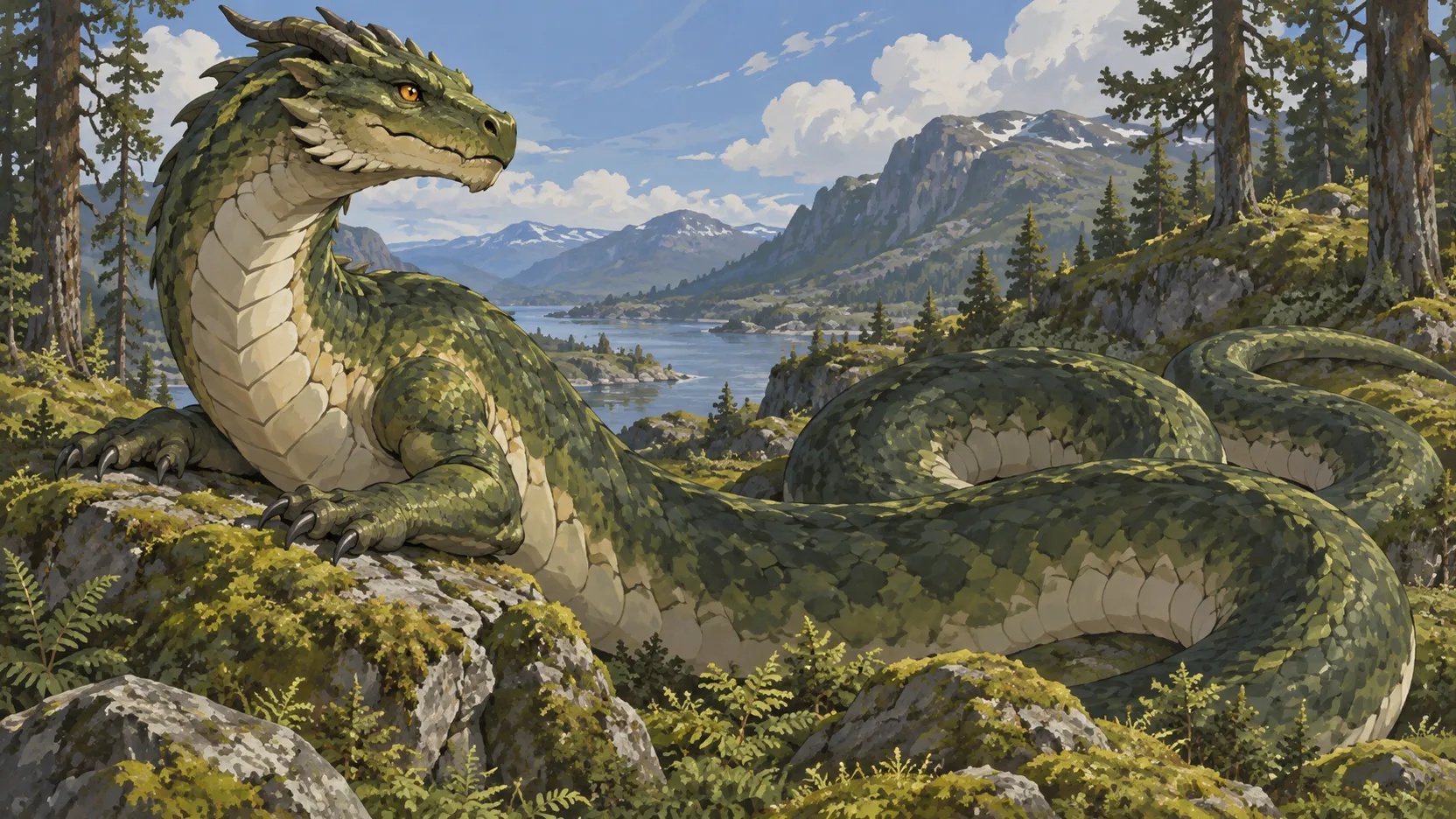
A wedge-shaped head came through the doorway, low enough to pass beneath the lintel. Its amber eye travelled over the bed, the hearth, the pot. Runa stood beside the basket with her hands pressed flat against her skirts.
The lindworm drew himself into the room. Two clawed forefeet gripped the floorboards; behind them his body kept coming, thick as a fallen trunk, until the tail slid clear of the threshold. He coiled between Runa and the door. A chair overturned beneath him with a small, absurd clatter.
“You have dressed for winter,” he said.
His voice was rough, but the words were perfectly clear.
Runa made herself breathe out.
“You have brought the forest indoors.”
A dry leaf had caught beneath a scale along his jaw. She looked at it because she could not yet bear to look at his teeth.
“Take off your shirt.”
“Take off your skin.”
His head rose. The leaf fell.
The Bargain
The lindworm came close enough that she could see her own white shape in his eye.
“The others did not ask that.”
Runa’s fingers closed on the rim of the basket. It was too light to stop him. She let go.
“I am asking.”
He opened his mouth. Behind the first teeth stood smaller ones, angled inward. She had expected a roar, but the breath that touched her face was slow and damp.
“Do you know what I am?”
“I know what happened to the other women.”
His head drew back. For a moment she thought she had killed herself by saying it. Then a ripple passed down his throat, lifting the scales in rows.
He pressed his jaw against the overturned chair. Wood snapped beneath his weight. He pushed harder, dragging the side of his face along the broken edge until something split beside his mouth. A grey seam opened. He hooked a claw into it and pulled.
The sound made Runa’s stomach close.
Skin came away from the head in a stiff fold. Beneath it lay another scaled head, wet and brighter. The lindworm braced his feet and dragged himself forward, turning the old hide inside out as he moved. It caught at his shoulders. He strained; the floor shook; then his body slid free, leaving an empty length of him heaped against the bed.
Runa had backed into the hearthstones without knowing it.
“Now.”
She reached for her outer shirt. The sleeves resisted. For one dreadful moment she was blind inside the linen, her arms trapped above her head. She pulled until a seam tore and dropped the shirt over the empty skin.
He had not moved towards her.
The head before her was still terrible. But where the old hide had dulled his scales, the new ones shone with moisture. His breath came faster.
“Again,” he said.
“Yours first.”
The second skin loosened more quickly. The third did not. He twisted against the bedpost until its joints creaked, and Runa had to move the pot away from his tail before he knocked it into the fire.
“Leave that,” he snapped.
“It is for afterwards.”
“What afterwards?”
She could not answer. In the strange certainty she had brought from the grave, there had been no promise that either of them would live to morning.
She set the pot on the hearth’s outer edge and faced him again.
“Your skin.”
When the fourth lay on the floor, his head no longer reached the bed’s carved canopy. When the fifth came away, he missed the chair with his claw and struck the boards instead. Runa flinched. He turned towards her so quickly that she thought he would bite.
“Do not look.”
She looked down at the shirt in her hands. Five discarded layers lay among the skins. Two remained against her body, damp with sweat.
“I cannot do this without looking.”
“Then turn away.”
The door was three steps beyond his tail. The latch was free. She could see the iron tongue resting in its catch.
She also saw the great body drawing inward, the head sinking between the forelegs. He was trying to hide inside a shape that had already begun to fail him.
“Have you ever come this far?” she asked.
The tail dragged across the floor, covering the way out.
“No.”
The Last Skin
The sixth skin peeled off in strips. He no longer ordered her to undress. He watched while she lifted the sixth shirt over her head and laid it down. One thin linen layer remained.
Under the hearth light his body looked almost colourless. The shape of the scales was there, but without their hardness. His forefeet slipped when he tried to brace himself.
“Enough,” he said.
Runa crouched beside the brushes. Three pale wooden backs; three rows of new bristles. She touched them in turn to steady her hands.
“There is one more.”
He lunged towards the bedpost. His jaw struck it, and the seventh skin broke around his mouth. He heaved forward. The hide rolled back over his brow and caught behind the ridges of his head.
He jerked sideways. The bed scraped across the boards. A split opened along the old skin, but it would go no farther.
Runa rose.
“Be still.”
He shook his head again. His mouth opened blindly beneath the fold. She could have put her arm between his teeth without touching either row.
“Be still, or I cannot reach it.”
The shaking stopped. His claws scratched once, then held.
She came close to him. The skin smelled of wet leaves and something shut away too long. She caught the torn edge with both hands and pulled it clear of the ridge. It slipped. Her knuckles struck his jaw.
He recoiled, and she fell hard on one knee.
For a breath neither moved.
“Back,” she whispered. “Push backwards.”
He obeyed. She held the fold against the broken bedpost while he worked beneath it, inch by inch. The edge cut into her palms. Then the whole weight released, and she stumbled with the empty skin in her arms.
What lay on the boards had no armour left.
The long shape still moved, but uncertainly, drawing together and spreading as though it had forgotten how to hold itself. Runa could find neither the amber eyes nor the familiar line of the jaw. A thin sound came from it.
She dropped the hide and reached for the first brush.
At the first touch of lye the body convulsed. The pot rocked. Runa dragged it back with her heel and held the brush with both hands.
She had scrubbed winter mud from cloth until her wrists ached. She had scoured pots while other people ate. None of that had taught her how to go on when the thing beneath her hands cried out.
She stopped.
The pale mass shuddered. Something within it struggled towards the surface, then sank back. The floorboards beneath it were cold; the fire was dwindling. If she left him now, she did not know what would remain.
“Can you hear me?”
A movement, small as a nod.
“I have two brushes after this one.”
She began again.
The first wore down against a substance that clung in ropes. Beneath it she found the bend of an elbow. She changed brushes, shifted her knees, worked along the shoulder. A hand emerged and closed around her wrist.
She froze.
The grip loosened. The hand turned palm upwards on the boards.
“Please,” he said.
She dipped the second brush.
By the time its bristles splayed, she could see a face. He kept his eyes closed. The mouth was human, the lips split where the skin had caught, and each breath stirred a wet strand of hair against his cheek. Runa worked more slowly now. She turned his arm to reach the last dark membrane along his side. The third brush rasped against the boards as she rinsed it, and she discovered that she was crying without having felt it begin.
At last the brush passed over bare skin.
She set it down. Nothing rose beneath it. No scale, no new fold, no further creature waiting to be stripped.
A young man lay beside the hearth.
What Came Out
Runa fetched the blanket from the bed and put it within his reach. She sat on the empty basket because she could no longer trust her knees.
He dragged the blanket over himself. His fingers fumbled at its edge, as if each one required a separate thought.
“My brother,” he said. “Did they tell you about my brother?”
She shook her head.
“He rode past the wood in a golden carriage. I had watched that road for years. When I stopped him, they brought me here.”
His eyes moved towards the door.
“They will know me now.”
Runa looked at the shirts lying over the collapsed hides. One sleeve had fallen into the cold lye.
“Will they know the names of the women?”
He pulled the blanket tighter. The fire settled with a brief red fall of ash.
“I remember them,” he said.
“Then tell them.”
A knock came at the door. Runa stood too quickly and caught the bedpost. Beyond the wood a woman called her name. Marta. She had come with the water.
The young man tried to rise. His first attempt brought him onto his hands and knees; he looked at his hands as though ashamed to need them. Runa waited. On the second attempt he caught the bed and stood.
“Will you stay?” he asked.
“I shall go through that door.”
He looked towards the latch. She saw the question he might have asked, the command he might once have made. Instead he bent and gathered the nearest skin.
It slithered out of his arms. He caught it again, bundling the loose coils into the blanket’s spare fold. Runa lifted her shirts clear as he gathered the others. They were lighter now, dry at the edges, but awkward enough to make him stagger.
Outside, more feet were coming. Someone called for the queen.
“Open it,” Runa said.
He balanced the skins against his chest and raised the latch.
Marta stood with a jug in both hands. Behind her the queen stopped so abruptly that the people following nearly collided with her. Her gaze went to the young man’s face. Her mouth opened.
He shifted the burden before she could reach him.
“There are things I must tell you.”
Runa took the jug from Marta. Water splashed her wrists and ran into the small cuts across her palms. She drank, lowered it, and stepped over the threshold.
The young man came after her carrying the skins. When one trailed across the passage, he stopped to pick it up himself. Runa waited until he had it, then walked beside him down the stairs.