Senu had one foot over the threshold when the thing beside the door opened its eyes.
He snatched his foot back. Teeth closed where his throat had been, with a sound like two stones struck together. The roll under his arm slipped; he caught it against his ribs and stumbled into the sand.
Behind him, somewhere among the pale rocks, Meru was still calling him a thief.
The creature settled again.
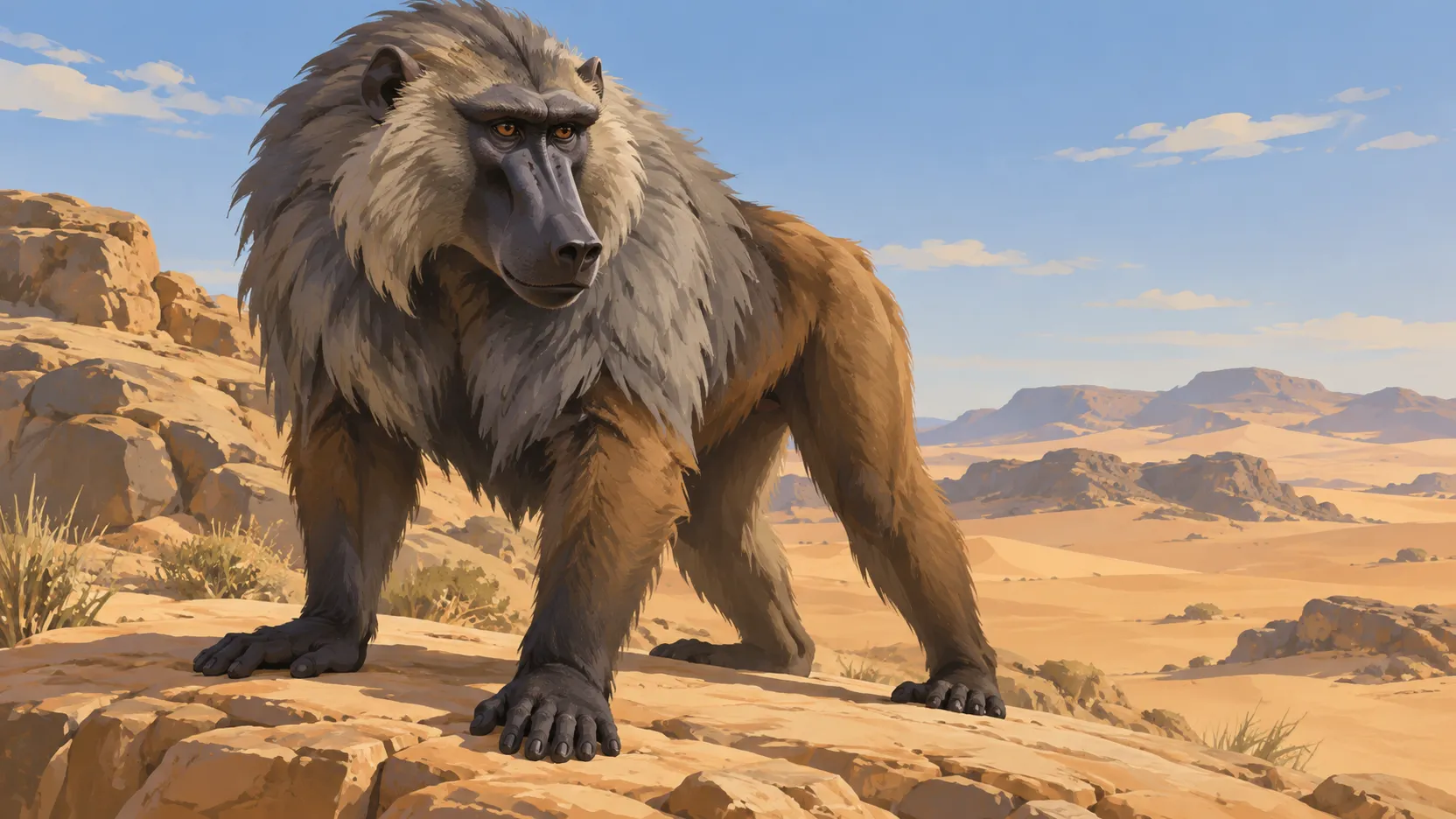
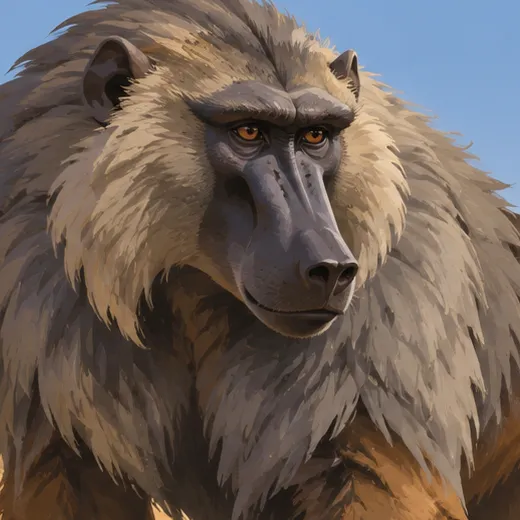
It had a baboon’s heavy shoulders and long hands, but its muzzle thrust forward like a dog’s. A fold of dark lip lifted above one tooth. Its eyes rested on Senu’s neck. There was no chain, no keeper, no bowl beside it. Nothing suggested it had ever needed to leave that place.
Senu backed away until his heel struck a stone. The creature did not follow.
Beyond its shoulder lay a narrow doorway. Light shone through a second door farther in, catching the upturned prow of a boat. Senu could see neither water nor anyone aboard. He could hear, very faintly, the creak of rope under strain.
He had been dead since morning. Already he had learned that thirst survived death, and fear, and the people one owed.
“Senu!”
He crouched behind the outer wall, pressing the roll against his chest. The wooden palette hanging at his side knocked against the stone. He held it still with his writing hand.
Meru came limping around the last rock. In life he had worn linen so fine that Senu could count its folds through a doorway. Now it hung in strips from one knee. He stopped when he saw the creature.
Then he saw the roll.
“Give it here.”
“You said you would pay me.”
“I did pay you.”
“You paid for the papyrus.”
“And whose ink was it?”
Senu’s thumb found the groove worn into his palette. He had mixed that ink himself, ground it until his wrist ached, written Meru’s name into every place where a name could help a dead man. When Senu’s own fever came, the last money in his house had gone for water. There had been nothing left for a roll.
Meru held out his hand.
“You cannot use it. It has my name.”
“I know whose name it has.”
For a moment Senu wanted to tear the papyrus straight through the middle. Meru saw his fingers tighten and lowered his hand.
Neither man spoke. Beside the door, the baboon moved one long finger through the dust.
The Name at the Door
Senu unrolled a little of the papyrus.
He knew its passages better than Meru did. He knew where the reed had split and made a letter too broad, where he had scraped away a blot, where his daughter had fallen asleep against his knee while he worked. The figure beside this doorway was familiar too. He had drawn its long muzzle with the last good point on his brush.
“In-tep,” he said.
The creature’s eyes moved from his throat to his face.
Meru took a step forward.
“Keep speaking.”
Senu looked at the cramped line beneath the drawing. Here was the guardian, here the passage, here the chamber beyond. In the painted boat, the sun had been no larger than the nail of his thumb. Now its light filled the deep room, and the rope was creaking again.
He remembered the words he had written for Meru to speak. He wet his mouth.
“I am—”
Meru waited.
Senu could give the other man’s name. He had given it a hundred times with his brush. He could speak it once with his mouth.
The thought made the doorway seem almost close enough to reach.
“I am Meru,” he began.
“That is mine.”
Meru’s voice was quiet now. It was worse than the shouting.
Senu looked down at the papyrus. His fingers covered the place where the painted man stood upright, clean and well provided for. Farther along, other hands had furnished him with bread, linen, cattle. Senu had painted none of those hands.
The creature rose onto all fours.
Senu stopped reading. He could not tell whether it had moved because of the name or because he had leaned toward the door. Its forefingers rested just inside the worn sill. The nails were blunt. The teeth were not.
Meru came nearer.
“Read me through,” he said. “I will take you with me.”
“You would not take me through your courtyard.”
“That was different.”
Senu laughed once. The sound hurt his dry throat.
The roll trembled between his hands. He was tired of writing a place for someone else. Tired enough to imagine that, if he could only finish the sentence, the painted man might become him.
But he had seen the teeth close. He could not finish another man’s name with his head bowed over the page and pretend he did not know whose head was at stake.
He rolled the papyrus shut.
“My name is Senu.”
Meru reached for it. Senu stepped sideways and laid the roll on a low stone outside the threshold, where either man could take it without approaching In-tep.
“There. Yours.”
For the first time since Meru had come around the rock, Senu let both hands hang empty.
The guardian watched him. Slowly, Senu shifted one foot backward. Nothing happened. He moved the other. Still nothing. Past the corner of the building, the ground sloped into a narrow, open way between two ridges. He had run past it while looking for a door to hide behind.
He could leave.
He turned toward that way.
Meru seized the roll, tucked it beneath his arm, and hurried for the entrance.
“Wait,” Senu said.
“I know its name now.”
Meru put his weight across the sill.
The Hand That Wrote
The guardian struck him sideways.
Meru fell against the broken edge of the doorpost. The roll flew from his arm and opened across the stone. He caught at the wall, but his knee folded beneath him. One leg remained outside in the sand; his chest and head lay inside the door.
In-tep stood over him.
Senu had already taken three steps toward the ridges.
He heard Meru draw breath. It was a small, astonished sound. Then came the scrape of linen as he tried to pull himself backward.
Senu turned.
The long muzzle lowered. Meru pressed his chin hard against his chest. One hand scrabbled along the floor, finding nothing to hold.
“Do something.”
Senu did not move.
Meru’s heel dug a little channel in the sand. His body scarcely shifted. The torn linen had caught on a splinter in the ruined doorpost.
There was still time to walk away. The open way lay behind Senu, empty from end to end.
“Please.”
Senu ran back.
He caught Meru by the ankle and pulled. Cloth tightened across the man’s shoulder. Meru cried out, and In-tep’s head jerked toward the movement.
“Your garment. It’s caught.”
“Then tear it!”
Senu pulled harder. The ankle slid through his sweating hands. The linen held.
He dropped to his knees. From there he could see the snag: a twisted strip wound around a jagged length of wood, close to Meru’s neck. To reach it he would have to put his arm across the sill.
His palette swung forward against his wrist.
For one foolish instant he wanted Meru to notice it. To understand what it meant that these were the tools Senu had carried all his working life, the only things he had brought that were his.
Instead he slipped the cord over his head and thrust the narrow wooden palette between the linen and the splinter.
In-tep’s jaws closed on the wood.
The sound went through Senu’s teeth. His palette broke across the hollow that held the red ink. The reed case fell from its cord, and the little bundle of brushes scattered inside the doorway.
Meru twisted toward the sound. The trapped linen tightened again.
“Lie still!”
Senu pressed the broken edge of the palette against the cloth and sawed. A tooth caught his knuckle. Heat ran across his fingers, but he kept the wood moving until the strip parted.
He flung the splinter away, hooked both hands under Meru’s arms, and hauled.
Meru’s head struck the sill. Senu dragged again, with a cry he did not recognize as his own. His heels dug into the sand. The long muzzle came down after them.
Then Meru’s shoulders crossed the threshold.
In-tep stopped.
Senu fell backward with Meru on top of him. For several breaths there was only weight and the taste of dust. He pushed the other man off, scrambled up onto one elbow, and looked at the doorway.
The guardian stood with its hands inside the sill.
A brush lay between them. Beside it, the papyrus had come to rest face upward. Meru’s painted figure stretched across the floor, one small arm raised in an address neither man had finished.
Senu touched his throat. The skin was whole.
He looked at his hand instead. Blood ran into the old ink stains around his nails.
Meru sat up slowly. He reached toward the doorway, then drew his hand back.
“My roll.”
Senu could see the brushes too. One still had a sharp point. He had cut it the evening before the fever.
He stayed where he was.
Within the chamber, a rope creaked. The light shifted along the boat’s prow. In-tep lowered itself beside the scattered tools, its eyes open.
Meru struggled to stand. Senu watched him fail once, then offered his uninjured arm. They rose together.
At the corner, Meru paused.
“What will you write with?”
Senu almost answered that there was nothing left to write. Instead he held up the damaged hand. It had begun to shake.
Meru looked at it for a long moment. Then he tore a clean strip from the linen at his waist and wound it awkwardly around Senu’s knuckles.
“That is too tight,” Senu said.
Meru loosened it.
They went into the narrow way with their shoulders touching. Behind them, the guardian remained at the door.