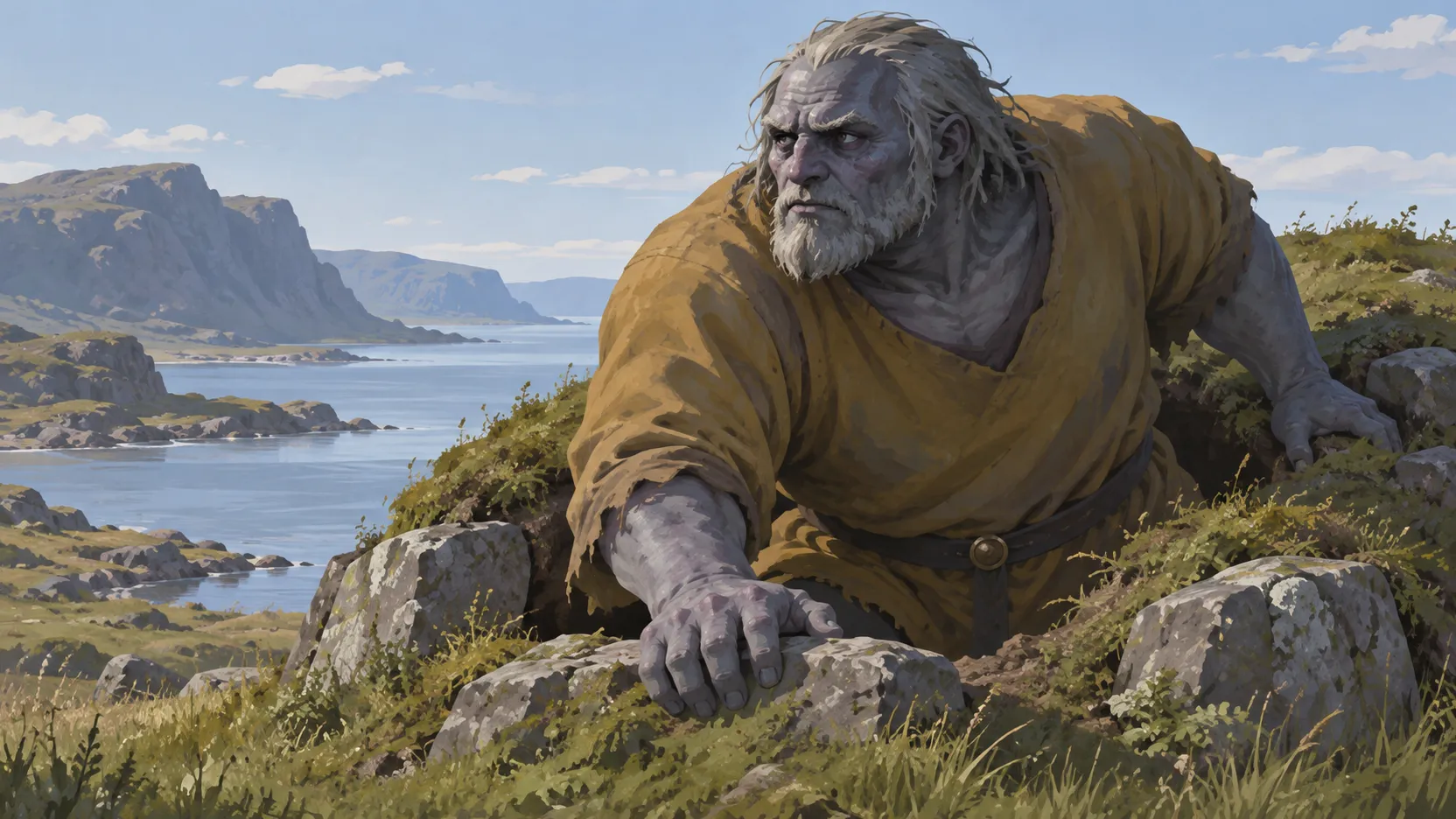
Einar had stopped screaming by the time Runa reached the opening in the mound.
That was worse than the screaming. She lowered the lantern ahead of her and saw her brother kneeling before their father’s chair, his right arm stretched across the dead man’s lap. The hand around his wrist was too large to be their father’s. The thumbnail was the same: split down the middle, with a black crescent underneath.
“Don’t pull,” Einar said.
Runa climbed down and set the lantern on the earth. She had brought the wood axe because it was beside the door when she heard him. Now its head struck the roof whenever she tried to straighten.
“What did you take?”
“The silver.”
“Where?”
His other hand opened. Three little pieces fell between his knees.
She gathered them, pushing one finger into the dirt for the smallest. Their father sat with his chin on his chest. The tunic she had wrapped around him at the burial had split beneath one arm. He smelled of wet wool and something thick and sweet that she could taste behind her teeth.
Runa put the silver back in the open chest beneath his feet.
“There. All of it.”
The fingers tightened. Einar’s breath came out in a whistle.
She caught the dead wrist with both hands. It felt like a stone lifted from deep water. She tried to turn it, then to force one finger away from her brother’s skin. Nothing moved. The flame fluttered behind its horn pane, throwing light onto her father’s face.
His eyes were open.
She had closed them herself.
“Father,” she said.
The eyes shifted towards her. The rest of him remained still.
Einar was watching her instead of him. Dirt had dried beneath his nose, and there was a white mark where he had bitten his lower lip.
“He isn’t going to let me go.”
Runa looked at the rope. It hung behind her, three arm-lengths from the chair. She could climb it. She could be standing in the clean wind before the lantern burned out.
Einar tried to draw his arm back, and his whole body jerked towards the chair.
“Hold still,” she told him. “Let me think.”
What He Kept
They had carried the chair into the mound because their father had asked for it. Six men, grumbling beneath the weight, and Runa telling them to mind the carved arms. The lower end of the right armrest had always been loose. Her father used to strike it with his fist when it rattled at supper.
She put down the axe and took hold of it.
“Help me.”
Einar caught the upright with his free hand. Together they worked it backwards and forwards. The dead man’s knee pressed against her shoulder; through the cloth she could feel the round hardness of swollen flesh. The joint creaked. Her father’s head began to lift.
“Harder.”
The armrest broke loose so suddenly that she fell against the chest. Silver spilled beneath her feet.
The corpse stood.
It did not rise like a man getting out of a chair. Its knees straightened without any forward lean, lifting Einar with it. His feet scraped the earth. The dead head struck a roof beam, and soil pattered onto the lantern.
Runa drove the broken armrest between the gripping hand and her brother’s wrist.
“Turn with it. When I say.”
She pushed. The wood bent. Einar made a thin sound she had never heard from him, and she almost stopped. Then her father’s free hand closed over her shoulder.
The weight forced her down. Her knee struck a piece of silver. She could no longer get breath enough to tell Einar to turn.
She let herself fall sideways, bringing her whole weight onto the lever.
His wrist came free.
“Rope,” she managed.
He staggered back. Her father followed, still holding her shoulder, dragging her on one knee. She seized the lantern before his foot crushed it and thrust it at Einar.
“Take it. Go.”
“I can’t climb with—”
“Hook its handle over your belt.”
He did. He was seventeen, taller than she was, but he had the same narrow face he had worn at seven when their father sent him onto the roof to clear the snow. Runa had stood underneath then, ready to catch him, as if she could have caught a falling boy.
Now she braced the broken armrest against the earth and shoved its jagged end into the dead man’s elbow. His grip shifted from her shoulder to her sleeve. The seam tore. She wriggled out of the tunic, leaving him with a fistful of wool, and snatched the axe.
Above her, Einar groaned with every movement of his injured hand.
“Keep going.”
She backed towards the rope. Their father held the empty tunic before him. He turned it once, slowly, then dropped it onto the scattered silver.
“Mine,” he said.
The word was low and thick. She felt it in the soles of her feet.
She climbed.
Hands seized her beneath the arms when she reached the opening. Einar hauled her out, fell backwards with her, and cried out as his injured wrist folded beneath them. For a moment she lay against him, staring up at pale sky.
Then the rope snapped taut between her boots.
The peg securing it slid through the turf.
Runa scrambled up and struck at the rope with the axe. The first blow buried itself in earth. The second cut through. The loose end whipped into the hole.
Below them, wood cracked.
“We have to shut it,” she said.
Einar was already retreating down the slope.
“Einar.”
“He’ll lift the stones. You know he will.”
She did know. For nine nights she had listened to steps around the house and told her brother that an animal could sound like a man. Yesterday their last cow had been found pressed against the byre wall, its neck broken. She had gone up to the mound with a bowl of food.
The bowl lay overturned beside her. She could see the marks of her fingers in the dried porridge.
Inside the hole, her father’s hand found the edge.
The Boat
They ran towards the shore. The path to the house climbed away across open ground, with nowhere to hide and a broken gate at the far end. Below the mound lay their father’s fishing boat, drawn up for repairs among the beach stones.
Einar had already put a bundle under its bow.
Runa saw a blanket, bread, their mother’s small cup.
“You were leaving.”
“I was coming back for you.”
He was trying to free the boat’s stern from its wooden prop. With one useful hand he could scarcely move it.
“There’s a split in the bottom.”
“I brought wool to stop it.”
“You’d sink before the point.”
“Then help me stop it properly.”
A stone knocked against another above them.
Their father was coming down the slope on his feet. He had pushed the earth away from his shoulders, leaving a low ridge behind him. Runa could see the place where his bare heel pressed into the turf and stayed pressed after he lifted it. He did not hurry.
Einar shoved at the boat again. The prop slipped, and the hull rocked towards him.
Runa caught the gunwale.
“Leave that. Get the lantern.”
“What?”
“From your belt.”
He looked at the boat, then at her.
“No.”
She pulled the blanket out and threw it beyond the stones. The bread rolled free. Beside the bow, under a hide, lay the shavings they had saved for the repair and a bundle of dry kindling. Their father had taught them never to waste good wood. The tar pot sat inside the hull.
It would take days to walk around the inlet. No one at the neighbouring farms would lend them a boat; the last man who had come to their door had heard the footsteps and left before dawn. Without this hull they could not fish, could not carry their grain to be ground across the water.
Runa took a handful of shavings.
Her father’s foot struck the beach. A flat stone tilted under him and sank into the shingle.
“Get behind the boat,” she told Einar.
He caught her arm. “We can run.”
“He comes home.”
She did not say anything more. Her brother looked past her towards the path to their house. Then he took the lantern from his belt.
Runa crouched at the near end of the hull, opened the lantern, and put the shavings to the flame. Her fingers shook so badly that she scattered half of them. The first curl blackened without catching. She held the next one still.
A little flame travelled along its edge.
She fed it into the dry bundle beneath the bow. Einar set the lantern down and took up a loose oar. He could not close his right hand around it. He tucked that wrist against his chest and gripped the shaft with his left.
“Here,” Runa called.
Her father stopped on the other side of the boat.
Close to him, she could see a thread still hanging from the collar she had sewn. His beard had spread over it. Beneath the beard, the skin of his throat bulged against the fastening.
She lifted the axe.
His eyes followed it. He had kept its edge himself, rubbing his thumb across the steel and making her hold the stone steady.
“Put that down.”
Her arms lowered a little before she caught herself.
Einar struck him with the oar.
The blow landed across his chest. Her father caught the shaft and pulled. Einar was jerked against the gunwale, his injured wrist trapped between wood and body.
Runa swung at the hand.
The axe bit, but the fingers held. Her father pulled again. The oar cracked against a rowlock. Einar fell sideways into the boat, and the huge body came over the opposite edge after him.
The hull rolled with their weight.
Runa jumped back. Its rim struck her shin, and she fell among the stones. Above her, the boat settled with a long splitting noise. Their father lay across it, one foot still on the shore, his chest sunk between two broken ribs of timber. Einar was underneath his arm.
The little fire was out of sight beneath the bow.
Smoke threaded through a seam.
The Last Command
Runa got up without putting weight on her struck leg. Her father was pressing against the hull, trying to lift himself. Each movement pushed the broken wood farther into the shingle.
Einar turned his face towards her. His mouth worked, but she could not hear him.
The oar lay across the gunwales beneath the dead man’s elbow. She thrust its blade under the arm and hauled down on the other end.
It shifted a finger’s breadth.
“Crawl.”
Einar tried. His shoulder caught.
She pushed the oar down with both hands. The blade began to split along the grain.
“Now.”
He slid out, leaving a strip of shirt under their father’s arm. Runa let go and caught him before his face struck the stones. They crouched together beside the boat while something inside it broke again.
Smoke thickened behind her. A tongue of flame showed at the tarred seam.
“He’ll get up,” Einar said.
Their father turned his head. He could still reach the upper gunwale. His fingers settled over it, finding a hold.
Runa limped around the bow and dragged the kindling farther underneath. Heat stung her face. She heard Einar gasp and looked up to see the corpse lifting its chest clear of the broken boards.
She grabbed the axe from where it had fallen.
Their father looked directly at her.
“Give it here.”
She remembered bringing him that axe when she was little, carrying it in both hands with the blade turned away from her legs. He had praised her for remembering. The pleasure of it returned so sharply that for an instant she could smell fresh-cut wood instead of the burning boat.
His hand opened towards her.
Behind him Einar was trying to raise the oar again. He could not lift it high enough.
Runa stepped onto the low bow. It shifted beneath her good foot. She steadied herself with one hand against the stem, then raised the axe where there was sky enough to swing it.
She struck the reaching wrist.
The hand fell against the planks. Her father lurched towards her, and the weakened gunwale broke under his chest. He dropped back into the hull. Runa nearly followed. She caught the stem, pulled herself upright, and struck again, at the exposed neck above the rim.
The axe lodged.
She put a foot against the side and dragged it free.
Einar came beside her. He wedged the oar across their father’s shoulders and leaned on it with his whole body. Runa raised the axe once more.
When she stepped down, nothing in the boat moved except the fire.
They fed it the broken prop, the kindling, the spare thwart. The body resisted the flame long after the tar was burning. Once Runa thought she saw a knee rise; she seized the oar, but the timber beneath it had only given way. She stayed close enough to watch, turning her face aside when the heat became too much.
Einar went along the beach gathering driftwood. He made several journeys, carrying each load against his chest with his good arm. When he stumbled, Runa went to him. Neither of them looked back towards the silver in the mound.
By evening, the shape in the boat had fallen apart. They kept the fire going until no shape remained. Then they waited beside the embers.
Einar unwrapped the bread. Sand clung to one side. He scraped it with his knife and offered her the larger piece.
She tried to take it, but her hands would not close.
He broke off a mouthful and put it in her palm.
When the fire had cooled, they gathered what was left of their father into the hide that had covered the repair wood. Together they carried it over the rocks, farther along the shore than either had gone that day, and emptied it into a deep cleft below the tide mark. Water moved in the bottom, dark and clear. Runa watched it cover the ash.
At the foot of the path, Runa stopped to pick up the axe. She could hardly lift it.
“Shall I carry it?” he asked.
She held out the haft.
He took it. At the place where the path forked, he waited for her, and they climbed towards the house together.