
The horses backed away before Iolaos saw what was moving in the reeds.
He held their heads toward the dry ground and spoke to them as though nothing were wrong. Behind him, Herakles drew another burning arrow from the little fire beside the chariot.
“Keep them here.”
“I can carry the bow.”
“Keep the horses.”
The arrow went into the dark opening above the spring. For a moment its flame showed inside the rock. Then the reeds flattened outward.
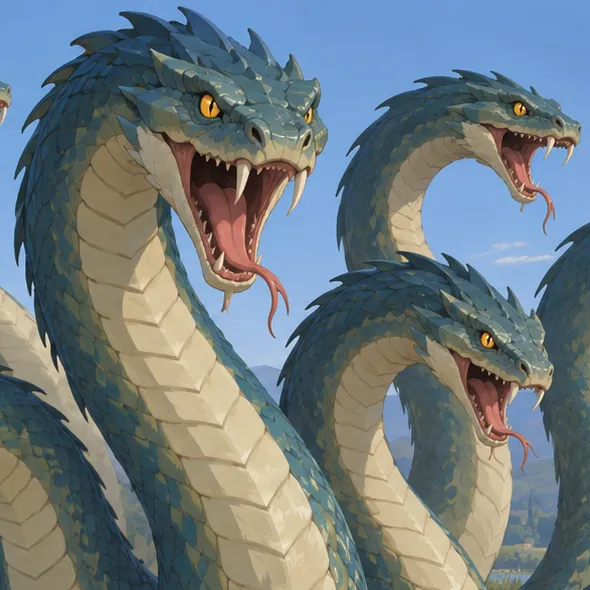
Iolaos counted heads because it was easier than understanding the body beneath them. Three rose above the water. Two more slid across the bank. Another pair lifted behind those, and then an eighth, and in their midst a ninth that remained very still.
The horses jerked him sideways.
He caught the nearer bridle with both hands. Herakles had already waded into the shallows. He struck the first reaching head with his club and drove it down against a stone.
Iolaos heard the blow over the splashing.
Then two heads lifted where one had fallen.
He forgot the horses. They pulled him three stumbling paces before he dug his heels into the mud.
“Herakles!”
“I see them.”
The club rose again. Another blow. Another pair of necks uncurled, small at first, then filling the space before the fallen club could rise.
Herakles stepped back. One coil slid behind his ankle.
Iolaos hauled the horses toward a stunted tree and wound the reins around its trunk. The knot came wrong. He pulled it apart, hands thick and useless, while the sounds behind him changed from blows to splashing and a harsh breath drawn through clenched teeth.
He tied the knot again.
When he turned, Herakles was down on one knee.
The Hydra had wound itself around his leg. Its heads crowded toward him from different sides, each withdrawing just far enough to let another strike. He caught a neck beneath his arm, forced the jaws away, and reached for the club half buried in the water.
Iolaos ran to the bank.
Something broad and hard broke the surface beside Herakles’s foot. A crab fastened there. Herakles stamped until its shell gave way, but in that moment a serpent head passed his shoulder and snapped at his face.
He drove it back with his forearm.
“Iolaos!”
Iolaos stopped at the water’s edge, waiting for the order.
“Help me.”
He seized a fallen branch and struck at the coil. It did nothing. He struck harder. Herakles had recovered his club and brought it down across a neck.
Two wet points pushed upward from the place of the blow.
“Stop hitting them,” Iolaos said.
Herakles stared at him.
For a heartbeat Iolaos thought he would be sent back to the horses. Then the nearest jaws opened and Herakles thrust the club between them, holding them apart.
“What else?”
The small fire beside the chariot crackled behind Iolaos. He looked from it to the new heads, growing pale and supple out of the broken neck.
“Cut one. Only one. When I’m ready.”
He ran.
The fire was too small. Its arrow brands had burned low. He dragged dry branches from beneath the trees, snapped them across his knee and piled them over the embers. Smoke stung his eyes. He knelt and blew until a thin flame climbed between the sticks.
Behind him, Herakles shouted his name again.
“Not yet!”
He hated himself for saying it. He blew harder. The flame caught, spread, and curled around a thick branch with a forked end. Iolaos took it up. Heat reached his fingers almost at once.
He carried it into the water.
The first step sank to his shin. The second sent a wave over the glowing end. It hissed and darkened.
“No,” he whispered.
He lifted it high, keeping the flame above the spray, and pushed close enough to feel the Hydra’s body shift against his knee.
“Now.”
Herakles had drawn his blade. He struck at the neck held against his arm and swung clear.
Iolaos drove the brand down.
The Hydra recoiled. Another head swept toward his cheek. He ducked, almost losing the branch, and kept it pressed where the severed neck had begun to stir.
“Hold it,” Herakles said.
“I am.”
The wood buckled. Heat pierced Iolaos’s palm. He wanted to let go so badly that his fingers began opening without his permission.
He caught the branch with his other hand.
The neck stopped moving beneath it.
They waited one breath. Two.
Nothing grew.
Herakles looked at him across the writhing heads.
“Another.”
Iolaos backed away for a fresh brand. This time he carried two, holding them above his head as he returned. Herakles moved to meet him, drawing the Hydra toward firmer ground a pace at a time.
They found a rhythm, lost it, found it again. Once Iolaos came too late and two new mouths opened against the flame. Once Herakles raised his blade while the brand was still in Iolaos’s path, and stopped with the edge trembling beside the younger man’s wrist.
“Wait for me,” Iolaos said.
Herakles nodded.
After that he waited.
The marsh around them filled with broken reeds. The fire on the bank climbed into the dry branches Iolaos had dragged together. His hands hurt beyond any thought he could give them. He watched the blade, the neck, the place where the fire must go.
At last only the middle head remained above them.
It had not hurried. Even now it swayed slowly, following Herakles as he shifted his grip on the sword.
Iolaos raised his last brand.
Herakles caught the neck, bent it against his knee, and struck.
The body slackened in the water.
The head did not.
Its jaws closed on the burning wood and held it. Iolaos pulled. The brand broke, leaving a blackened length between the teeth. The severed head turned toward his hand.
He stumbled backward.
Herakles pushed it away with the flat of his blade.
“There,” he said.
Beyond the spring a great stone lay half out of the earth. Iolaos ran to it and scraped away the loose soil at its base with a piece of branch. Herakles came after him, keeping the head pinned beneath the club until the hollow was deep enough.
They worked without speaking. Iolaos widened the pit. Herakles forced the head into it, then put his shoulder beneath the stone.
The rock rose a little. Earth crumbled from its underside.
Iolaos braced it with the unburned end of his branch. Beneath them, the jaws opened.
“Out,” Herakles said.
Iolaos pulled the branch clear and threw himself sideways.
The stone fell.
Dust passed over his hands. Under the rock something struck once, a muffled, patient sound.
Neither man moved until it stopped.
When they reached the chariot, Iolaos could not untie the reins. He picked at the knot with swollen fingers and made it tighter.
Herakles came beside him and worked it loose.
Days later, the king’s herald told them the labor would not count. Herakles had received help. The words were spoken carefully, from a safe distance, as though correct phrasing could make the marsh dry and the heads grow back.
Iolaos stood at the horses, his palms wrapped in linen. He looked down before Herakles could look at him.
The herald finished. No one answered.
Then Herakles climbed onto the chariot and held out his hand for the reins.
“I can drive,” Iolaos said.
“I know.”
Herakles waited until he gave them up, then moved aside to make room for him.
