Butes missed a stroke.
His oar struck the water flat, splashing the man behind him. He did not curse or laugh. He lifted the blade and left it hanging above the sea.
Orpheus looked up from the loose cord he was winding around his lyre.
“What is it?”
Butes raised one hand for silence.
Then Orpheus heard the voices.
They came from the island ahead, over a bright reach of water. At first he could not separate one from another. A low phrase carried a higher one; beneath both, a third movement seemed to promise the place where the melody would finally come to rest.
He waited for that resting place.
It did not arrive.
The sail held its curve above them. Argo moved steadily forward, but along the benches the oars began to lose their common beat. A man leaned across his neighbor to see the shore. Another stood, shading his eyes.
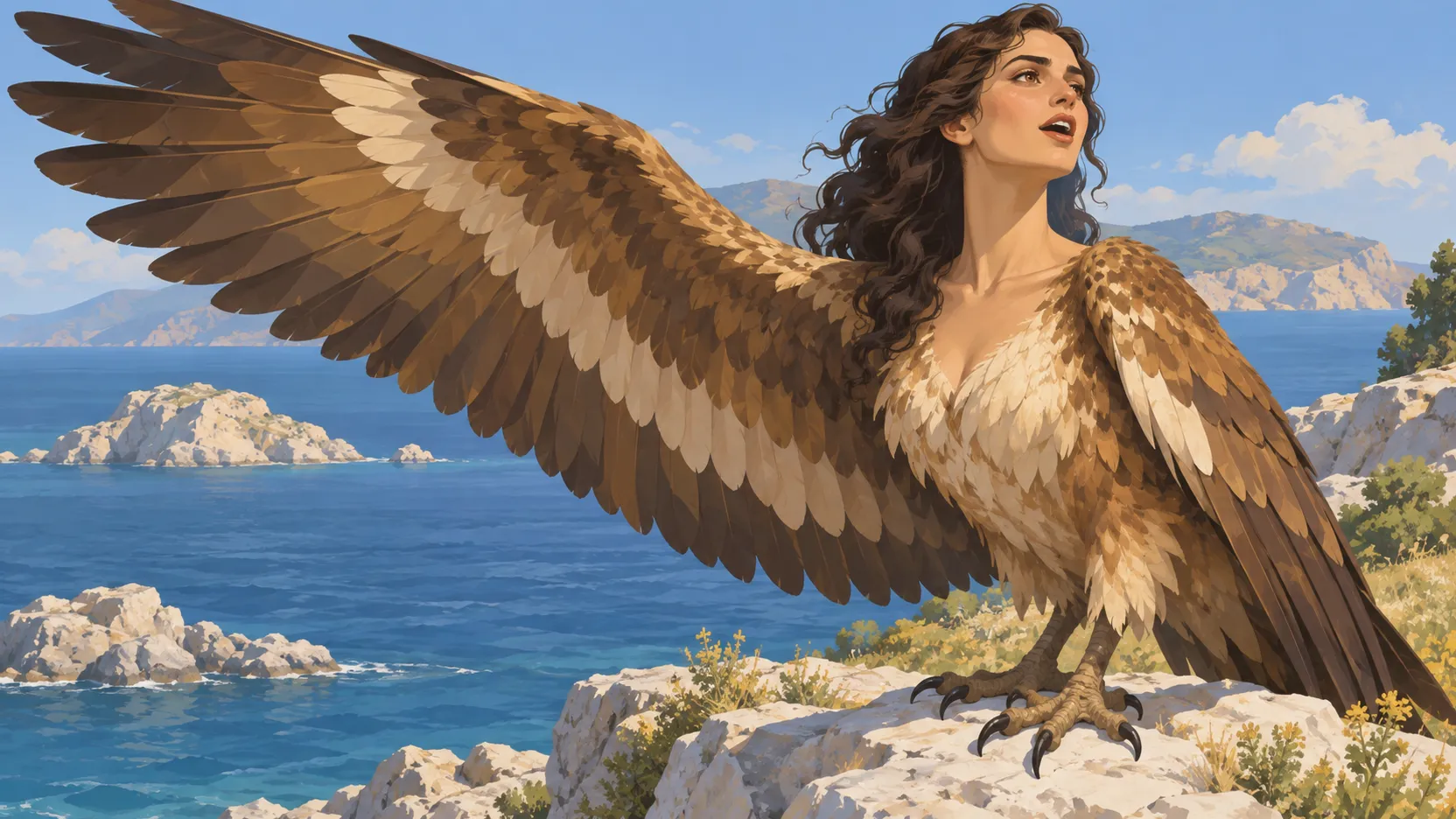
On a pale rock above the haven, something spread its wings.
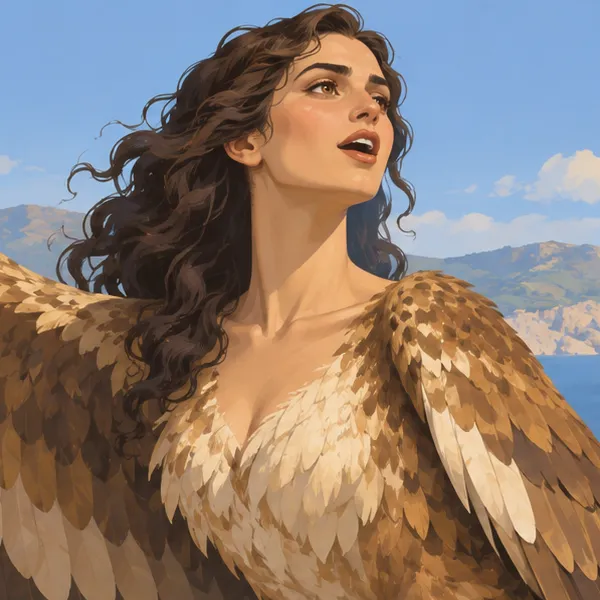
Orpheus saw a woman’s face, a throat lifted in song, feathers folding against a shape that was not wholly human. Beyond her, the grass moved in the wind. The island looked sheltered. They had crossed so much hard water that shelter itself seemed an argument.
Butes set his oar across the gunwale.
“We could put in.”
Jason, standing near the bow, did not answer. His hand lay on a coil of rope.
Orpheus knew what they were. He knew the danger. Yet the next phrase reached him, and knowledge became a small dry thing beside it.
If he could hear how they joined those notes—only that much—he could leave afterward.
His fingers loosened on the cord.
At the bow, Jason lifted the mooring rope.
Orpheus stood so abruptly that his knee struck the bench.
“Leave it.”
No one turned.
He pulled the cord from the lyre. It caught around one of the arms. He tugged, tangled it worse, and for a moment the only sound he could make was a clumsy scrape of wood against his belt.
The Sirens sang on.
Butes smiled toward the shore. There was nothing drunken or wild in his face. He looked as if someone had at last explained a thing he had been trying to understand for years.
Orpheus tore the cord free and struck the strings.
The first sound was ugly.
He had meant to answer them with a phrase of his own. Instead his hand, moving too fast, caught several strings together. The sharp clash cut across the voices, and Butes blinked.
Orpheus struck again.
“Take your oars.”
A man at the nearest bench looked at him, irritated by the interruption.
Orpheus did not try to make the next phrase beautiful. He made it quick. Three notes, a hard return, three notes again. He set the beat beneath the creak of the tholepins and played it until the man’s hands closed around his oar.
“Pull.”
The blade entered the water.
Another followed.
He moved between the benches, the lyre held high against his chest. At each return of the phrase he stamped his foot. The deck answered. Wood, string, heel, the forward lean of bodies: he gathered the sounds together and made them something the men could do.
Argo’s bow began to turn away from the haven.
The Sirens’ voices slipped into the spaces he left between notes.
Orpheus heard a turn in their melody so delicate that his hand faltered. He wanted to follow it. His own pattern suddenly seemed crude, a child beating a cup with a spoon.
Two oars slowed.
He struck the return harder and filled the space with another run of notes.
Jason dropped the rope.
For a moment they looked at one another. Then Jason went to the bow and called for the ship to hold its course.
Butes had not taken up his oar.
Orpheus played toward him, standing close enough that the lyre almost touched his shoulder. Butes turned his head, listened, and gently moved the instrument aside.
“Not now,” he said.
The words frightened Orpheus more than a shout would have.
He changed the pattern, driving it faster. Butes stepped over the bench.
“Sit down.”
Butes put a hand on the gunwale.
Orpheus reached for him. The lyre tilted, and his playing broke off for less than a breath.
All along the ship, faces turned toward the island.
He snatched his hand back to the strings.
Butes climbed.
Jason shouted. A man lunged across the bench and caught the edge of Butes’s tunic. The cloth slipped through his fingers.
Butes went over the side.
The splash vanished beneath the singing.
Orpheus took a step toward the rail. He could still see the man in the water, arms driving him toward the shore. A rope. They could cast a rope. Turn the ship a little. Go close enough—
The rower beside him had risen from his seat.
Orpheus blocked his way with his own body and kept playing.
“Pull,” he said.
The man stared at him.
“Pull.”
Jason seized the unused oar and drove it into the water. The rower sat. The others bent their backs again.
The wind pressed the sail outward. Water rushed beneath the stern. Argo carried Orpheus away from the swimmer one stroke at a time.
He had never played so loudly. Every phrase ended before it could open into another thought. There was no room in it for the island, no room for the white wake behind Butes’s shoulders, no room even for the music he was refusing to hear.
Then a brightness moved across the water near the swimmer.
Orpheus saw an arm lift him clear of the turning swell. A woman held him where no mortal woman could have stood. The sea broke around her without drawing her down.
“Aphrodite,” someone breathed.
She turned with Butes in her arms, away from the Sirens’ shore. Spray rose between them and the ship. When it fell, the water was empty.
Orpheus kept playing.
The island diminished. The voices thinned until he could no longer tell whether he heard them over the strings or only remembered them. He added another phrase, then another, afraid of the silence that would follow if he stopped.
At last Jason touched his shoulder.
“We are past.”
Orpheus let the final note sound by itself.
The sea filled the space around it. Men breathed heavily over their oars. One looked toward the empty bench and then away.
“Did she take him?” he asked.
Orpheus nodded.
“Where?”
He could not answer.
He sat where Butes had been and laid the lyre across his knees. The cord he had torn loose still hung from one arm. He began to wind it, then stopped.
The rowers were falling out of time.
Orpheus lifted his hand and gave them a plain, steady beat.