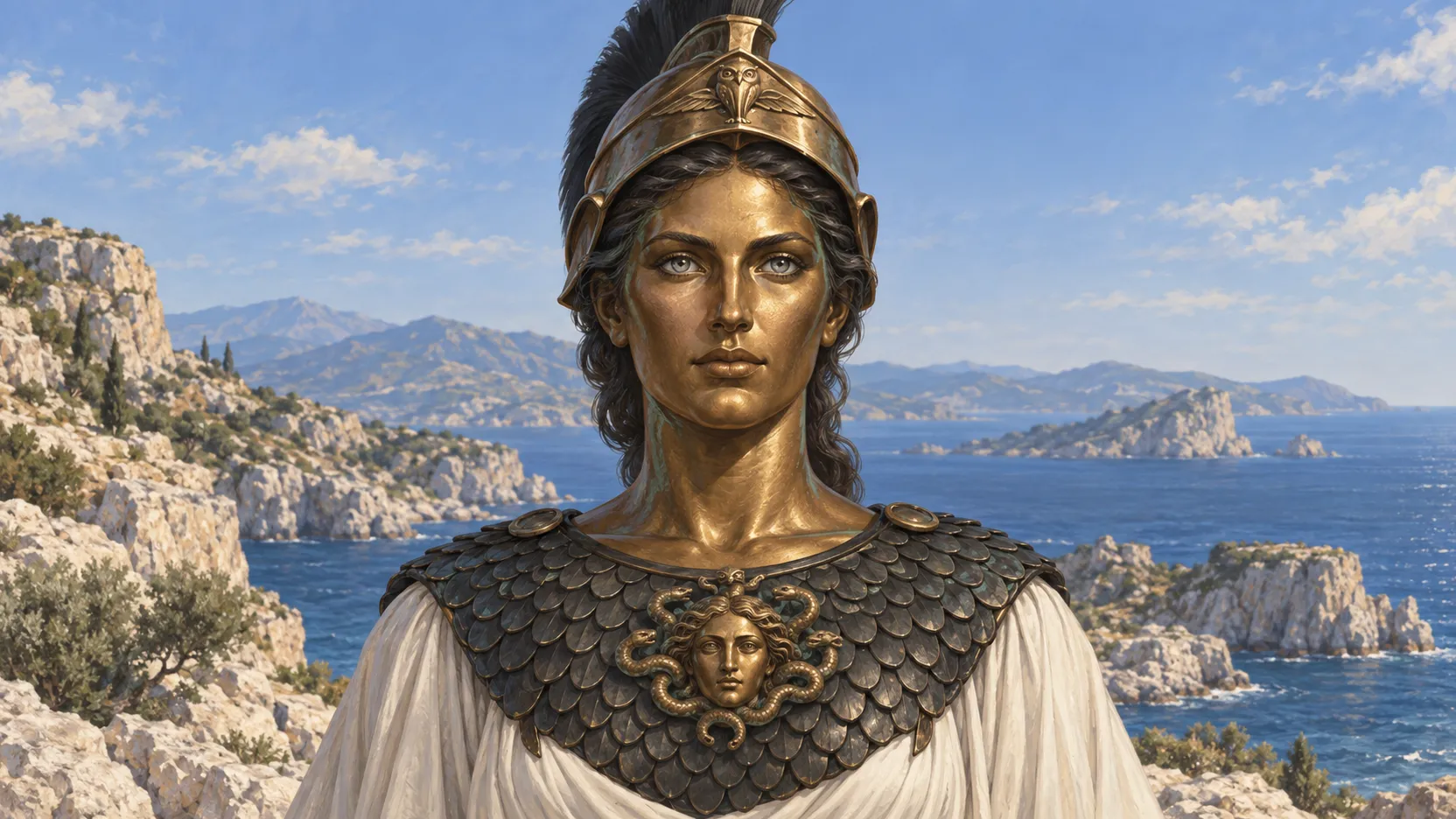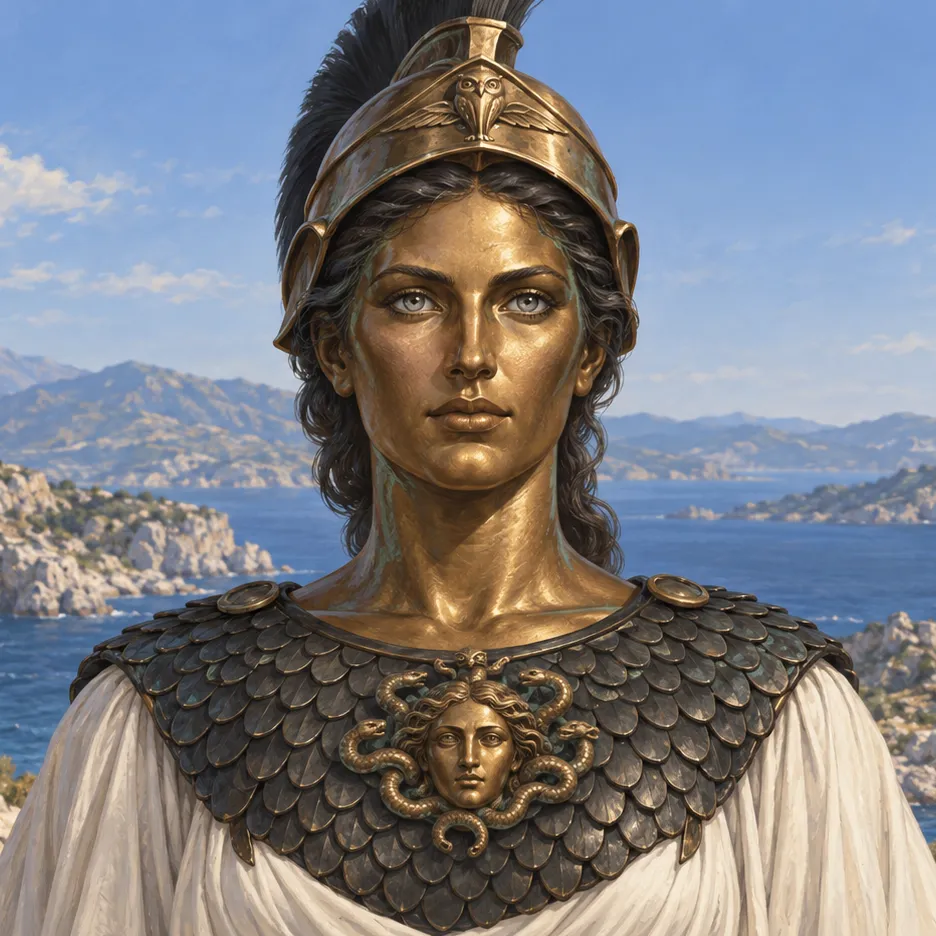
The First Work of Athens
The boy came up the hill carrying a rope with nothing at its end.
He stumbled through the people gathered around Athena’s olive tree, struck his knee on a root, and tried to speak. Salt water ran from his hair. Below him, where the road had curved between gardens, a brown current carried a door sideways through the fig trees.
Athena caught his wrist before he fell.
“Where?”
“The kiln.” He swallowed and tried again. “My father. The others are on the roof. I had the rope round a post, but the post—”
He opened his hand. A splinter lay across his palm.
Athena looked past him. The potters’ yard stood on a low shoulder of ground beneath the western slope. Water had cut across the neck of it. Six people crouched on the roof of the drying shed, and a seventh lay beneath them on a platform beside the kiln. Between that platform and the hill, a strip of rushing water widened as she watched.
Behind her, the olive leaves rattled. The gods had scarcely finished awarding her the city. Cecrops still wore the wreath he had put on to witness their judgment.
Out on the drowned road stood Poseidon.
Water struck his knees and divided around them. He held his trident loosely, as a man might hold a staff while waiting for someone who had kept him too long.
“You have your hill,” he said.
Athena took her spear from Cecrops. “Clear the path.”
The king began ordering the crowd aside. The boy clung to her wrist.
“He cannot walk.”
“Then he will not have to.”
She went down the slope with him running behind her.
The Broken Crossing
At the edge of the breach, Athena drove her spear deep into firm ground and looped the boy’s rope around its shaft. On the far side, a woman held a little girl above the water that had begun creeping across the roof.
“Thestor!” the woman called. “Can you reach us?”
The boy snatched up the free end. Athena stopped his arm.
“Not from here. It will fall short.”
She gathered the rope, weighted its end with a stone, and cast it over the roof. The woman caught it on the second swing. At Athena’s command she knotted it under the child’s arms.
The girl refused to leave her.
Athena stepped into the torrent.
Cold water drove against her greaves. Gravel struck her legs; somewhere underneath, a large stone rolled with a sound like teeth grinding. She planted her feet, reached upward, and waited until the woman lowered the child into her hands.
The little girl seized the rim of her helmet.
“Hold there,” Athena said.
She lifted her onto the bank. Thestor caught her and passed her to the people descending from the hill.
The woman reached for the rope again. Before she could knot it, the earth beneath the spear broke away.
Athena seized the shaft. A slab of bank slid into the water, taking the place where Thestor had been standing. He scrambled backward on his hands. The spear came free, and the rope snapped tight against Athena’s arm.
Across the breach, the drying shed shuddered.
A man on the roof dropped to his belly and caught the woman by her belt. The others crawled away from the sagging corner. Beneath them, the old potter tried to drag himself off his platform. One of his legs lay stiff behind him.
“Stay still!” Thestor shouted.
His father looked up at the sound, then hid his face against his sleeve.
Athena measured the widening gap. The rope could bring the strong across one at a time, if the roof held. It could drown the old man before anyone hauled him halfway.
She pulled her spear clear and examined the ground above the breach. Solid rock showed through a little higher up. Opposite it, the kiln’s stone foundation stood above the flood.
“More rope,” she told Thestor. “From every house. Belts, too. Bring them to that rock.”
“What will you fasten them to?”
She looked uphill.
The olive stood alone against the sky, its new leaves silver underneath.
The Gift
Cecrops met her beside the tree with a woodcutter’s axe in his hand. He had seen where she was looking. Yet when she reached for the axe, he did not release it.
“This is the witness,” he said.
“I remember. You were there.”
“The gods gave us to you because of it.”
From below came the crack of a roof beam. Thestor shouted his father’s name.
Cecrops’s fingers tightened around the handle.
Athena could have taken it from him without effort. Instead she turned his hand so that he could see the potters’ yard between the branches.
“Count them.”
He looked down. His lips moved.
“Again,” she said.
This time he let go.
Athena set the axe against the trunk, a little above the roots. She had brought this tree out of the hard ground with its bark already furrowed and its branches ready for the sun. She knew where the grain twisted, where a split would run, where the timber would bear a man’s weight.
She struck.
The sound carried across the hill. People stopped bringing ropes. One woman covered her mouth.
Athena struck again, and again, opening a pale wedge in the wood. Sap wet the edge. She moved to the other side and cut higher, leaving a hinge to guide the fall.
“Stand clear.”
The crown leaned toward the empty path. Leaves swept across the stones. Then the trunk broke with a long, tearing groan, and Athena caught it before it could roll into the crowd.
She stripped the branches with the axe. Beside her, Cecrops knelt and dragged them away.
Poseidon’s laughter rose from the flood.
“A short reign for your tree.”
Athena shouldered the trunk and started downhill.
Thestor waited on the rock with a heap of ropes. He stared at the cut end passing above him.
“Under the beam,” she told him. “Two loops. Keep them apart.”
His hands shook too badly to make the first knot. She put the trunk down, took his fingers, and led the rope around itself.
“Now the other.”
He bent over it. This knot held.
Across the Water
Athena laid the olive trunk across the breach, one end on the rock and the other on the kiln foundation. She ran a rope above it for a handhold, then placed the longer lines into the citizens’ hands. They stretched uphill in two rows.
“Do not pull against each other. Watch my hand.”
She crossed first, testing the timber under her feet.
On the far side, the old potter caught her ankle.
“The roof,” he whispered.
A corner post had begun to buckle. His people could reach the bridge only by coming down beside it.
Athena put her shoulder beneath the roof beam.
“Come down. One at a time.”
The woman who had lowered the child came first. She slid down the post, caught the handrail, and stepped onto the olive trunk. Halfway across she froze. Her foot searched for a broader place that was not there.
“Look at me,” Thestor called from the bank.
She lifted her head.
“One more step.”
The trunk dipped. The citizens leaned backward on their lines, and the woman reached the rock. Two workers followed her, gripping the handrail. Then another.
The weight above Athena shifted. Wet clay tiles slid off the roof and struck the water around her. She pressed upward, feeling the grain crush against her shoulder.
The last worker reached the bridge just as Poseidon lifted his trident.
The current rose against the underside of the olive trunk. It rolled a hand’s breadth toward the sea.
On the beam, the worker fell to his knees. The people on the ropes stumbled forward. Thestor dropped flat and wrapped both arms around his line.
Athena’s spear stood within reach, where she had leaned it against the kiln. With her free hand she drew it across her knee and broke the shaft.
The sharp report cut through the shouting.
She drove the bronze-headed half between the olive timber and a joint in the kiln’s stonework. The other half she wedged beneath the roof beam, taking its weight long enough to free her shoulder.
“Left line back! Right line hold!”
The rows on the bank separated. The olive trunk settled against the spearhead. Its wet upper surface stopped turning. The worker crawled the remaining length, and waiting hands drew him onto the rock.
Athena bent and gathered the old potter into her arms.
“My wheel,” he said.
She looked where he was looking. Through the broken doorway, water spun the wheel in slow, useless circles.
“Leave it.”
He reached toward it once. Then he gripped her shoulder.
She stepped onto the bridge.
Behind her, the broken shaft bowed beneath the roof. The first fastening tore loose with a small, vicious snap. Thestor started onto the far end of the beam, letting go of his rope.
“Stay!” Athena called.
He stopped.
“Your line.”
He looked at his father, at the moving water between them. Then he backed onto the rock and seized the rope again.
Athena felt the tension return beneath her feet.
She took another step. The potter’s hand closed over her shoulder so tightly that his nails bent. One more step brought her beyond the center. On the bank, the citizens pulled together, their heels cutting furrows in the mud.
The roof fell.
A sheet of water struck the bridge from behind. Athena drove her foot against the timber, sprang onto the rock, and turned with the old man sheltered against her chest. The trunk kicked free of the broken spear and swung downstream, still caught by the ropes.
“Hold it!” she commanded.
They held.
Thestor crawled to his father. For a moment neither spoke. The boy put his wet forehead against the old man’s, and Athena withdrew her hands.
Beyond them, Poseidon stood among the floating tiles. His eyes moved from the cut tree to the people gripping its ropes.
Athena faced him with mud on her armor and no spear in her hand.
He lowered the trident. Water curled away from the rock. Farther down the slope, a drowned wall began to show its stones.
Athena waited until the current slackened. Then she turned back to her people.
“Bring the timber up.”
By evening the olive lay beside the path, scored by ropes. The potter sat on a dry cloak while Thestor cleaned the mud from his injured leg. Around them, people sorted the branches into straight lengths and crooked ones. Cecrops carried an armful toward a house whose door had gone down with the flood.
Thestor found a small jar that had survived in the kiln’s upper chamber. He washed it, filled it from a spring above the flood line, and brought it to Athena.
She took a mouthful, then gave it back.
He stood beside her at the stump. The axe cuts were still pale. Below them, a narrow strip of green bark ran unbroken into the earth.
Thestor knelt and poured the rest of the water around the roots.