Hori had driven his forehead against the doorpost twice before Merit caught his hair.
He turned on her so quickly that she struck the wall with her shoulder. For a moment they stood with her fist closed at the back of his head and his hand around her wrist, breathing into each other’s faces.
“Let go,” he said.
“You first.”
His fingers opened. She kept hold of him until his knees bent, then lowered him onto the sleeping mat. He was heavier than when he had left. The shoulder under her hand belonged to a man who carried stone all day; the frightened noise he made belonged to the boy who used to sleep with a heel hooked over her ankle.
She put a folded cloth between his head and the wall.
“How long?”
“Since yesterday.”
“And you walked here?”
“I thought the air—” He pressed his palms against his temples. “Don’t make me talk.”
Outside, someone was driving a reluctant donkey up the lane. Merit listened to the blows falling on its pannier, each one answered by a movement in Hori’s jaw. She went to the door and asked the man to pass quietly. He looked at her, looked beyond her, and took hold of the animal’s halter.
When she came back, Hori was sitting up.
“Who else is here?”
“No one.”
He pointed to the corner beyond the water jar.
Merit raised the lamp. A rolled mat leaned against the wall. Beside it stood her mother’s empty basket, with a loop of cord fallen across its rim.
“Lie down.”
“He puts his arm up when you look.”
The flame shifted. She could see all the way into the corner.
She set the lamp beside Hori and brought him water. He swallowed once, then closed both hands around the cup without drinking again.
“I won’t sleep,” he said.
“Then keep me company.”
“You’re angry.”
“Yes.”
That seemed to steady him. He knew what to do with her anger. He had left it behind three months ago, along with the washing and the broth and the little work their mother could no longer finish. Now their mother was buried, and the basket was still waiting to be emptied.
“You can be angry in the morning,” he said.
Merit took the cup before he spilled it.
The Face Above the Arm
The charm hung beside the bed on a cord through a hole in a pale piece of stone. Her mother had paid to have it written years before. Merit knew the beginning because she had once copied its unfamiliar signs onto the floor, and her mother had made her scrub them away before anyone trod on them.
She lifted it from its peg.
“That didn’t help her,” Hori said.
Merit nearly put it back.
Then his eyes went to the corner, and she turned with them.
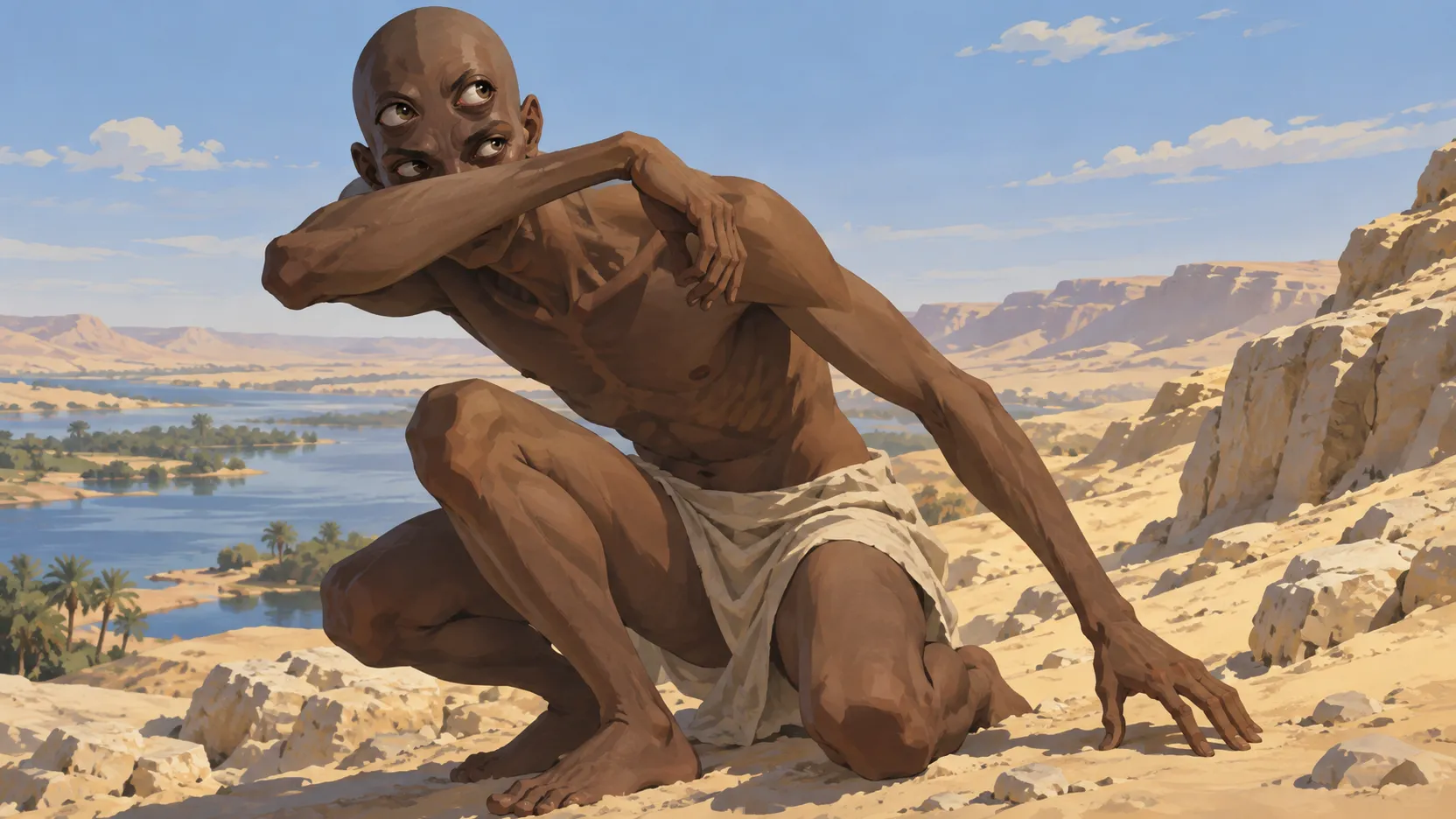
A narrow shoulder stood clear of the rolled mat.
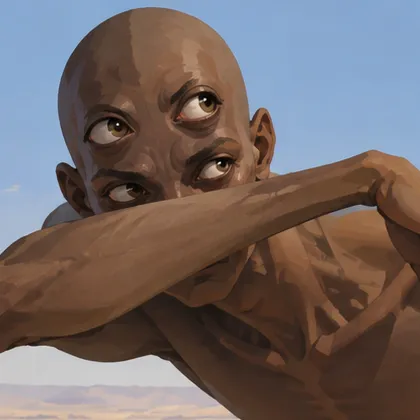
The figure was about the size of a young man, bent so that its head came forward over its chest. One arm crossed the face. Above the forearm, too high on the smooth forehead, two eyes watched the lamp.
Merit did not cry out. She drew breath to do it, but her chest would not give the breath back.
Hori caught her skirt.
“You see him.”
She set the stone on her knee. Its bottom edge clicked against her tooth before she realized she had brought it up too close.
“Sehaqeq,” she said.
The figure’s eyes moved to her.
There was no wound on Hori’s forehead. She looked at it nevertheless, searching for something she could wash, something she could close with a strip of linen. His lips had become pale. His hands were pushing against his skull again.
“Read it,” he said.
She held the lamp beside the stone. The signs grew sharp, then doubled. She blinked until they steadied and began the address, giving each word enough space to leave her mouth.
At the first command to withdraw, Hori’s hands relaxed.
Merit went on. She stumbled over a phrase she remembered hearing differently. She returned to its beginning. In the corner, the raised arm still hid the lower face.
“Don’t stop.”
“I haven’t.”
“You stopped.”
She could hear the wet click of his tongue against his teeth. She wanted to tell him that he was making it harder. Instead she moved the lamp closer and found her place.
Hori let out a long breath. His fingers fell away from her skirt.
For several heartbeats there was nothing but the small noise of the wick.
“Better?” she whispered.
He nodded without opening his eyes.
She should have kept speaking. Later, she would remember that small pause more clearly than the terror that followed: the weight of the stone, the relief of being able to swallow, her brother lying still.
His mouth opened.
“Mother?”
Merit leaned toward him.
“It’s me.”
He began to crawl past her.
His eyes were shut. One hand reached toward the corner, feeling over the floor as though he were searching for the edge of a step. Merit caught his shoulder. He thrust her away with such force that the lamp slid from her hand.
It broke against the water jar.
The room went black. Hot oil splashed her foot. She dragged the folded cloth from beneath Hori’s head and pressed it onto the scattered flame before it could catch the mat.
In the darkness he called for their mother again.
Merit reached for him and touched a forearm raised across a face.
She snatched her hand back.
“Hori.”
He answered from the other side of her.
The Name She Could Say
Merit crawled toward his voice. The broken lamp cut her palm. She felt the edge and moved around it, keeping the injured hand flat so she would not close glass-sharp pottery into her skin.
The pain began above her right eye.
At first it was a point. Then it spread behind the eye and across the bridge of her nose, until her teeth seemed to have roots inside her forehead. She lowered her face to the floor. The coolness helped for the length of one breath.
Beyond the door, the lane lay open. She could go out and shout. Someone would come. She began to lift herself.
Hori’s head struck the wall.
She caught him before he could do it again.
“Here,” she said. “I’m here.”
He fought her hands. She moved behind him, pulled his shoulders against her knees, and held his head between her palms. His hair was damp. He smelled of stone dust and the sourness of clothes worn too long.
“Merit?”
“Yes.”
“Don’t let her take me.”
Her hands tightened before she could stop them.
Their mother had spent her last afternoon asking for him. Merit had carried that fact like a shard in her mouth, turning its edge against her tongue whenever she imagined him coming home. She had meant to give it to him whole.
“She’s not in this room,” she said.
“I can hear her.”
“Then hear me too.”
He twisted. She let his head turn inside her hands rather than forcing it still. The pressure behind her eyes rose until she could see white shapes in the darkness.
She needed the stone. It had fallen when the lamp broke. She moved one hand toward the floor, and Hori immediately tried to follow it with his forehead.
She put her palm back.
The first words were easy. She had already spoken them. Sehaqeq’s name came out between her teeth. The commands that followed were pieces, some from the stone, some from her mother’s voice, and she could not tell where one ended and the other began.
“Leave his head. Draw your arm away.”
Something shifted close to her knee.
She pressed Hori’s head against her breast. His breathing stopped.
“Breathe,” she said.
He would not.
“Hori. Do you remember stealing the figs from the roof?”
A small breath escaped him.
“You stole them.”
“You held the basket.”
“It was too small.”
“Yes.”
She was crying now, and that made her nose close, and she had to open her mouth wide to get enough air. She waited for his next breath, then took one with him.
“Say your name.”
“You know it.”
“Say it to me.”
“Hori.”
“Hori,” she repeated, speaking beyond him into the room. “Tia’s son.”
He went rigid.
Merit had not spoken their mother’s name to him since he entered the house. There it was now, with no accusation attached, and she had nothing to put in its place.
“Tia’s son,” she said again. “You have no claim here, Sehaqeq.”
A face came close enough for her to distinguish it from the darkness. Not the whole face: the slope of a bald head, the eyes set above the screening arm. The elbow moved toward the space between her wrist and Hori’s ear.
She wanted to recoil. Her shoulders had already begun to draw back.
Hori raised a hand and caught her wrist.
He did not pull it away. He held it against his head.
Merit stayed.
She spoke the refusal once more, slowly enough to finish it. She named her brother. She named their mother. The pain broke into separate blows, and she waited out each one without surrendering the space her hands enclosed.
The elbow was no longer touching her wrist.
She could not say when it had touched her, or when the pressure ceased. Only that Hori’s weight had changed. He had stopped holding himself against her. His cheek settled into the cup of her palm.
“Keep talking,” he said.
She had no more of the charm left that she trusted herself to remember.
“You dropped half the figs,” she told him. “You blamed the basket. Then you ate the ones that split so she wouldn’t see.”
His breath warmed her fingers.
“You had some.”
“I had some.”
She told him which ones.
When his answers stopped, she kept her hands where they were.
At dawn, the room returned a piece at a time: the white stone on the floor, the dark spread of oil, the basket with its fallen cord. Merit watched the corner until sunlight reached the wall behind it. Then she loosened her fingers.
Hori woke when she tried to move her stiff leg. He lifted his head carefully. There was a red mark above his eyebrow and dried blood on her wrist where her palm had rested.
He took her hand.
“The lamp,” she said. “I broke it.”
He looked at the pieces beside the jar.
“I can mend that.”
She meant to tell him where the resin was. Instead her head dropped against his shoulder.
Hori sat very still. After a while, he reached with his free hand and drew their mother’s basket closer, so Merit could rest her swollen foot upon it.