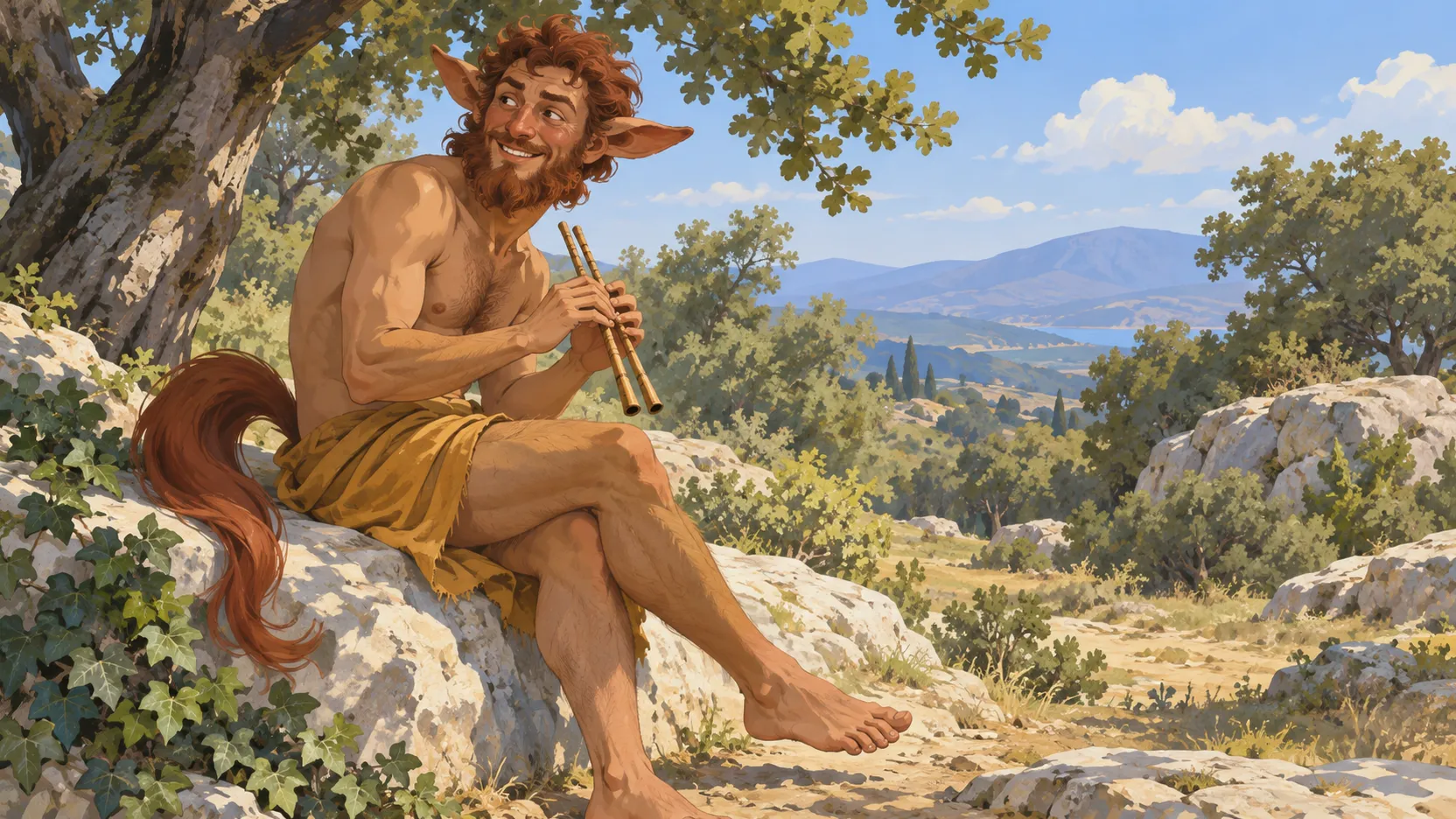
The satyr would not step onto the clean straw.
Melas played the invitation again, a little quicker, and backed toward the wine bowl. Beyond it the straw lay golden between two oaks. The men in the bushes had stopped moving. Even the flies seemed loud.
The creature lifted one bare foot, considered the straw, and set the foot down exactly where it had been.
“Beds,” he said. “Always a disappointment when someone else has made them.”
His ears stood out through his russet curls. A horse’s tail switched behind the rag of cloth at his hips. He was watching Melas’s fingers with an attention no man had given them for months.
Melas lowered the pipes. “It’s only to keep the dust out of the wine.”
“Then put the wine on the dust. I don’t mind dust.”
From the bushes came the small, deliberate sound of a throat being cleared.
Melas had until noon. After noon Kallias would sell the pipes. They were his father’s work: boxwood, darkened around the holes by two generations of fingers, with a little silver band at the end of each tube. Melas had pledged them for food in winter. Now he had borrowed them back for one morning, on the understanding that he would bring home something worth considerably more.
He began a dancing tune.
The satyr cocked his head. Then he made an appalling noise with his lips.
Melas stopped.
“There,” the satyr said. “That’s what you’re doing.”
“I know the tune.”
“Yes. You’re making certain it can’t get away.”
He tapped his heel, missed the beat on purpose, and caught it again so neatly that Melas felt the answering movement in his own knee. The satyr saw it. His grin widened.
“Again.”
This time Melas followed the heel.
The creature led him through the tune sideways. A pause grew too long, became a joke, and broke into a quick run that Melas barely managed. He laughed around the reeds and spoiled a note. The satyr slapped his thigh with delight.
“Keep that one.”
Melas played the broken note again.
For a few breaths he forgot the men. He had played weddings where nobody listened and suppers where a raised hand silenced him halfway through a phrase. Here was someone who wanted the next sound so badly that his whole body waited for it.
The satyr advanced, toes spreading in the dust.
At the edge of the straw he stopped.
Melas could have moved the bowl. He could have taken the music toward the open hillside, where nothing lay hidden underfoot.
Instead he stepped backward and left the phrase unfinished.
The satyr sprang after it.
The net lifted with a crack of ropes. Wine flew across Melas’s shins. For an instant the creature hung sideways, one hand reaching for a note that had stopped. Then the oak branches bent beneath his weight and the men came out of the bushes.
“Mind the teeth,” said the keeper.
Melas stood with both pipes in his mouth. He had run out of breath.
The Price of a Tune
They carried the satyr downhill in a cage on a cart. He had bitten through one man’s sleeve, kicked another under the chin, and then gone silent. His tail lay trapped beneath his thigh. Each jolt pulled it.
Melas walked beside the wheel, carrying the pipes wrapped in their cloth.
At the estate, Kallias came out to inspect his purchase. He was dressed for the feast already, with a clean purple edge to his robe. He leaned close to the bars.
“Dance.”
The satyr spat between his sandals.
Kallias stepped back. He did not look angry. That was worse.
“The courtyard cage,” he told the keeper. “And have someone see to those teeth tomorrow. The tail can be shortened as well. It catches in everything.”
Melas looked at the creature’s face. One long ear had folded against a bar. The satyr eased it free with two fingers, carefully, as though nobody were speaking.
“You said you wanted him for the feast,” Melas said.
“I have more than one feast.”
The keeper opened a little leather purse. Kallias counted coins into Melas’s hand, then nodded at the wrapped pipes.
“Your debt is settled. You see? A useful morning.”
The silver felt hot. Melas closed his fist around it.
“You won’t need to hurt him.”
“Will you guarantee that he doesn’t bite my guests?”
Melas said nothing.
“Then leave his keeping to someone who understands animals.” Kallias turned toward the house. “Stay and play tonight. My guests will enjoy hearing how you caught him.”
There was another fee in that. There would be food, perhaps an introduction to a household that wanted a musician through the winter. Melas could walk away tomorrow with his father’s pipes and money still in his purse.
The keeper hauled the smaller cage toward a broad wooden enclosure beneath the courtyard vines. Its front was a heavy grille that slid upward in grooves. While two servants held it raised, he pushed the captive through with a forked pole.
The satyr caught the pole. For a moment nobody moved. Then the keeper twisted it against his throat.
Melas took a step forward.
The creature let go.
The grille dropped. The keeper drove a wooden pin through the frame above it and hung the pole on two pegs beside the door.
“Wine?” Melas asked him.
The keeper looked around.
“For the feast. Where do they keep it?”
He pointed toward the jars under the opposite wall.
Melas made himself look at them, count them, notice the basin where the servants would mix the drink. Then he went to sit in the shade until evening.
He did not unwrap the pipes.
A Dance for the Guests
By the time the lamps were lit, the courtyard smelled of roast meat and crushed vine leaves. The guests reclined with their feet toward the open space. Kallias had placed his own couch where he could watch both the cage and their faces.
Melas played a quiet melody. Nobody heard it.
“Now,” Kallias said, when the first bowls were empty. “Let’s have our visitor.”
The keeper prodded between the bars.
The satyr moved out of reach. He had eaten none of the bread. His eyes followed the wine jug passing from couch to couch.
“He dances to the pipes,” Kallias told the guests.
Melas played the tune from the hillside.
The satyr turned his back.
A guest laughed. Another asked whether Kallias had bought a satyr or merely a very hairy sulking boy.
The keeper took down the pole.
Melas stopped playing.
“He won’t dance alone.”
Everyone looked at him.
“On the hill I had to dance with him.”
“Then dance.”
“With wine,” Melas said. “And space. If your keeper stands over me with that thing, he’ll hit me before he hits the satyr.”
The guests were smiling now. Kallias glanced around the couches and made a small movement with his hand. The keeper retreated to the courtyard entrance, carrying the pole.
Melas went to the mixing basin. Beside it stood a full jar of dark wine. He lifted it, feeling the weight drag at his shoulder, and carried it to the cage.
The satyr came close enough for Melas to smell the dust in his hair.
“Another bed?” he murmured.
Melas put the jar down between himself and the watching couches.
“When I turn,” he whispered, “push the door.”
The satyr looked at his hands, then at the jar.
“No.”
Melas had expected anger. He had prepared for a bite. The small word emptied him.
Behind him, someone clapped impatiently.
He could still play. There would be laughter, a second fee, perhaps a little cruelty that he could tell himself he had tried to prevent.
He took the coins from his purse and laid them on the rim of the jar, where the satyr could see them.
Then he began.
His first steps were deliberately stiff. He lifted his knees too high and bowed to his own shadow. A guest snorted. Melas repeated the bow, deeper, until the pipes nearly touched the ground.
The satyr’s ear twitched.
Melas played the wrong note from the hillside.
Nothing.
He played it again, stretched it until it became unbearable, and broke into the quick run the creature had shown him. Inside the cage, a heel struck wood.
Melas turned with the sound. His free elbow brushed the pin. It moved a finger’s width.
Again: the stiff knees, the foolish bow. Now he bowed toward Kallias, borrowing the little lift of the chin with which his patron summoned servants.
The laughter grew louder.
“Careful,” Kallias said, smiling without pleasure.
Melas turned. His fingers closed around the pin and pulled it free.
The keeper left the entrance.
Melas kicked the jar.
Wine and coins burst across the paving. A guest jerked his feet off the floor. Another reached for a rolling silver piece before remembering that he was rich. Melas danced after it, piping furiously, and the satyr shoved the grille upward.
“Stop him!”
The keeper lunged through the spreading wine. His front foot slipped. He struck the ground on one knee, still gripping the pole.
The grille rose scarcely a handspan. The satyr was crouched inside it, both palms upward, his shoulders shaking. The heavy wood had swollen in its grooves.
Melas thrust the end of one pipe beneath the bottom rail and leaned on it.
Boxwood bent. The silver band bit into his palm.
The rail lifted another little way.
The satyr flattened himself, got his head and one shoulder through, and stuck. His ear scraped the paving. The keeper was getting up.
“Pull,” the creature said.
Melas could not pull and hold the door. He wedged the pipe upright beneath the rail, heard the first thin split, and caught the satyr under both arms.
For a heartbeat the weight held.
Then his father’s pipe broke.
The door struck the satyr’s hip. He cried out, twisted, and came free with his tail whipping across Melas’s face.
Melas stumbled backward, clutching an empty fist. The broken silver-bound end rolled into the wine.
The keeper raised his pole.
The satyr seized the fallen jar by its handles and flung the last of its contents straight into the man’s eyes.
“Now that’s a bowl,” he said.
He sprang onto Kallias’s couch, planted one wet foot in the roast meat, and leaped from there to the low courtyard wall. For one horrible instant Melas thought he would vanish and leave him.
Instead he reached down.
“The other one, fool. Bring the other one.”
Melas snatched up the surviving pipe. A hand closed on his ankle as he climbed. He kicked backward, lost a sandal, and felt the satyr haul him over the wall by his tunic.
They landed among the kitchen herbs.
Beyond the Wall
Melas ran until his bare foot would take no more. He sat beneath an olive tree, breathing against the pain, with the remaining pipe across his knees.
The satyr arrived more slowly. He was limping, and he carried a small wine jug stolen from somewhere during the escape.
Melas stared at it.
“You went back?”
“Not far.”
He drank, wiped his beard, and held out the jug. Melas took it. Wine stung his split lip.
From the estate came a confused shouting. No footsteps approached the tree.
“I can’t play a pair with one pipe,” Melas said.
The satyr settled beside him. A strip of skin had been scraped from his ear. He touched it, inspected his fingers, and glared toward the house.
Melas waited for thanks. When none came, he almost laughed.
The creature took the jug back and tapped its belly with one knuckle. Once. Twice. A pause just too long.
Melas looked up.
The satyr tapped again.
“Don’t mend that note,” he said.
Melas put the surviving reed to his mouth. His first breath hurt. The sound came out thin and rough, and the satyr’s bare heel found a place beneath it.