Regin had put three gold rings in the left-hand pan before Fáfnir caught his wrist.
The balance swung. One ring struck the table and rolled towards their father’s open hand.
“Leave it,” Fáfnir said.
“I am weighing it.”
“I can see what you are doing.”
Regin looked down at the fingers around his wrist. Fáfnir had not wiped them. There was blood in the creases, drying black beneath the nails.
Their father lay beside the bench where he had fallen. One knee still rested against its leg, as if he had only slipped while sitting down. Fáfnir had expected him to look smaller dead. Instead the body took up too much of the room. To move between the table and the door, a man had to step over him.
“Half,” Regin said. “That was what we asked him for.”
“What you asked him for.”
“And you?”
Fáfnir tightened his grip until the smith’s fingers opened. The little balance chain slid between them.
Across the table lay the skin of their other brother. Otr’s narrow paws protruded from a mound of bracelets, broken chains and thick pieces of gold. The gods had killed him by the river in his otter shape, then brought him home as something fit to eat. Their father had made them fill that skin with gold and cover it. He had bent over the heap until he found a single uncovered whisker. For that last hair, they had given him the ring.
Now Hreidmar lay within reach of everything he had demanded.
Regin pulled once against Fáfnir’s hand.
“You have hurt me.”
Fáfnir let go. He picked up the fallen ring and put it on the right-hand side of the table.
“Then I will take this side,” Regin said.
“There are no sides.”
The smith looked from the gold to their father. Fáfnir waited for him to say it: that the old man had brought this on himself, that he should have shared what both his living sons had helped him win. Regin knelt instead and tried to straighten the bent leg. The heel scraped the floor.
“Help me carry him.”
“Afterwards.”
“After what?”
Fáfnir swept the three rings out of the balance. Their small clatter filled the room.
The Division
Regin stayed beside the body for a while. When he stood, he had their father’s knife in his hand.
Fáfnir reached for his sword.
The smith saw the movement. Slowly, with two fingers, he laid the knife on the bench.
“I was taking it out of his belt.”
“Then leave it there.”
Regin went to the hearth. He pushed the cold ash with his boot, found a piece of charcoal, and brought it back to the table. Fáfnir watched the hand all the way.
A black line appeared on the pale wood, running between the rings and the heap of gold.
“You choose first,” Regin said. “Whatever I lay on one side, I will match on the other. If the weights differ, you take the heavier.”
He lifted a thick arm-ring. It had been twisted from three strands, worked so closely that Fáfnir could hardly see where one strand passed beneath the next. Regin turned it once, studying the join, then laid it to the left of the line. He chose another for the right.
The two rings were almost alike.
Fáfnir put them together.
Regin separated them again.
“This one is yours.”
He pushed the larger towards Fáfnir, patiently, as he might have put a tool into the hand of someone who did not know how to use it.
Fáfnir struck the table. The pans jumped; gold fell against gold. Regin snatched his hand away.
“I did not kill him to stand here while you take it from me.”
There it was. Spoken, it sounded worse than the thought had sounded in his head.
Regin glanced at the sword, then at the door. Fáfnir could have put the ring in his hand. The thing was there between them, small enough to close a fist around. His brother was waiting.
Instead Fáfnir drew the blade.
Regin stepped backwards and struck the bench with his calf. For an instant he seemed about to sit beside their father. Then he found his footing.
“Will you do that again?” he asked.
Fáfnir moved towards him.
Regin went through the door sideways, keeping his eyes on the sword. Outside, his feet stumbled on the threshold stone. Fáfnir followed far enough to see him recover and make for the shed where he kept his tools.
“Leave the gold.”
Regin turned. He held both empty hands out from his body. The charcoal had left a dark stripe across one palm.
Fáfnir waited until his brother had taken his tool bag and gone down the track. He waited until the small figure passed behind the trees.
Then he barred the door.
The ring Regin had offered him lay on the charcoal line. Fáfnir rubbed it clean against his sleeve and pushed it into the heap.
What He Could Carry
He found a hide in the store and spread it beside the table. The first load was easy. Gold poured into it with a thick, satisfying rush. He could lift the edges and hide the brightness from anyone at the window.
Beneath the gold, Otr’s skin collapsed.
Fáfnir took it by the scruff. The empty head dangled against his wrist. For a moment he remembered wet footprints crossing this floor and fish laid down with their gills still working. Then a bracelet slipped from the table. He dropped the skin to catch it.
There was more gold underneath.
He filled the otter skin again, tied its opening, and packed it with the rest. When he pulled the hide towards the door, nothing moved. He pulled harder. A seam in his sleeve split.
He could carry it in two loads.
The thought lasted only until he imagined the first load lying unguarded while he came back for the second. Regin knew the house. Regin knew the forest paths and could wait where Fáfnir would never see him.
He fetched a rope and made a harness.
By noon he had dragged the treasure beyond the last trees. The hide caught at every root. Where the path climbed, he went on hands and knees, the rope cutting into his shoulder, hauling a little and resting without letting it go slack. He had chosen the heath because he could see anyone coming. The higher he climbed, the less shelter there was from the wind.
At a shelf of stone, the hide tore.
He heard the gold scatter behind him and turned so sharply that the rope brought him down. One arm-ring rolled past his hand. It struck a stone, leapt, and stood upright for a moment in the heather before falling out of sight.
Fáfnir crawled after it.
He tore up the low branches. Roots held; he pulled harder, scraping the skin from his knuckles. He found a yellow flower, a pale pebble, nothing. Behind him the open bundle lay bright in the sun.
He could not watch both places.
He backed towards the treasure, then stopped. The ring was here. He had seen it fall here. He searched with one hand while looking over his shoulder, crushing heather under his knees, until his fingertips entered its circle.
He held it against his chest before he could make himself stand.
No one had come. Nothing else was gone.
He retied the bundle and dragged it higher.
The Shape of Keeping
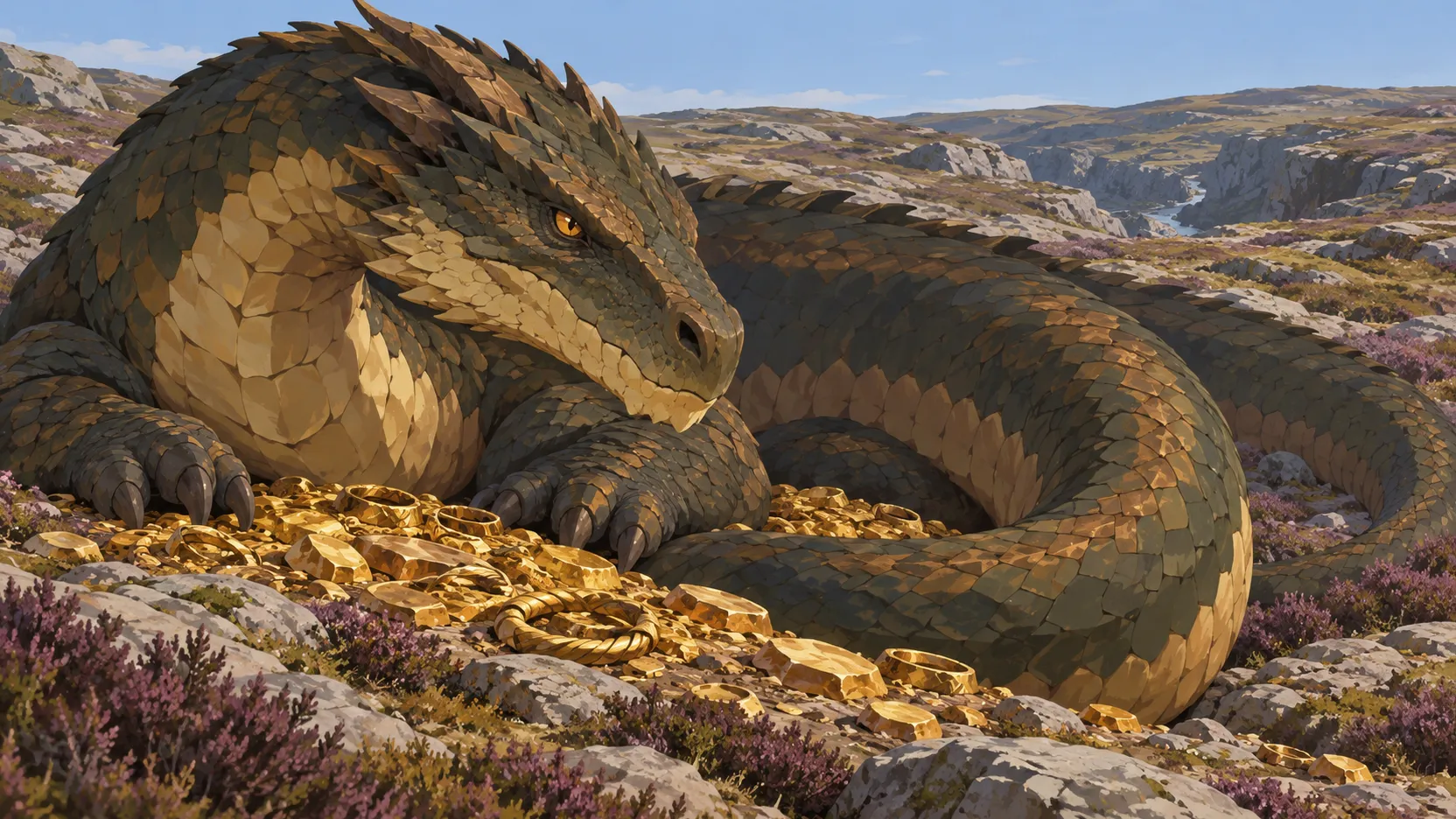
On Gnita Heath he found a hollow sheltered by a shoulder of rock. From its mouth he could see the slope he had climbed and the pale course of water in a ravine below. He pulled the gold inside, spread it against the stone, and sat with his back across the entrance.
His throat hurt when he swallowed.
He listened for the stream. He could hear it when the wind dropped. There was time to go down, drink, return before dusk. He stood and took three steps out of the hollow.
The gold disappeared behind the rock.
Fáfnir came back.
He tried covering it with the torn hide. One edge would not reach. When he pulled it over a bracelet on the left, a chain showed on the right. He gathered the edges together, but the knot made a dark bundle that anyone could lift.
He untied it and spread the treasure out again.
The little ring that had covered Otr’s whisker rolled into his palm. He knew it by its size. Loki had named the doom that travelled with it; Fáfnir had heard him. He put it down apart from the rest.
Perhaps that was enough. Leave the ring here, take the rest somewhere with water and a door. He could build a strong door. Regin could—
He stopped with his hand still extended.
Across the hollow, sunlight caught the ring. Anyone finding it would not know whose it was. A shepherd would put it on a finger. Regin might wear it. Regin might hold it up beside a smithy fire and tell how his great brother had been afraid of something so small.
Fáfnir drew it back.
He lay across the gold, chest on the bracelets, one arm stretched along either side. It hurt. A cut end of chain pressed into his ribs. He shifted, trying to get his shoulder over the last uncovered edge, and felt the skin along his back pull tight.
He reached farther.
The pain travelled down his spine. His heels scraped the rock, then slid beyond it. He tried to brace a foot and found that the weight behind him no longer ended where his foot should have been.
Fáfnir lifted his head.
A long dark curve lay across the mouth of the hollow. It moved when he moved. The torn hide was caught beneath it, and the rope he had worn lay loose upon its ridges.
He could have rolled away. There was bare earth beside him, room enough to push clear of the gold. He put a hand against it.
His fingers had thickened. The nails dug into the soil.
Under his other arm, the treasure shifted. The little ring slid towards a crack in the rock.
He lunged to stop it.
His chest drove the bracelets forward. A weight swung behind him, struck the stone wall, and came around the heap. He bent to catch the ring with his mouth, but his jaws met too soon, teeth striking sparks from the rock. The ring trembled at the lip of the crack.
Fáfnir pressed his widening throat against the stone and dragged it back.
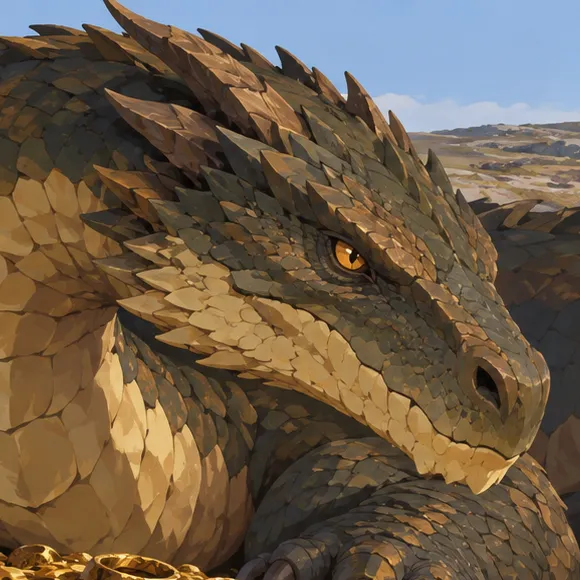
Gold rattled beneath him. The long curve of his body tightened, closing the hollow, forcing the scattered pieces inward. His shoulder rose into a ridge; the pressure under his skin broke into hard overlapping plates. He tried to cry out, and the sound filled the hollow so deeply that small stones ran down its wall.
Then his body settled.
Nothing lay beyond its reach.
For a long while Fáfnir listened. Wind passed over the heath. Water moved below. He could feel individual bracelets under the broad weight of his breast, but they no longer cut him.
He searched for the little ring with a claw. It was beneath him somewhere. He would have to lift himself to find it.
Fáfnir lowered his head across the place where it lay and kept his eyes on the path.