
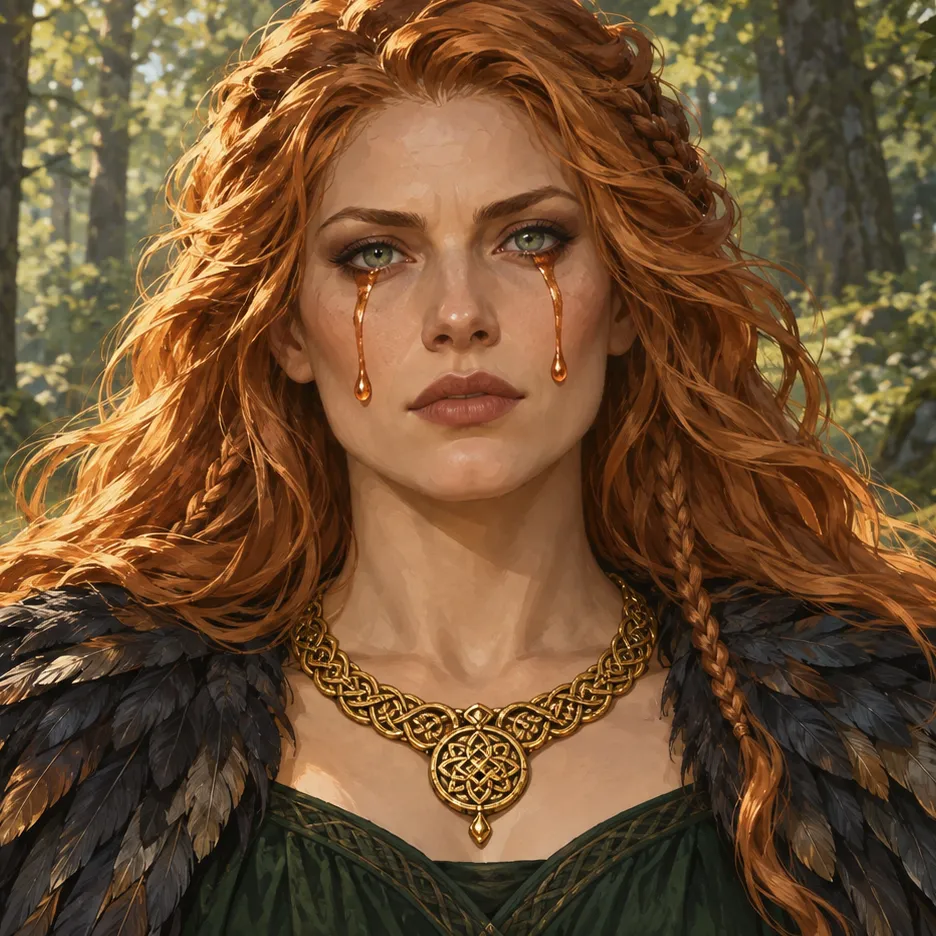
The boar stopped at the mouth of the cave and would not go another step.
Freyja felt the shudder travel beneath her knees. Inside, something scraped against stone. A wolf came forward until its forepaws showed in the moonlight, then lowered its head to smell the golden bristles along the boar’s neck.
“Keep still,” she whispered.
The boar’s ears flattened. Beneath that thick hide was Óttarr, who had asked her for help with a man’s voice and followed her into the mountains on four feet. She laid her palm between his ears. The wolf’s breath steamed over her fingers.
“Have you brought my supper?” a voice asked from the dark.
“I have brought you company, Hyndla.”
“Then it is a poor night twice over.”
The giantess rose behind the wolf. She had been lying against the cave wall with a stone beneath her head. Her eyes moved from Freyja’s necklace to the animal she rode.
“Hildisvíni,” Freyja said, before Hyndla could speak. “He has carried me far. Call off your wolf.”
Hyndla showed her teeth.
“Does he answer to that now, son of Insteinn?”
The boar jerked beneath Freyja. She caught his mane and steadied him. Hyndla had seen through the disguise before they had crossed her threshold; there would be no coaxing the names from her while she supposed herself speaking only to a goddess.
Freyja slid to the ground.
“In three mornings he must stand against Angantýr and tell his descent. His father’s wealth is at stake.”
“Let his father tell him.”
“His father is dead.”
“Most fathers become so. It makes little work for me.”
Hyndla turned away. The wolf remained where it was.
Óttarr pressed against Freyja’s leg. She remembered his shrine: stones carried uphill in his own hands, their surfaces darkened by the fires he had tended for her. He had never asked her to fill his storehouse or strike down a neighbor. When Angantýr had challenged his claim, he had come to those stones and spoken her name.
She stepped past the wolf. Its lip lifted, but it moved aside.
“Perhaps Angantýr knows more than you,” she said.
The giantess stopped.
“He knows enough to wager against a man who cannot answer him. If his account is wrong, it will be repeated. Men will teach it to their sons.”
“Men teach their sons many stupid things.”
“And you will lie here listening to them.”
Hyndla turned her head. Freyja waited. Beside her, Óttarr’s hooves made small, anxious sounds on the stone.
“At least,” Hyndla said, “your animal knows when to hold his tongue.”
She seated herself on a ledge and pointed at the ground before her.
“Bring him close. I will not raise my voice for a pig.”
The Names in the Dark
“Your father was Insteinn.”
Óttarr lifted his snout.
“Insteinn’s father was Álfr. Álfr came from Úlfr, and Úlfr from Sæfari.”
Freyja watched his ears turn toward each name. He was trying to fasten them in order. At first she could follow the effort: his father, his grandfather, the next man back. Then Hyndla began to speak of mothers, marriages, brothers, the branches of families that divided and met again.
Her voice quickened. Names crowded the cave. She spoke them with a relish that had nothing to do with helping him, correcting herself once to restore a woman whom she had nearly passed over, returning through another line to a king already named.
Óttarr looked at Freyja.
She held up one hand to Hyndla.
“Wait.”
“Why?”
“He must remember.”
“You asked what I knew.”
“And you are making certain he cannot use it.”
Hyndla leaned forward. “Would you have me trim his ancestry to fit his head?”
Óttarr struck a hoof against the floor. The noise startled even him. Freyja crouched and put her hand against his cheek, where the bristles thinned beneath his eye.
“Listen to the next name,” she said. “Only the next.”
He turned back toward the ledge.
Hyndla resumed. Freyja stayed beside him. She followed the names herself, joining one to another, but Hyndla would break off a line and take up a different one, as though walking paths she had known for centuries and expecting them to keep pace. The cave grew colder. Óttarr’s head drooped; each time it did, he hauled it up again.
At last the giantess fell silent.
A drop of water struck the rock behind her.
“Well?” she asked.
Freyja rose. She could remember the first line. Others remained in fragments, a mother with no child attached to her, brothers whose father had slipped away. Óttarr was staring at the floor.
“You have given him the names,” she said. “Now give him the drink that will hold them.”
Hyndla’s expression changed. Until then she had enjoyed herself.
“No.”
“The memory-beer. He must carry this knowledge to the meeting.”
“Then you should have brought a larger beast.”
She lay down on her ledge and pulled a skin over one shoulder.
Freyja looked toward the cave mouth. They could leave. Óttarr could return with scraps of his lineage and hear Angantýr pull them apart before his neighbors. He could say his goddess had helped him, and every man there would see how little that had been worth.
She went to the ledge.
“You will not send him away like this.”
Hyndla opened one eye.
“Is that how you spoke to Óðr when he left?”
The name struck before Freyja could brace herself. For an instant the cave was gone: there was a road, and another road beyond it, and a doorway where no one had seen the man she sought.
Hyndla saw the wound she had found.
“Always another journey. Always someone to follow. Do you bring them all here dressed as animals?”
Freyja’s fingers closed against her palm. Óttarr moved behind her, trying to put himself between her and the voice on the ledge.
She caught his bristles and drew him back.
“Stay with me.”
Then she faced Hyndla.
“Bring the drink.”
The Bitter Horn
A thin flame ran across the cave floor.
The wolf sprang away. Fire climbed a seam in the rock beside Hyndla’s bed, throwing her long shadow up the wall. She sat upright. Freyja stood between her and the entrance; the gold at Freyja’s throat caught the moving light.
“I have answered you,” Hyndla said.
“And he will remember your answer.”
The flame widened. Heat pressed against Freyja’s face. Hyndla gathered her skin about her and stepped down from the ledge, watching the strip of clear stone left between the fires.
In a recess behind her stood a covered vessel. She lifted its lid, dipped a drinking horn inside and brought it back. Foam clung to the rim.
Freyja reached for it.
Hyndla did not let go.
“For Óttarr,” she said. “A fine draught. Let it carry venom into him. Let him find an evil end in what you have demanded.”
Freyja seized the horn, but the words had already been spoken.
Hyndla released it. She stood quite still now, with fire on either side of her and satisfaction in her face.
Freyja looked down. The drink smelled of malt. Beneath that was something sharp enough to close her throat.
She could throw it into the fire. She could force Hyndla back to the vessel and demand another horn. The giantess would speak over that one too.
Behind her, Óttarr made a low sound.
Freyja turned. He had backed toward the entrance. His legs trembled. He had heard every word, and now the goddess he trusted was holding the thing that might kill him.
She lowered the horn.
The flames shrank from the ledge. Hyndla glanced at them, then at Freyja, uncertain for the first time.
Freyja knelt before the boar.
“Look at me.”
His eyes moved from the horn to her face.
She set her free hand beneath his jaw. All night she had brought him forward: onto the mountain, past the wolf, into the reach of that cruel voice. She would not thrust the drink between his teeth and call his obedience faith.
“I will not let her words have you.”
She laid her fingers across the mouth of the horn and called upon the gods. She named those who had shared her hearth, those whose paths had crossed hers in friendship and in anger. The names sounded plainly in the cave. No one interrupted her.
She asked their favor for Óttarr. She set her blessing against Hyndla’s curse, word against word, and held the horn steady until her hand ceased to shake.
The sharp smell lifted.
Hyndla made a small movement. Freyja looked up, and the giantess stopped.
When Freyja offered the horn, Óttarr did not immediately drink. He breathed against its rim. A bead of foam touched his snout.
She waited.
At last he leaned forward.
She tipped the horn slowly. He swallowed, drew back, then drank again. Nothing moved in the cave except his throat and the last small flames bending along the floor.
The horn emptied.
Freyja set it down and kept her hand beneath his jaw.
“Stay,” she whispered, though she could not have said whether she meant his courage, his life or the names.
His breathing steadied. He pushed against her hand with sudden strength.
She laughed once, roughly, and pressed her forehead to his.
Behind them, Hyndla lay down without a word.
His Father’s Seat
Outside, the eastern sky had begun to pale.
Freyja drew the disguise from Óttarr. Golden bristles passed beneath her hand; a young man knelt on the cold ground, clutching at the earth with fingers he seemed surprised to find again.
For a while he could only breathe.
Then he said, “Insteinn.”
She crouched beside him.
“Álfr,” he said. “Úlfr. Sæfari.”
He stopped, swallowed and began again. This time he went further. His mother’s name came, and her parents’ names after it. He touched each finger in turn, no longer chasing the words but finding them where he expected them to be.
Freyja sat back on her heels. The cave behind them remained silent.
On the third morning, she went with him to the meeting hall. She wore a traveler’s cloak, with Brísingamen hidden beneath it. Óttarr paused at the threshold. Across the room Angantýr was already seated, talking easily to the men gathered around him.
His father’s chair stood against the wall.
Óttarr looked at Freyja. She could hear him preparing the first name under his breath.
“Will you come in?” he asked.
“I am here.”
He nodded, though his hand stayed on the doorpost a moment longer.
Then he crossed the room. Angantýr broke off his conversation.
“Have you found someone to speak for you?”
Óttarr took hold of his father’s chair and pulled it away from the wall. Its feet scraped across the boards. Men moved their knees to let him pass.
He set it opposite Angantýr and sat down.
“My father was Insteinn,” he began.
At the doorway, Freyja let go of the latch.
