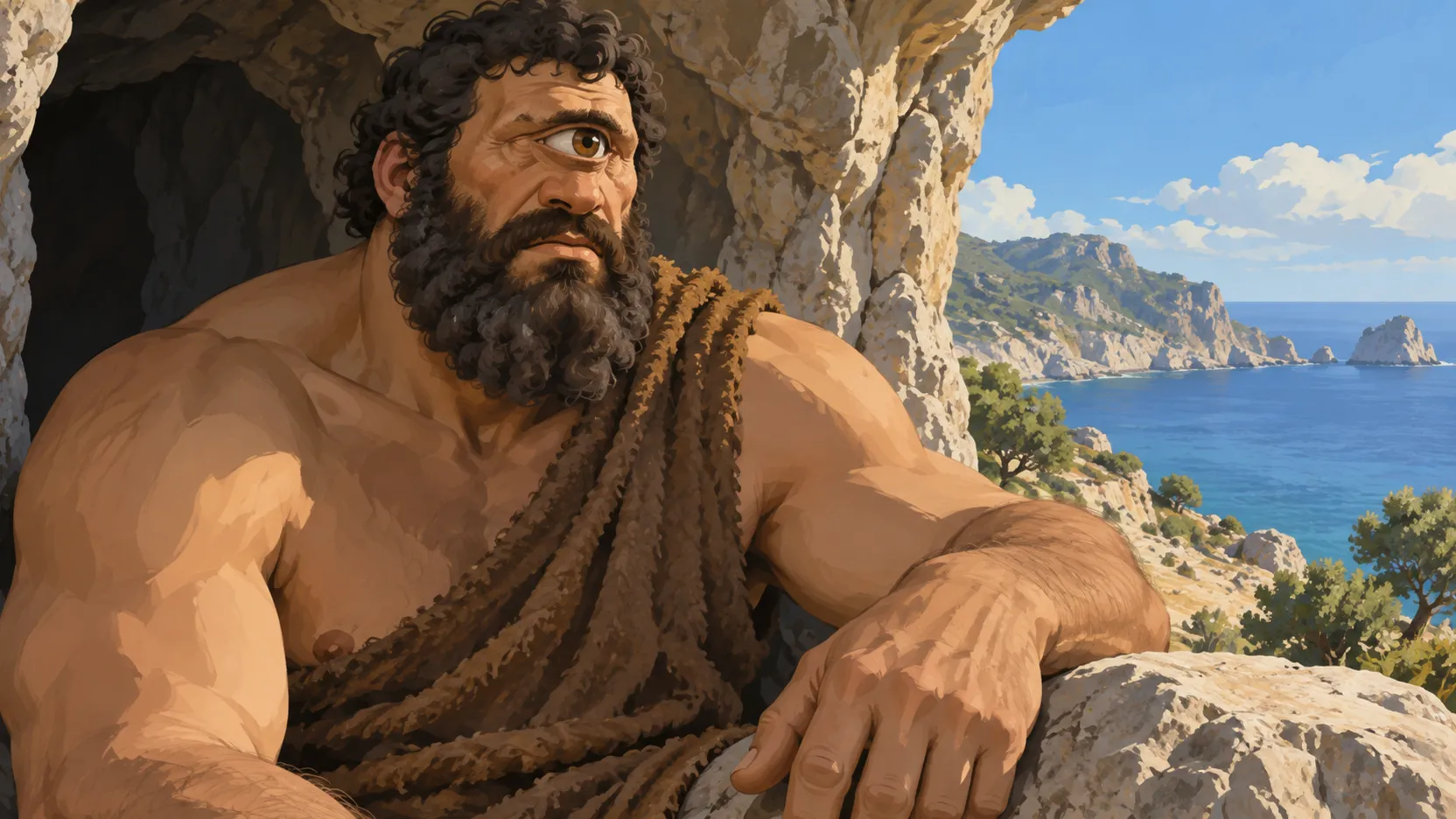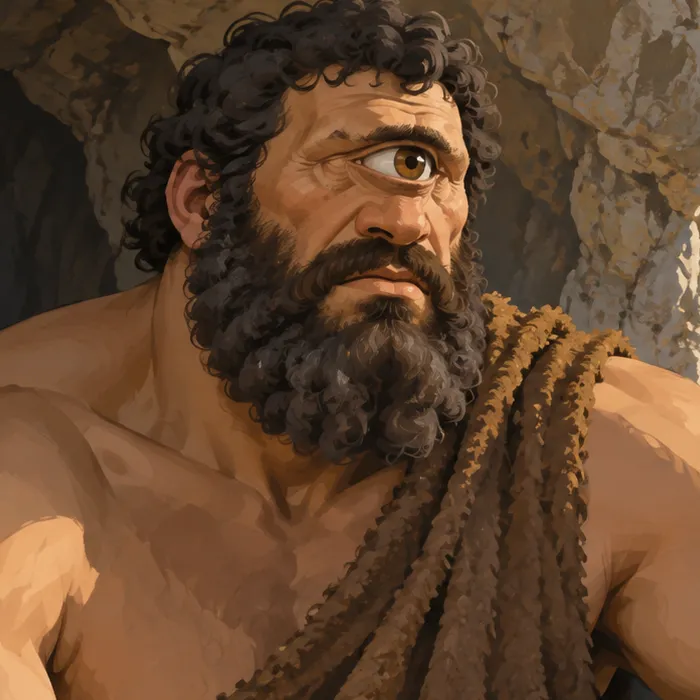
The strangers had moved his cheeses.
Polyphemus noticed that before he saw the men. A round he had left high on the drying rack lay broken beside the fire. Thirteen small figures rose from the shadows as he drove the ewes into the cave.
He set down his load of wood. The sound made them flinch.
His old ram pushed against his leg, impatient for the pen. Polyphemus scratched the thick wool between its horns, guided it aside, and rolled the door stone into place.
The men watched the light disappear around its edge.
Only then did he ask who they were.
One stepped forward. His clothes were salt-stiff, his beard untrimmed, but he stood as though expecting to be listened to. He spoke of Troy, of storms, of a long voyage home. He asked for the kindness owed to strangers. Zeus, he said, watched over men who came in need.
Polyphemus looked at the broken cheese.
“Does Zeus keep my sheep?”
The little man did not answer.
“Does he bring the lambs in when the weather turns?”
“We ask you to remember the gods.”
“I remember who feeds me.”
He reached past the spokesman and caught two of the men. The others scattered against the rock. Their cries followed him to the fire and died there.
After he had eaten, he drank milk from a broad bowl and lay down among his sheep. The strangers huddled together beyond the embers. He could hear them whispering.
Let them whisper. They could not move the stone.
In the morning he chose two more. Then he milked the ewes, set the lambs beneath them and drove the flock out. Before leaving, he closed the stone behind him as easily as a man might set a lid upon a jar.
All day he thought of the spokesman’s face. The man had been afraid; Polyphemus had seen it. Yet the fear had not made him silent.
When he returned, the cave smelled of fresh shavings beneath its usual smells of wool and milk. His olive club lay where he had left it. He gave it no further thought.
There were two fewer men by the time the stranger approached with a wooden bowl.
“Drink this.”
Polyphemus took it. The smell rose before the bowl reached his mouth: dark fruit, summer heat, something sharper beneath.
He drained it.
The stranger waited.
“More,” Polyphemus said.
The man filled the bowl again. Polyphemus drank more slowly, holding the taste on his tongue. The sour edge of his milk seemed suddenly a poor thing.
“You have a name.”
“Nobody.”
Polyphemus laughed. The sound rolled around the roof and frightened a lamb into crying.
“Your mother called you that?”
“My father too. And my friends.”
The third bowl warmed his hands though the wine was cool. He leaned toward the little man, pleased to have something to give in return.
“Then Nobody will be last. I’ll eat the others first.”
The stranger lowered his eyes.
Polyphemus meant to ask where the ship lay. He had asked once already, and the answer had slipped away from him. Wrecked, perhaps. Broken on the rocks. It no longer mattered. The men were here, the stone was shut, and the wine kept coming.
The fire stretched into a long wavering bar of light.
He lay down before it stopped moving.
He woke inside pain.
For an instant he could not separate the heat from the hands driving it into his eye. He caught the wooden shaft and tore it free. Men fell away from him. The cave shook with his cry.
He reached for the fire and struck stone. Reached for the wall and overturned a rack. Cheese and clay fell across his feet.
There was nothing before him. No red fire, no pale rock, no running men. He opened his eye against the darkness and found only greater pain.
“Nobody!”
Outside, feet approached over the stones. His neighbors called through the doorway, asking what had happened, whether someone was stealing his flock or attacking him.
He pressed his hand against the wound.
“Nobody is killing me!”
There was a pause.
A voice asked whether he was ill.
“Nobody,” he shouted again. “Nobody did this.”
They told him that a sickness sent by the gods was beyond their help. He should call upon his father Poseidon.
He heard them leave.
Polyphemus struck the stone with his open hand. “Come back.”
Their steps dwindled. The sheep stirred behind him. Somewhere in the cave, a man was breathing carefully through his mouth.
Nobody.
The name had been laid in his hand as plainly as the bowl, and he had taken both.
He crawled along the wall until he found the door stone. The men would have to come this way. They could hide among the pens, behind the racks, beneath his bedding; it made no difference. Their way out passed through his hands.
He rolled the stone aside and sat in the opening.
Cold air touched his face. The flock crowded toward it. He spread his arms and felt the first broad back come beneath his palm.
Wool. Warmth. A familiar ridge of bone.
He let it pass.
The next animals pressed close together. He pushed his hand over their backs, searching for a flat belly, a clutching arm, a man’s weight riding where it should not be. Beneath his hands the sheep moved awkwardly, crowding one another through the narrow space.
He shoved them onward. The strangers would try to slip between them. He kept his other hand low beside the wall.
The ewes bleated from the pens. He should have milked them. The thought came with such ordinary force that for a moment he almost rose to fetch the bowl.
Then something scraped behind him, and he lunged toward it.
His fingers closed on empty air.
He sat back in the doorway and waited.
At last his old ram came beneath his hand.
Polyphemus knew the horns, the heavy neck, the dense fleece that held the warmth longer than the others. He stopped it with one hand against its chest.
“Last today?”
The ram shifted its feet.
“You always want the first grass.”
He ran his fingers along its back. It was trembling, or perhaps his own hand was. He bent close, breathing the wool’s familiar smell.
“Have you seen him?”
The ram made a small impatient sound.
“If you could tell me where he is.”
He held it there. His hand moved toward its flank, then returned to the horns. He knew this creature. He had watched it push through snow, lead the flock home, lower its head against younger rams. Now it waited while he spoke, the only living thing that had not fled his voice.
He took his hand away.
“Go, then.”
The hooves passed over the threshold.
For a while he heard only the ewes behind him and the wind outside. Then a voice reached him from the sea.
The stranger.
It mocked him for eating the men who had come beneath his roof.
Polyphemus rose too fast and struck his shoulder against the rock. He followed the voice down toward the water, broke loose a great stone and hurled it. The crash was followed by shouting, then the slap of oars.
He listened, smiling through the pain. They were still close.
Another call came, farther out this time.
“Remember Odysseus. Laertes’s son. Of Ithaca.”
The name reached him more clearly than the rest.
Long ago a seer had spoken that name. Polyphemus had imagined a giant, a splendid enemy whose strength would match his own. He touched the empty place above his nose and remembered the little man holding out a bowl.
He called him back, offering the welcome he had refused. Odysseus answered with another threat and denied even Poseidon’s power to heal the wound.
Polyphemus turned his face toward the sea he could no longer see.
“Father.”
He spoke the name carefully this time. Odysseus. Son of Laertes. Ithaca. He asked that the man never reach his home, or, if he must, that he arrive late, alone, and find trouble waiting there.
Then he lifted another stone and sent it after the departing voice.
Water struck the shore around his feet. The oars grew faint. He stood listening until he could no longer tell them from the sea.
His empty hand closed slowly, remembering the warm wool beneath it.