
Ra ordered the palace doors shut before he called the gods.
Outside, people were whispering that their king had grown old. They had whispered in courtyards and beside the river, then gathered where they thought no light could reach them. Now they were making plans to overthrow him.
Ra sat with his golden hands upon his knees. Beneath that flesh his bones were silver; his hair had the deep blue of lapis lazuli. He had ruled while generations of human children became old, and still the sound of their voices could hurt him.
“Bring Nu,” he told his attendants. “Bring the gods who were with me before there was land. And bring my Eye.”
An attendant reached for the door.
“Quietly. They must not see you coming.”
The gods entered without heralds. Shu and Tefnut came, and Geb and Nut, and the ancient fathers and mothers who remembered the waters before the world. Last, the doors closed upon Hathor. She stood beside the throne, waiting.
Ra looked past her to Nu.
“They came from me. Now they meet in secret against me.” His fingers tightened on his knees. “Tell me what to do. I will hear you before I kill them.”
Nu raised his head.
“Keep your throne. Let your Eye go out.”
Beyond the palace the conspirators had already begun to flee. They left the river and the cultivated land, climbing into the stony wilderness where caves and broken ridges offered hiding places. Ra could see the paths they took.
“They are afraid,” he said. “They have gone into the hills.”
“There is no hiding place from your Eye,” the gods answered. “Send Hathor.”
She turned towards him. There was no question in her face, only the bright stillness of something awaiting release.
Ra gave the command.
Hathor passed through the doors, and the gods moved aside to let her go.
The Eye in the Wilderness
The people in the hills saw her coming across the bare ground.
Some climbed higher. Some pressed themselves into the dark between rocks. The Eye found them. Where they scattered, she followed; where they stood together, she struck. Their calls dwindled among the ridges, and the wilderness grew quiet behind her.
When Hathor returned, Ra rose to meet her.
“Is it done?”
“I have mastered them.”
She spoke with pleasure. The sound checked him more sharply than a cry would have done.
“It was sweet,” she said.
In her terrible strength she was Sekhmet, the Powerful One. The lioness face lifted towards him, and her gaze was already travelling beyond the hall, seeking the country she had left. There were still people in it.
Ra looked out over his land. A door swung open in an empty house. By a grinding stone, grain lay spilled from a bowl. Farther away, the living were hurrying from one hiding place to another, carrying whatever they could hold.
He had sent her.
Hathor went on with the work he had given her. The killing spread, and the people who remained had nowhere certain to turn. A fold in the hills, a locked door, the darkness under a roof: each might hide them for a little while.
Ra called for his swiftest messengers.
“Go to Elephantine. Bring red ochre. All that is needed for a great brewing.”
They bent before him and ran.
Then he summoned the brewers.
Seven Thousand Jars
The grinding began in Heliopolis.
Women leaned over stones, working the barley to meal. Beside them the red earth from Elephantine was crushed to powder. Dust clung to wrists and settled into the creases of palms. Grain went to the brewing vessels; the ochre waited beside them.
Ra moved among the jars with the gods following him. There were rows beyond rows, filling the working places, standing in the passageways. Seven thousand vessels had been prepared.
The ochre was stirred into the beer.
Red spread through the pale liquid. A worker drew up the stirring paddle, and a dark stream ran from its blade. Ra watched it fall.
From a distance, in the first light, it would look like blood.
He bent over a jar. The smell was still the smell of beer.
“The people must live,” he said.
Beyond the walls, the Eye was moving towards the place where she would hunt again. The messengers knew her course. Ra ordered the jars carried ahead of her, to the fields she would cross at dawn.
The vessels passed from hand to hand. Men and women lifted them against their shoulders and bore them away. No one could carry all that was needed; no single journey would be enough. As one line departed, another came back for more.
In the deep of the night, Ra rose to oversee the pouring.
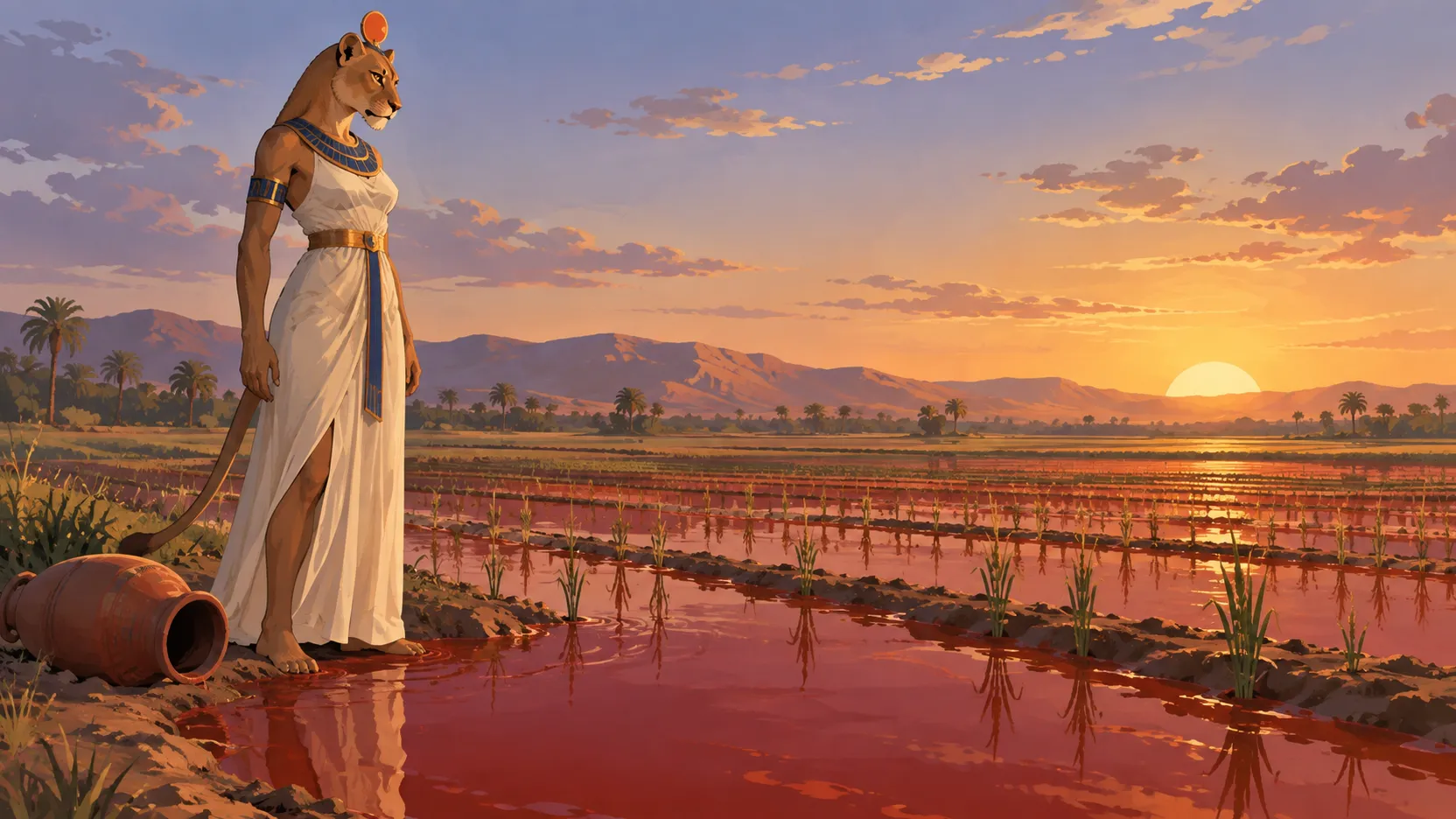
The first jar emptied with a hollow gulp. Beer darkened the soil and gathered in the furrows. More jars tipped. Narrow streams joined; shallow pools spread until the ridges between them disappeared. Through Ra’s power the draught filled the fields, rising into a broad red flood.
The last bearers retreated with empty vessels.
Ra stayed until the eastern darkness began to thin.
The Red Field
Hathor came at daybreak.
She stopped where the dry path ended.
Before her lay a sheet of red, stretching across the fields. Light trembled upon it. She lowered her lioness head, looking over the abundance that seemed to await her, and stepped into the shallows.
The surface broke around her ankles.
Ra watched.
She stooped and drank.
For a moment she lifted her head again. Red drops fell from her mouth. Behind the fields, beyond the reach of that flood, the survivors remained hidden.
Hathor drank once more.
The draught pleased her. She moved farther into it, bending again and again, while the ripples she made ran together across the level ground. Her steps lost their purpose. She paused as though she had forgotten where the path had been taking her.
Then she laughed softly to herself.
When she looked towards the places where people were hiding, she no longer knew them for the prey she had come to find. She turned away. The red liquid swayed around her legs as she made her unsteady way back towards Ra.
He went to receive her.
“Come peacefully, Hathor.”
This time she came.
Behind her, the fields lay still. No cry rose from the hills. No pursuing footfall drove the survivors farther from their homes.
Ra ordered that beer should be prepared for the goddess at her festivals, in the seasons to come. The women who had brewed for her would brew again.
But when the gods gathered around his throne, he did not sit down.
Beyond Their Reach
“I cannot remain here,” Ra said.
They spoke of his strength. They spoke of the power that still obeyed him. He listened with one hand resting upon the throne.
The people had survived. His weariness had survived with them.
“I will not wait for this to happen again.”
Nu turned to Nut.
“Carry him.”
She looked from the old god to Ra.
“How shall I carry him?”
At Nu’s command, she took the shape of a great cow. Her back rose beside the throne, broad enough to bear the sun god. Ra mounted, and her hooves sounded upon the floor as she carried him out.
People came when they saw him. Those who had hidden their faces now raised them, calling after the god upon the cow’s back.
“Stay! We will fight your enemies!”
Nut kept moving. Ra did not come down among them.
Darkness settled over the land.
At the next dawn, men took up bows and clubs. They went against those they called his enemies, and once more people fell at the hands of their pursuers. Ra heard their promises, then the sounds of what they had promised. He did not return to his throne on earth.
“Higher,” he told Nut. “Take me higher.”
She rose.
The palace dwindled beneath her. The river narrowed; the fields became small strips of colour beside it. Ra made a place for himself in that immense height, spreading out heavenly fields, filling them with reeds, kindling stars.
Nut looked down.
Her legs began to tremble.
There was nothing beneath her hooves. The distance she had crossed opened below her, and the sun god shifted upon her back as she shook.
Ra called forth the divine supports. They took their places around her, holding her steady. Then he called to Shu.
“Stand beneath her. Bear her up.”
Shu raised his arms.
The trembling eased. Nut stretched above the earth, and the stars shone along her body. Ra’s light travelled through that height, beyond the palace doors, beyond the voices calling from below.
In the fields, the red flood was sinking into the ground. People stood at the edges of it, waiting, until sunlight reached their feet.