
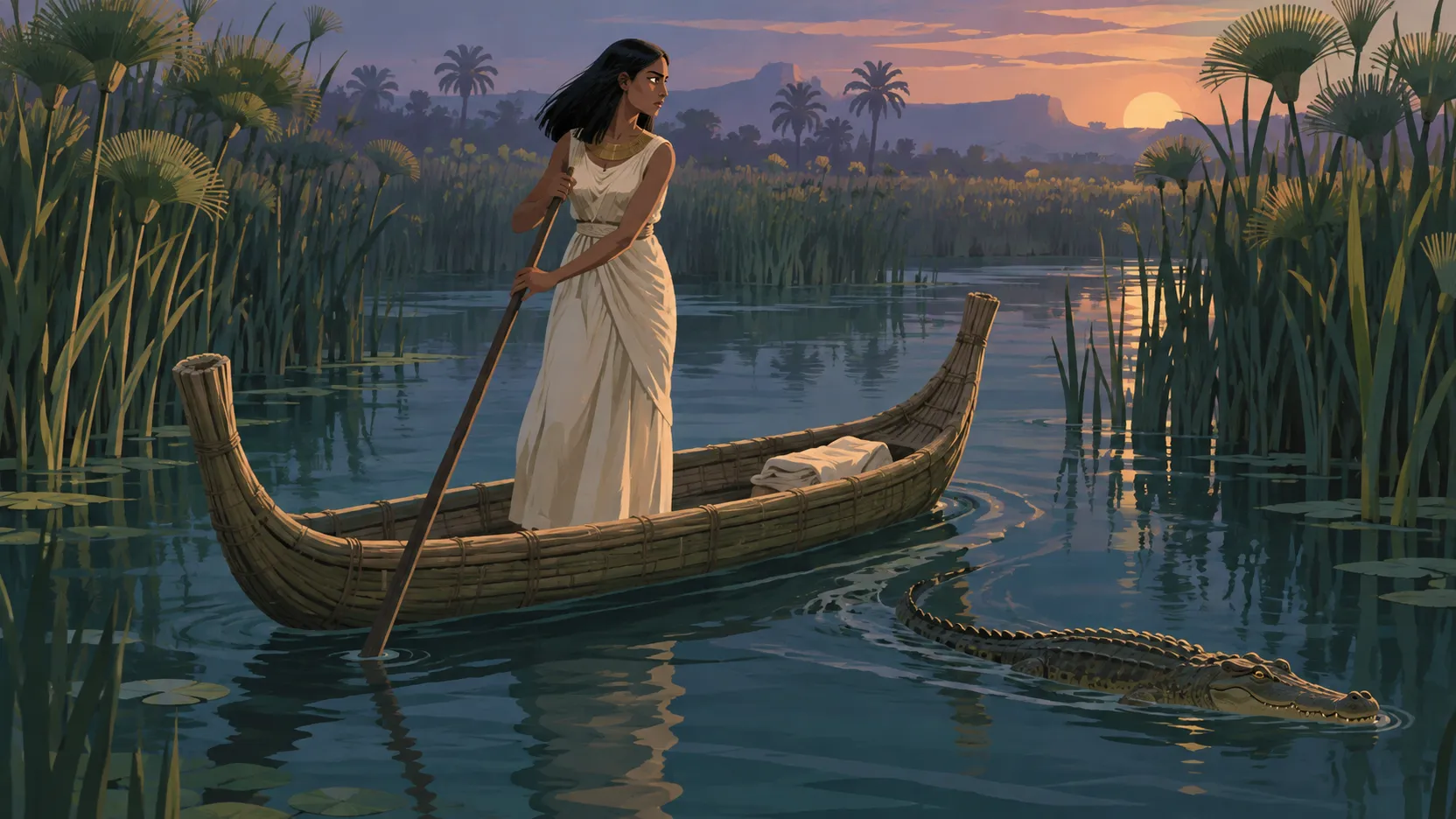
Isis left the chest where no traveller was likely to find it.
She had brought Osiris home from Byblos. She had stripped away the tree that enclosed him and carried him back across the sea. Now her son Horus was waiting in Buto, where he was being reared, and she had to go to him.
Before she left, she rested her hand upon the lid.
When she returned to this place, she would know exactly where to kneel.
Seth came there by moonlight.
He was hunting. The pale light showed him something that did not belong among the ground’s rough shapes: a straight edge, worked wood. He went nearer.
He knew the chest he had made.
Seth opened it. Inside lay the brother he had shut away and sent downriver. The sea had not kept him. Neither had the foreign land in which Isis had found him.
This time Seth divided the body into fourteen parts. He scattered them in different places, until there was no whole body left for Isis to recover.
The Boat of Papyrus
When Isis learned what he had done, she took a boat made from papyrus into the swamps.
Its narrow hull moved between the reeds. She pushed against the mud, drew the pole free and pushed again. Water gathered where the stem had pierced it, then closed over the mark.
She watched every bank.
The first time, there had been people to question. Children had pointed her towards the sea. Rumour had carried news of a tree in Byblos. Now she searched the edges of the water, the places where things caught and settled, the ground hidden beneath the reeds.
A crocodile lay across her way.
Only its eyes and the ridge of its back showed. Isis brought the pole out of the water and waited. The boat drifted towards it.
The creature turned.
Its tail made one slow movement beneath the surface. It passed beside the papyrus hull without striking, leaving a widening line that rocked the little boat. Isis set her pole into the mud again.
She went on.
Farther into the marsh she saw something near the bank and stopped.
She stepped from the boat. The mud held her ankle; she pulled free and knelt in the shallows. Her hands hovered above what she had found.
“Osiris.”
She had known his face, the breadth of his shoulders, the weight of his arm across her. Now her hands could lift what lay here.
She spread a cloth and gathered it carefully.
For a while she stayed with the bundle against her knees. Water moved around her. The reeds knocked softly together behind the empty boat.
Then she stood.
Many Resting Places
Isis prepared a funeral where she had found him.
She smoothed the linen, folding its edges inward. Each time a fold slipped, she laid it down again. She spoke his name before she covered the resting place.
When it was finished, her hands had nothing left to do there.
The rest of him was still missing.
She returned to the papyrus boat.
The waterways carried her to another finding and another funeral. Each new place demanded the care she had given the first. She could not hurry past one because others remained, and she could not stay because they were waiting to be found.
At one resting place she rose before she was ready. She stood beside the folded cloth, looking down, then knelt once more to straighten an edge that had caught beneath itself.
After that she left.
Across Egypt, the resting places multiplied. People would know them by Osiris’s name. What Seth had scattered, Isis honoured wherever she found it.
But the river did not give everything back.
Fish had taken the intimate part of his body. She searched without recovering it. At last she made a likeness of what was lost and consecrated it.
Her hands worked upon the shape she had made. It could take the missing part’s place in worship. It could not become the living body she remembered.
She set it apart as sacred.
The boat lay near the last bank, with mud drying along its side. Isis drew it farther from the water. The reeds from which it had been made bent beneath her hand and held.
Behind her was a resting place bearing her husband’s name. Beyond it lay the others, spread across the land through which she had searched.
She laid the pole inside the boat.