
The water came through a joint Iri would never have allowed out of his workshop.
He pressed his heel against it. The trickle became a thin jet and struck the underside of the seat. He tried his other heel, then both together, clutching the funerary roll under his chin while the little boat rocked.
“Bad work,” he said aloud.
His voice astonished him. The last time he had tried to speak, his daughter had been bending over his bed, and he had not managed even her name.
Now there was water, and a boat, and his own voice. He chose not to ask for more until he had stopped the leak.
A narrow pole lay along the gunwale. He lifted it, tested its weight, and drove it down beside the boat. It went in to his elbow. He pushed farther. The black water swallowed the pole without the smallest scrape of wood on earth.
Iri hauled it back and looked for a bank.
Ahead, something pale stood above the water. He paddled toward it with the pole, keeping the roll wedged under his arm. His daughter had bought that roll. He remembered the scribe waiting at their door while she counted out the payment twice. There had been less money the second time, after she stopped counting the pieces that were not there.
She had sold the good adze.
He paddled harder.
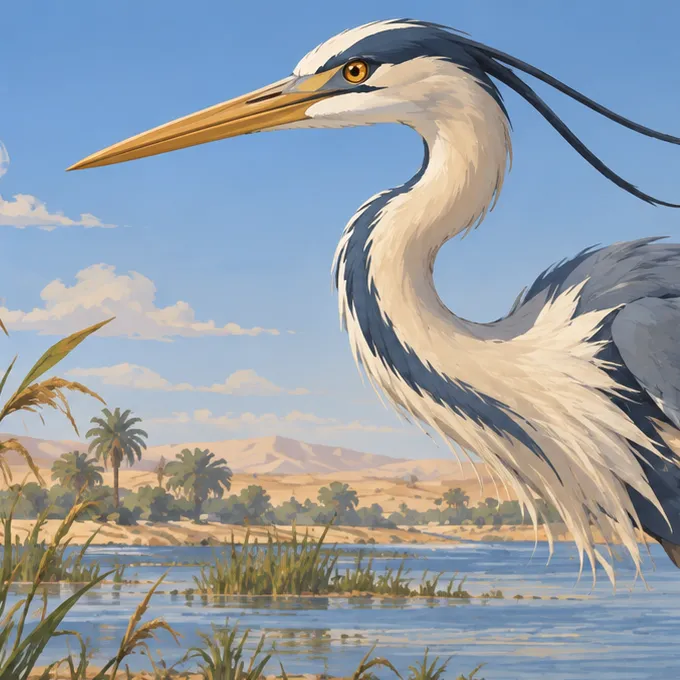
The pale shape turned its head. A straight bill caught a light he could not find anywhere else. Behind the head trailed two long feathers. Then a grey breast emerged from the darkness, and the folded angle of a wing.
A heron.
It stood on something no wider than the boat.
Iri ceased paddling. He knew this bird. He had seen it painted on coffins, stepping across surfaces that other men were afraid to touch. The name came to him with an unexpected certainty, as if he had been waiting all his life to use it properly.
“Bennu.”
The bird raised one foot. Water slipped from its toes. It set the foot down again.
“There’s room beside you,” Iri said.
There was not. But he had spent forty years bringing overloaded boats to narrow landings, and saying otherwise had never helped.
The Shape on the Roll
He brought the bow against the little rise beneath Bennu’s feet. Something scraped. The boat steadied, and Iri laughed once through his nose.
Earth. He could work with earth.
He reached out to hold the rise, but his fingers sank into soft mud. There was no edge to seize. Beneath the surface the mound sloped away, and water was already climbing it.
Bennu watched him with one gold eye.
“I need to get out,” Iri said. “Only as far as morning.”
The bird bent its neck and drew its bill through the feathers of its breast.
“My daughter is there.”
A bead of water ran from the bill. Bennu shook it away.
Iri disliked asking twice. He had disliked it when he was alive, and apparently dying had done nothing to improve him.
“I can make you something. A perch. A boat with a perch, if you want one.”
The bird opened a wing. The feathers separated with a dry, close sound, like a hand passing across reeds. Beyond them a strip of pale colour appeared on the water.
Iri turned toward it so quickly that his elbow struck the gunwale. The roll fell into the boat.
He snatched it up. One end had darkened.
“No. No, that isn’t for you.” He said this to the water, which continued coming through the joint.
He loosened the cord. The outer sheet uncurled across his knees, stiff at first and then suddenly soft where it was wet. There were columns he could not read. There was his name, which he could. The scribe had pointed it out to him when they chose the roll, before Iri’s cough had become a thing everyone listened for.
Below the writing stood a bird with a long bill and two feathers at the back of its head.
Iri looked from the painted bird to the one on the mound.
The scribe had spoken of shapes he might take. Iri had been concerned with the price. When the man explained that the dead could come forth again, he had imagined himself walking through a door, a little less tired, with the use of his lungs restored.
He had not imagined this narrow head. These legs. A mouth that could never close around his daughter’s name.
Bennu stretched its neck toward the pale water.
Iri found himself stretching too.
A sharp itch ran down the outside of his wrist. He rubbed it against his knee. Something caught in the weave of his kilt.
A small grey feather lay against his thumb.
He stared. Another pushed from his skin, wet at its root, opening as it grew.
He bent his fingers. They bent together.
Iri struck his hand against the seat.
“No.”
The feathers withdrew. His fingers spread, clumsy and trembling. He pressed each fingertip in turn against his thumb. He could still count them. He could still feel the little notch a saw had left beside his nail.
The bow scraped backward.
While he had been looking at his hand, the water had lifted his boat clear of the mound.
What His Hands Could Hold
Iri thrust the pole forward. Its end slid across the mud and struck Bennu’s foot.
The bird stepped aside.
“I didn’t mean—”
He lunged again. This time the pole went past the mound. Its far end dipped; the near end knocked the roll from his knees. A length of papyrus slipped under the seat.
The boat swung broadside to the current.
Iri dropped flat and caught the roll before it could follow the water through the split joint. The wet sheet stretched between his fist and the seat’s lower edge. His name was caught beneath it.
He pulled very gently.
A white line opened across the fibres.
He stopped.
The leak was no longer a leak. Water welled through the joint in slow, heavy pulses. He could feel the boat lowering around him. His knees were cold. Then his thighs.
He knew exactly how long badly joined timber could hold when water worked it from both sides. Knowing did not give him anything useful to do.
Beyond the gunwale, Bennu stood on the last visible patch of mud. The pale strip behind the bird had widened. It was beginning to show the surface of the water, each little ridge bright on one side and black on the other.
The bird lifted its wings.
“Wait.”
Iri tried to free the papyrus with his other hand. The space under the seat was too narrow. He pushed two fingers into it, scraping the skin from his knuckles, and felt the sheet tear against a peg.
Tia would have got it out. Her hands were smaller.
He saw her at nine years old, trying to mend the toy boat he had made her. She had sat on the workshop floor with the broken hull between her knees and demanded more glue.
There was already enough glue on it to mend a fishing boat.
He had laughed. She had not. He remembered that now with a sudden, uncomfortable sharpness: how badly she had wanted him to stop laughing and hold the pieces straight.
Later he had held them all afternoon.
His fingers loosened on the roll.
He could remember the pressure of those little wooden halves without looking at a single written mark. He could remember the pitch under his nails, and Tia ordering him not to move, and the stiffness in his back when they were finally done.
“Iri,” he said.
The boat settled another finger’s width.
“Iri. Boatbuilder.”
Bennu bent its legs.
The roll began to slide from his hand. He caught it once more, by habit, and the wet fibres parted. The piece with his name remained trapped under the seat.
His right hand was empty.
Feathers opened along it.
This time he held still.
Coming Forth
The change pulled through his arm and across his shoulders. It was not painless. His back tightened; his chest seemed suddenly too narrow for the breath he was trying to take. He reached for the gunwale, and the edge passed between feathers that could not grip it.
The boat tipped.
Black water struck his face.
He kicked. His feet caught in his kilt, then slid free of cloth that no longer fitted them. He could not tell which way was up. He tried to open his mouth and found a bill. Panic drove him toward the surface, but one wing remained folded against his side, and he turned in the water instead of rising.
Iri.
There was no sound. He had not lost the name.
He stopped trying to swim with hands.
The long toes of one foot brushed something soft. He bent the leg, feeling for purchase. Mud yielded beneath him. The little mound was still there, under the water.
Above it, a dark shape swept across the paling surface. Bennu’s wings came down.
Iri opened his own.
Water dragged at every feather. He pushed with his legs. The mud gave, but not before it had given him enough.
His head broke the surface. He drew a ragged breath through a throat he did not know. His first wingbeat struck water. His second cleared it on one side only. For a moment he lurched forward, half flying, half running on the yielding skin of the flood.
Then both wings caught air.
The boat rolled beneath him. He saw the pale underside of the seat, the faulty joint, the strip of papyrus moving in the water. He looked for his name until distance made the writing impossible to distinguish.
The next wingbeat took him higher.
Bennu flew ahead, its neck folded, its long legs trailing straight behind. Iri tried the same thing. The air no longer struck him in the throat. He found that a small change in the angle of his wings could carry him farther than a great effort spent against them.
Below, the black water broke into channels. Fields appeared between them. Smoke rose from a courtyard. The smell of wet reeds reached him, then wood shavings, then the hot, bitter smell of pitch.
He turned before he knew he had turned.
Tia was in the workshop yard. She had a boat propped on its side and one bare foot braced against the hull. A seam had opened near the bow. The old adze lay beside her knee, the one with the cracked handle that he had always meant to replace.
Iri beat his wings to stay above her.
She was fitting a patch. He could see from the tilt of her head that she was about to force it.
He opened his bill.
A harsh cry came out.
Tia looked up. His shadow crossed her hands.
For an instant he hung there, desperate for her to say his name. But she was looking into the light, one hand lifted to shade her eyes. He could not tell what she saw.
The wind moved him sideways. He struggled against it, watching the yard slip beneath his wing.
Tia lowered her hand. She turned the patch, tested it again, and began to pare a thin shaving from its edge.
Iri let the wind take him.
Ahead, Bennu banked over the bright river. He followed, carrying the smell of the workshop into the morning.
