The Last Crossing
The soldier had cut halfway through the rope when Sopdu closed a hand around his wrist.
Below them, the bridge struck the ravine wall. A basket fell from its decking, burst against the rock, and scattered blue stones into the dark.
“There are people on the other side,” Sopdu said.
The soldier tried to kneel. There was no room. Behind him, porters pressed along the narrow ledge with the king’s turquoise chests on their shoulders. Ahead, the bridge hung between two stone teeth, its far end lost in the dust of the eastern road.
“The captain’s order, lord.”
Sopdu took the knife. Its edge had parted the rope’s outer strands; the core still held. He slid his palm beneath it and felt each step on the bridge pull against the wound.
A man wearing a bronze collar pushed between the porters. His left sandal was dark with blood, but he set that foot firmly when he saw the god.
“We have invoked you since leaving the mines,” he said. “You have brought us to the crossing.”
“All of you?”
The captain looked east.
A gust cleared the dust. Beyond the bridge a woman was dragging someone down the road, backward, by the armpits. Behind her, farther up the slope, small figures appeared along a ridge. Sunlight caught a spearhead.
“Our guide,” the captain said. “She went back against my order.”
Sopdu released the soldier’s wrist.
“Then change your order.”
The captain’s jaw tightened. He turned and shouted for the last chest to be brought across.
The King’s Blue Stones
There were three chests still on the bridge. The first had wedged between the rope rails where the passage narrowed. Two porters strained beneath its carrying pole. A third man, trapped behind them, was trying to climb over the lid.
“Off,” Sopdu told him.
“I cannot go back.”
The man pointed past the chests. On the far side, the guide had reached the bridge. The person she was dragging was a boy whose splinted leg left a crooked furrow in the dust.
Sopdu knew the woman’s voice. For seventeen mornings she had named him before the expedition moved, touching two fingers to the little falcon bound to her water jar. The captain had offered him incense. She had offered the first mouthful of water, even when there was little left.
Now she was trying to lift the boy onto her back. Each time she bent, he screamed.
“Meri!” the captain called. “Leave him. You can still cross.”
She looked up, recognized Sopdu, and did not ask him to kill the men behind her.
“Hold the road,” she said.
The god stepped onto the bridge. Its ropes dipped. The porters stopped struggling and stared at the two tall feathers above his brow.
“Set the chest down.”
“There is nowhere—”
“Here.”
They lowered it onto the decking. Sopdu put his foot against its side and pulled the lid. The bronze fittings shrieked. A cord snapped, and the king’s clay seal broke against his thumb.
The captain caught his arm.
“Those stones have been counted.”
Sopdu looked at the hand gripping him. The captain let go.
“The king sent eighty men east,” he said quickly. “He expects this tribute. There will be a reckoning.”
“How many came back?”
“We have not yet—”
An arrow struck the open lid.
The nearest porter flinched against the rail. Sopdu caught his belt before he went over. Across the ravine, Meri lowered the boy and crouched beside him. The men on the ridge had begun descending, slipping between the rocks with bows in their hands.
Sopdu tipped the chest.
Turquoise poured through the space between the rail and the decking. Some pieces struck the cliff with a sound like hard rain. Others flashed once and were gone. The porters watched with their mouths open.
“The next one,” Sopdu said.
This time they moved before he touched it.
The emptied chests went over after their contents. Wood cracked below. Freed of their weight, the bridge rose under his feet. Men stumbled toward the western ledge, shedding baskets, tools, anything that caught against the rails.
The captain stayed beside him.
“I can carry the boy,” he said.
Sopdu heard the effort it cost him to say it. He stepped aside.
The captain went east.
What Held the Road
He reached the middle before the second flight of arrows came.
One cut across the god’s shoulder. Another struck the captain high in the arm and turned him against the rail. He gripped the rope with his good hand. His wounded sandal slid between two planks.
Meri started toward him.
“Stay with the boy,” Sopdu said.
He spread his arms. Feathers closed over them, broad and dark, and the wind beneath his wings flattened the dust against the eastern slope. For a moment the men with bows disappeared in it.
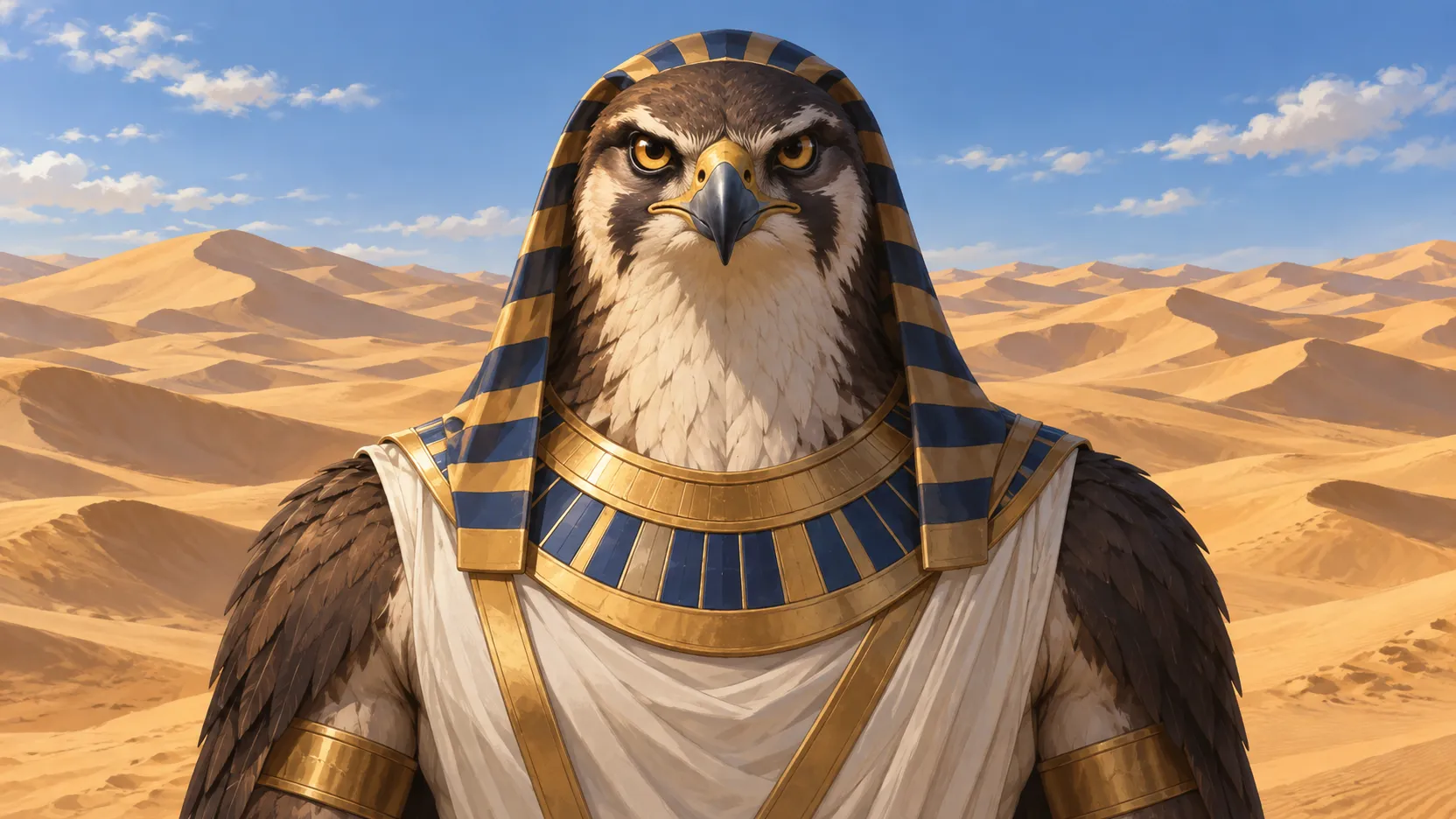
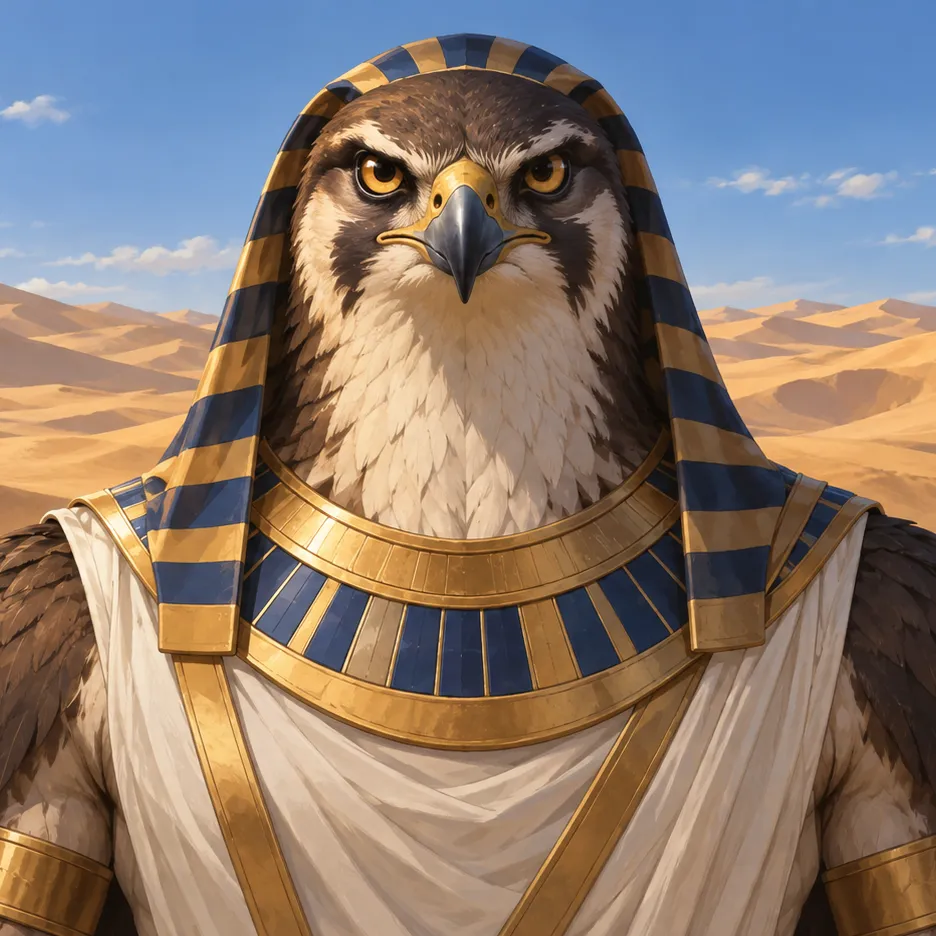
Sopdu crossed above the bridge in three strokes. He settled on the far stone as a great falcon, the two plumes lifting over his head. The nearest pursuer stopped so abruptly that the man behind ran into him.
They had expected exhausted miners.
Sopdu opened his beak.
The man nearest him dropped his bow. Another threw a spear, too short; it fell between the god’s talons and rang on the rock. The men backed up the slope, pulling one another out of his reach.
Behind him Meri dragged the boy onto the bridge. The captain had freed his foot and was coming to meet them, keeping his injured arm pressed to his chest.
Sopdu could have gone after the fleeing men. He could already feel where the first body would yield beneath his feet.
The bridge lurched.
At the western end, the rope the soldier had cut tore through its last inner strands. The loose end whipped across the ledge. One side of the decking fell, throwing the captain to his knees. Meri caught the rail with both hands. The boy slid between them, stopped only by the splint catching across two planks.
His cry reached Sopdu before the loose rope struck the cliff.
The god turned. He drove himself low across the ravine, racing the falling bridge toward the western wall.
He took the falling end in his mouth and beat his wings once, hard enough to drive grit into every upturned face. The rope pulled taut. The bridge stopped falling.
For an instant he hung above the ravine with the weight of the crossing dragging at his jaw. Then his talons found the western ledge. He braced them in two cracks and leaned back.
The rope was wet with old salt and fresh blood. Fibers pressed between his teeth. Below, the tilted planks knocked against the rock, and the boy began to slip again.
“Get his belt!” Meri shouted.
The captain reached. His injured arm gave way.
Sopdu pulled harder. The decking lifted a hand’s breadth. Pain ran up his jaw, a bright line to the root of each tooth. He could cut this rope with a single bite. He had to hold it without doing so.
The captain caught the boy’s belt with his good hand.
Above the eastern bank, the pursuers emerged from the settling dust. They saw the god bent backward, both feet fixed, his mouth occupied. One retrieved the fallen bow.
Meri saw him too.
“Move,” she told the captain.
He looked west. On the ledge, his soldiers held their spears without advancing. The bridge was barely wide enough for a single body now.
“A rope,” he shouted. “Send me a rope.”
No one moved. Their spare cordage lay in the ravine with the abandoned tools.
At the captain’s waist hung a small wooden case, strapped across his body. It held the tally of the stones, the seals, the record that would tell the king what his expedition had brought home. He looked down at it. Then he caught its long strap in his teeth and worked the fastening with his good hand.
The case dropped. It hit a plank, opened, and emptied its little written tablets into the gulf.
He looped the strap beneath the boy’s arms.
“Lift when I pull.”
Meri knelt in the slanting boards. She eased the splint free, one end and then the other. The captain hauled backward. The boy slid onto his lap and lay there without a sound.
An arrow struck the rope beside Sopdu’s mouth.
He felt its tremor through his teeth.
The Mouth of the East
The captain crawled toward him, dragging the boy with the strap. Meri followed, one hand beneath the broken leg. Twice the splint caught. Twice they stopped while she worked it loose.
The god’s talons scraped longer furrows in the stone.
The captain’s soldiers understood at last. They lay flat on the western ledge and reached down. One caught the captain by the collar; another seized the boy’s wrists. Sopdu watched them lift the child away.
Meri was still on the bridge.
Across the ravine, the first pursuer stepped onto the decking. He held his spear low, using the shaft to steady himself. Two more crowded behind him.
Sopdu’s jaw tightened.
Meri looked straight into his eye.
“Not yet.”
Her foot had gone through the gap left by a missing plank. The bridge twisted as the men advanced. She tried to pull free and fell against the rail.
The captain pushed away the soldier who was lifting him to safety.
“Hold my legs.”
He lowered himself headfirst over the edge. His wounded arm hung uselessly into the ravine. With the other he caught Meri’s wrist.
“Your sandal,” he gasped. “Leave it.”
She kicked. The strap held.
The pursuer raised his spear.
Meri bent her knee and drove her trapped foot down, deeper through the gap. The old leather parted. She pulled her bare foot free as the spear struck the boards where her shoulder had been.
The captain’s soldiers dragged him backward. Meri came over the lip of the ledge against his chest. Her heel cleared the wood.
Sopdu bit.
The rope parted so cleanly that for a heartbeat the loose fibers remained together. Then the bridge turned on its remaining support and flung its decking against the eastern cliff. The spear, the bow, the men vanished among the falling planks.
On the slope above them, those who had not crossed stopped running.
The great falcon stood on the western stone with a frayed length of rope hanging from his mouth. He let it fall.
No one tried to follow the expedition again.
By the time the survivors reached Per Sopdu, Meri had made the boy laugh once. She would not repeat what she had said to him. The captain walked beside their litter, carrying one end when his arm allowed it.
At the temple entrance, a clerk asked for the tally.
“Lost,” the captain said.
“And the tribute?”
He stood still for a long moment. Sopdu watched him rub a thumb across the empty place where the case had rested.
“Bring a clean board,” the captain said. “I will give you the names.”
Meri sat on the lowest step. She broke her bread into three pieces, handed one to the boy, and placed another beside her.
Sopdu came to her in human form. Sand clung to his shoulder where the arrow had passed. She moved her bare foot to make room.
“It is dry,” she warned him.
He took the bread. His mouth still hurt.
Beyond the temple doorway, the clerk began to write. Each time the captain called a name, someone answered.