
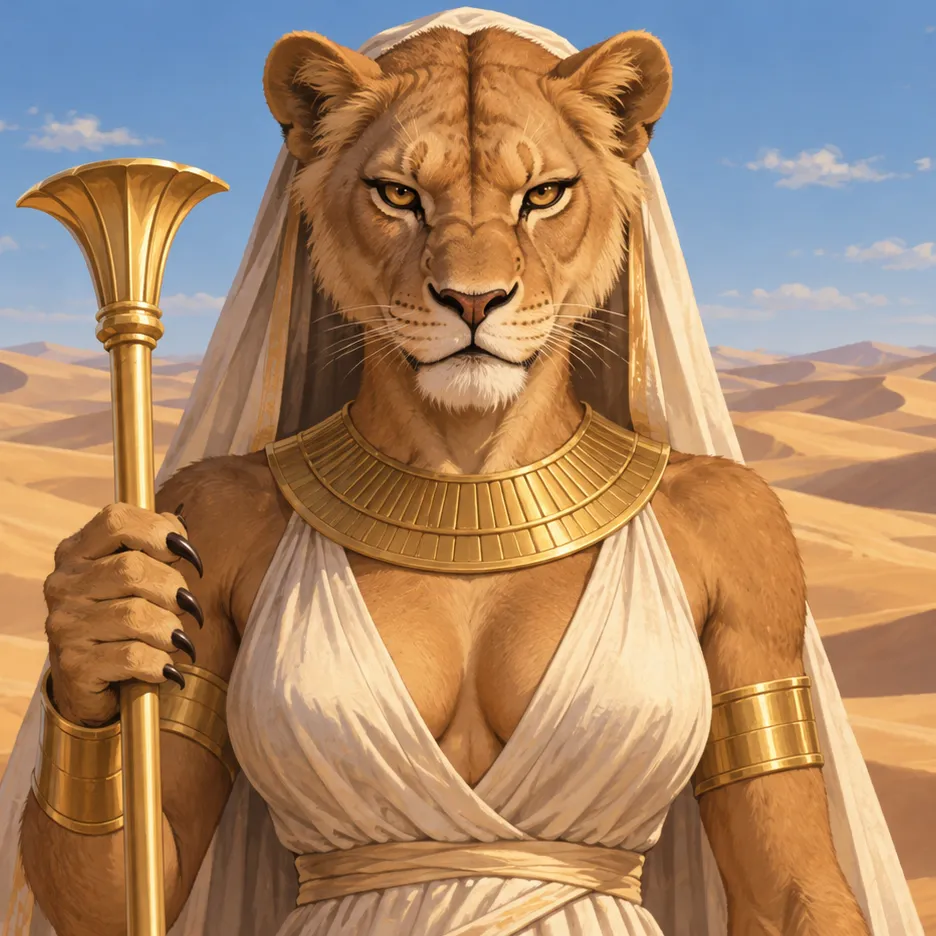
The boy had already tipped the last water out of her offering bowl when Pakhet caught his wrist.
He did not drop the jar. Even with her claws against his skin, he held it upright, protecting the stolen mouthfuls with his other hand.
“Put it back,” she said.
Beyond the shrine doorway the valley lay white with heat. Nothing moved among the broken stones. The boy’s breath scraped in his throat, and the sweat drying on him smelled of fear, but he kept looking past her toward the path.
“He cannot swallow the bread.”
“Who?”
“My father.”
Pakhet drew the jar toward herself. The boy came with it, stumbling, refusing to let go.
“It was yours yesterday,” he said. “I carried it here. I can carry more tomorrow.”
For three mornings her bowl had held less than the morning before. Now it was empty. She had left the cool depth of her mountain to find the hand that took from her, and here it was: thin, shaking, stubbornly closed around a clay handle.
“Show me.”
He started down the path before she released him. A bead of blood ran from his wrist to his thumb. He wiped it on his tunic so it would not fall into the water.
The stonecutters’ camp stood below the shrine, where the wadi widened before narrowing again between two cliffs. Fresh blocks lay beside rough shelters. At the far side of the camp, men knelt around a fallen loading frame. A beam had trapped a mason’s leg against a slab of limestone.
The boy squeezed between them.
“Iru,” the mason said, seeing the jar. Then he saw what followed it, and his mouth stayed open.
Pakhet crouched beside him. His leg was dark below the beam. Two men had their weight on a lever; another was packing stones into the finger-wide space they had gained. To lift him free they would have to unload the frame above him first. Its ropes had drawn tight as sinew.
Iru put the jar to his father’s lips.
The man turned his head away. “Where did you get it?”
“Drink.”
“Where?”
“From me,” Pakhet said.
He drank. His throat worked twice. Pakhet watched the line of water descend inside the jar and felt her own thirst sharpen.
Then a cool breath touched the damp hair at her jaw.
She raised her head.
Rain. Far above them, beyond the ridge. She could smell it breaking the dust of a country the men below could not see.
Her ears turned toward the upper valley.
“Get him out,” she told the stonecutters.
“We are trying.”
“Faster.”
She was already moving.
The Water’s Track
The first drops never reached the camp.
Pakhet climbed through sunlight while rain fell somewhere beyond the stone shoulders of the hills. Its scent thickened. She crossed a shelf of hot rock and found a black thread running along a crack. She followed it to a hollow, then to a shallow stream that carried beetles, grit, a torn tuft of grass.
She set two fingers in it. The water slipped between them.
Above her, something knocked against stone.
A branch came spinning around the bend. Behind it the stream swelled to fill the channel, brown and foaming, with white stones turning inside it. Pakhet sprang onto the bank as the first heavy surge struck the place where she had crouched.
The sound rose until she felt it in her teeth.
She ran ahead of it.
Each bend was familiar beneath her feet. Here the bed plunged; here a spur divided the flow; here the old channel would take the water past her shrine and down through the narrow outlet beyond the camp. She knew where to leap before the ground fell away. The rain followed, gathering weight from every gully.
At the outlet she stopped.
The cliffs had fallen together.
A pale scar shone high on one wall. Below it lay a jumble of boulders, packed with smaller stones. Dust still drifted from the gaps. Through the highest opening Pakhet could see the lower valley, the fields and roofs far off, unharmed beneath the sun.
She drove her claws into the nearest boulder and pulled.
It moved a hand’s breadth. Three stones above it settled. The gap closed, and the whole pile gave a low, grinding cough.
She let go.
The flood would fill the camp, lift the loose blocks and beams, and press against this barrier until it failed. Then all of it would go down together toward the houses.
Behind her, a man shouted. The stonecutters had heard the water at last.
Pakhet climbed the fallen rock. Beyond the shrine’s ridge lay an old, empty basin, broad enough to receive the torrent. But the ridge stood unbroken between it and the wadi. Unbroken except where men had cut her sanctuary into the mountain.
She looked toward its dark entrance.
The chamber reached deep into that ridge. At its back, behind her carved image, only a short thickness of stone separated it from the basin.
A channel through it would catch the flood before it reached the camp.
Below, Iru was running toward her with the empty jar.
“Leave it,” she called.
He stopped so abruptly that he fell to one knee.
“Come here. Bring a hammer.”
Through the Mountain
The shrine was cool. Pakhet entered with floodwater snapping at her heels and crossed the floor where the boy had knelt each morning.
On the rear wall her lion face looked out above a carved shoulder. Workmen had finished the eyes first. They caught the little light from the doorway, so that even in darkness someone approaching with water could find her gaze.
She pressed her palm below the face.
The stone was thickest there.
Iru stumbled in carrying a mason’s hammer with both hands.
“On the side,” she said, pointing to a seam near the floor. “When I loosen it, strike there. Then get out.”
He stared at the image.
“Strike your wall?”
“My wall.”
Pakhet spread her claws. Their points bit into the limestone. She drew them down, slowly at first, until four pale grooves opened beneath the carved shoulder. Dust burst against her muzzle. She pulled again. A strip of stone broke loose and struck the floor between her feet.
Iru flinched but did not run.
“Now.”
He swung the hammer. Its head glanced off the seam. On the second blow a corner split away.
Cold water reached his ankles.
Pakhet thrust her hands into the grooves and pulled outward. A slab came free. Behind it, daylight showed through a hole no wider than the boy’s fist.
She could smell the dry basin beyond.
The water found the hole immediately. It shot through with a thin hiss, dragging sand from beneath their feet. Iru struck again. Another piece fell, lodged across the opening, and began to tremble.
“Clear it,” Pakhet said.
He bent over the fragment. The current pushed his legs apart. He braced a foot against the wall and hooked the hammer behind the stone.
Outside, someone screamed his name.
He looked back.
Pakhet heard it too: his father, alive, furious with fear. The men had lifted him onto the path above the camp.
“Go to him,” she said.
“The stone—”
“Leave it.”
He pulled at the hammer. Its head had wedged in the narrowing gap. He pulled harder, and the wooden handle broke. Iru staggered backward into water now above his knees.
Pakhet caught the back of his tunic before the current took him.
The broken handle was still in his fist.
She set him on the raised threshold. Beyond it, the steps to the upper path remained clear. He scrambled up them, once, twice, looking back at every turn.
Pakhet returned to the wall.
The trapped fragment had turned sideways. It held firm beneath the carved shoulder, and water piled against her thighs. She pushed her claws into the opening, but the angle was wrong. She could not reach around the stone without opening the wall above it.
Above it was her face.
Through the doorway she saw the next surge round the bend: not water alone now, but branches and rolling stones, a whole hillside coming toward her.
She put her fingers into the carved eyes.
For an instant her living face touched the cool muzzle of the other. The first water Iru had ever brought her had run down that stone cheek. His father had lifted him high enough to pour it.
The surge hit the doorway.
Pakhet tore the face from the wall.
It split between her hands. One half struck her shoulder; the other vanished beneath the water. The stone below dropped into the basin, taking the jammed fragment with it.
The current seized her.
She drove her claws into the sides of the breach, held, and dragged them outward. Rock ripped loose. The opening widened with a report that shook dust from the ceiling. Water burst past her body and fell into the basin beyond, carrying the offering bowl, the broken hammer, the carved fragments of her jaw.
A crack raced across the roof.
Pakhet released her grip.
The torrent flung her through the wall into daylight. She struck the sloping rock outside, rolled, caught a ledge with one hand. Behind her the roof collapsed into the channel. Water climbed over it, found the opening again, and came pouring through.
She hauled herself above its reach.
Across the ridge, the camp still stood. Men were climbing the path with the injured mason between them. Iru followed, carrying a jar he had gone back to retrieve.
Pakhet spat limestone dust from her mouth.
The boy would be the death of a potter’s whole store of jars.
The Offering
By evening the basin held a shallow lake. The torrent had dwindled to a stream running through the place where the shrine had been.
Pakhet stood in the ruined doorway. Her chamber was open to the sky. Of the image on the back wall, only the edge of one shoulder remained.
Someone came slowly up the path.
Iru’s father leaned between two of the stonecutters. His bound leg hung clear of the ground. The boy walked ahead of them with the jar against his chest.
At the threshold the men lowered the mason onto a flat stone. He looked into the wreckage, searching for a place to set an offering.
“The bowl is gone,” Iru said.
His father held out his hand for the jar.
Beside Pakhet’s foot, one of her claw grooves ran down a surviving block. The mason bent toward it. His breath caught with the movement, but he steadied the jar and poured.
Water filled the groove, clear for a moment against the white stone.
Pakhet knelt. She drank before it could run away.
