
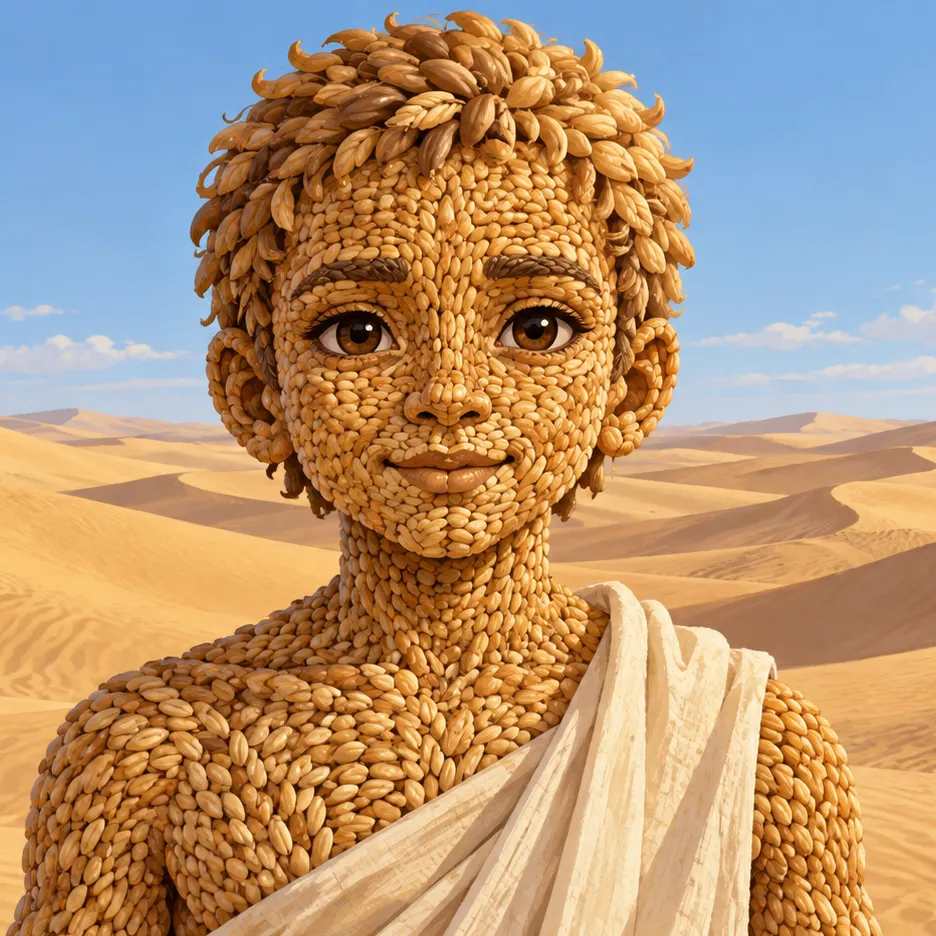
The woman had already broken one tooth on the clay seal when Neper caught her wrist.
She turned with blood on her lip. For a moment she stared at his hand, at the pale grains fitted tightly together where another child’s skin would have been. Then she tried to bite him.
He let go.
Behind him, the keeper of the granary lifted his staff.
“Put it down,” Neper said.
“She has come for the seed.”
“I have come for something to eat.” The woman spat a red fragment of clay into the dust. “If you know a place where the two are different, show me.”
Her name was Tia. Neper remembered her at the harvest, carrying a basket so full that grain slipped between the reeds. She had laughed when he caught it. Now the basket hung against her hip like an empty rib cage.
The keeper stood across the door. He was an old man, and the staff shook in his hands, but Neper knew he would use it. Each morning he counted the seals. Each evening he brought the child a cup of water and swept the floor around his feet, carefully returning every fallen grain.
“We sow when the water leaves the fields,” the keeper said. “Eat this, and there will be nothing.”
Tia took his staff just below the head and pushed it down.
“My brother cannot stand. Tell him when to sow.”
Neper pressed his palm against the door. Inside, beneath the dry whisper of husks, he should have felt a multitude waiting. He knew that crowded patience. It had rocked him to sleep for nights without number.
Something else came through the wood.
Heat.
“Open it,” he said.
The keeper looked from him to Tia.
“Lord—”
Neper pushed his fingers into the broken seal. Clay ground between the kernels of his knuckles. He pulled until the cord tore free.
A sour breath came out of the dark.
The Grain That Would Not Wake
The top of the heap was pale and clean. The keeper plunged his scoop into it, brought up a brimming measure, and held it out with the trembling relief of someone who has found his child asleep.
“See?”
Neper climbed past him.
The grain shifted beneath his small feet. He sank to his knees, then to his waist. Warmth closed around him. Somewhere in the roof, water had found a way through; beneath the dry surface, the kernels clung together in dark lumps.
He thrust both arms into the heap.
There were places he could feel: small, closed lives that answered his touch with the faint pressure of a root not yet grown. Between them stretched a silence too wide for the chamber.
He pulled out a blackened handful.
The keeper lowered the measure.
“No one has entered,” he said. “I kept it sealed.”
Neper pressed one ruined kernel between his palms. Nothing moved within it. He pressed harder, until it broke.
Tia was beside him now. She reached into the heap, smelled what she brought out, and threw it away.
“Bring baskets,” she told the keeper.
He did not move.
“Bring them.”
They worked in the light from the doorway. Neper found what still answered him; Tia carried it out; the keeper spread it thinly on mats. Every time Neper descended into the heap, he expected to discover a deep, cool place where the grain had survived. Every time he climbed back with less.
By afternoon, the spoiled mound outside was taller than the child.
The living seed filled one basket.
People had gathered without calling to one another. They stood in the shade of the granary wall, watching that basket. A boy slept against a man’s knee. The man’s hand rested on the boy’s chest and moved whenever the child breathed.
Tia went home. When she returned, she carried a grinding stone.
The keeper stepped in front of the basket.
She set the stone down between them.
Neper had heard that sound all his life: stone placed on earth, the beginning of a meal. Now it made him want to run.
A Handful
He spread his arms over the seed.
“No.”
Tia knelt. She did not reach past him.
“How long?” she asked.
He knew what she meant. Roots first, then blades. Days of green growth. Ears filling slowly. The hardening beneath the husk. He could feel the whole season within the basket, folded small.
“Not today,” he said.
She nodded toward the boy against the wall.
“He has today.”
Neper looked at the man’s hand. It waited between one breath and the next.
He unclasped his left thumb.
It came away grain by grain. A few kernels slipped into Tia’s lap. She looked down, then caught his wrist as he began to loosen the finger beside it.
“Will it hurt you?”
“Yes.”
She opened her hand to return what he had given.
From behind the doorway came his mother’s voice.
“Do not make him take it back.”
Renenutet stood where the dark of the chamber met the light. Neper had not heard her arrive. He tried to hide his damaged hand behind him, but she was already kneeling, drawing it gently forward.
Tia laid the grain on the stone.
The first stroke was louder than Neper expected.
He jerked against his mother. She held him while the kernels cracked. He felt their small chambers open, felt the possibility of roots pass beyond his reach. The second stroke reduced them further. By the third, the grain in Tia’s hand had become meal.
She stopped.
In the shallow hollow of the stone lay scarcely enough to cover three fingers.
Neper stared at it. He had imagined the giving would be greater than this.
His mother brushed flour from his wrist. For an instant he wanted only the granary at evening, the water cup, the keeper gathering his scattered pieces. He wanted someone to tell Tia to go away.
Instead he asked, “How many mouths?”
Tia counted the people against the wall. Then she named those who could not leave their houses. At her brother’s name her voice caught, and she started the count again.
Neper listened to the end.
He could not feed them through a season. He could give them this meal. Enough to stand, to carry water, to get the saved grain into the earth. After that there would be nets to mend, roots to dig, help to seek from farms farther along the river. None of those things could be done by the boy whose father was waiting for his next breath.
“Mother,” he said, “if you hold me, I cannot do it.”
Her fingers tightened.
He had never needed to ask her to let go before.
What Was Given
Renenutet sat on the threshold and drew him onto her knees.
“You may be afraid,” she said.
“I am.”
She laid her cheek against his head. He could feel the tiny movements of her jaw, as though she were keeping words between her teeth.
The keeper had begun to cry without making a sound. Neper found that harder to bear than the stone. He pointed at the basket.
“Take that to the field.”
The old man wiped his face with the heel of his hand.
“All of it?”
“All of it. And stand where they can see you sow.”
Tia rose at once.
Neper caught her garment with his remaining fingers.
“The seed stays whole.”
She looked at the basket, then at the flour on the stone. Her mouth worked. There was blood drying on her chin.
Finally she took the basket herself and pushed it into the keeper’s arms.
“I will go with him after we eat.”
Neper watched until the keeper stepped out of the shade. Then he turned in his mother’s lap and pressed his face against her.
“Will you hear me?”
She put her palm flat against his back.
“I will listen.”
He opened his hands.
The fingers loosened first. Kernels ran over Renenutet’s knees and struck the threshold, a quick, light pattering. Neper tried to keep his arms around her, but the arms were opening too. Tia snatched up the empty mats. The people at the wall moved at last, crawling and stumbling forward to spread them beneath the falling grain.
Renenutet’s hands followed the changing shape of him. She did not close them.
For a moment he still had a mouth.
“Don’t—”
His mother bent low.
He meant to say don’t put me back in the dark. But the words came apart against her neck. Grain filled the fold of her garment. It spilled across her feet and onto the mats, and the child who had been sitting on her knees was gone.
Tia waited for Renenutet to look up.
Then she took a measure to the stone.
They ground in turns. Those who could not push the upper stone gathered fuel. A woman brought water in a cracked jar, walking slowly so it would not spill. The first cakes stuck to the hot clay, and Tia scraped them free with the edge of a potsherd.
She carried one to the boy by the wall.
His father broke it, softened a piece with water, and waited while the child swallowed.
Renenutet remained on the threshold. Flour settled on her hands. When Tia offered her a cake, she took it and held it until it cooled.
Beyond the granary, the keeper was making the first furrow.
Tia ate standing. Then she went to join him.
When he reached for another handful of seed, she steadied the basket. Together they covered the grain, a little earth over each small, unbroken life.
At harvest she returned with that same basket.
It was mended along one side. Her brother carried it with her, and they set it before Renenutet on the threshold. Tia had brought the first measure, still warm from the field.
The goddess let it run between her hands.
Grain struck grain. She bent her head to hear.
